


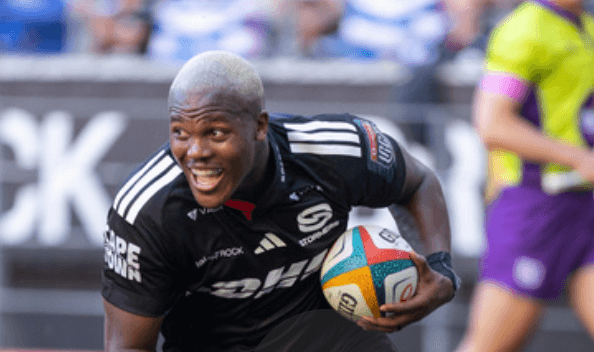
Siya Kolisi has spent his rugby career breaking tackles and barriers.
Last week in London, the Springbok captain helped break another significant milestone as Steadfast Africa‘s annual fundraising gala generated R2.5 million (£108,000) for the Kolisi Foundation and the Good Work Foundation.
Hosted at the historic Chelsea Physic Garden on 16 June, the event brought together philanthropists, business leaders and supporters committed to backing community initiatives in South Africa. With an online auction and raffle remaining open until 8 July, organisers expect the total to grow further.
For Kolisi, the evening was about something far greater than the impressive figure on the fundraising scoreboard.
“I am not a self-made man,” said Kolisi.
“I am here because people invested in me. They saw something in me, opened doors for me, and gave me opportunities I could never have created on my own.
“Today, through the Kolisi Foundation, we want to do the same for others. Partnerships like this one with Steadfast Africa and the Good Work Foundation remind us that lasting change is never the work of one person or one organisation. It is built by people who choose to invest in the potential of others.”
While his achievements on the rugby field have become part of Springbok folklore, his foundation has quietly built a growing footprint in communities across the country. Guided by the values of dignity, hope and unity, the organisation focuses on food security, education, youth empowerment, sport and raising awareness around gender-based violence.
The gala’s fundraising auction proved one of the evening’s biggest attractions, with guests competing for luxury safari experiences, exclusive travel packages and premium hospitality offerings from across Southern Africa.
The Good Work Foundation, Steadfast Africa’s other long-standing beneficiary, continues to bridge the digital divide in rural communities through education and skills development programmes.
Chief executive Kate Groch said the success of the event highlighted the strength of collaboration.
“Good Work Foundation is able to serve the communities we work in and do the work we do because of the support of our partners; they are an integral part of our Pink family.
“This was again shown at the amazing Steadfast event held in London. Thank you from myself and the entire GWF family. Thank you to everyone who organised, attended, donated and made the event so successful.
“We are grateful for our partnership with Steadfast and how it continues to grow. Together we will continue to do Good Work and reimagine education and opportunity for young rural South Africans.”
In rugby, captains are often judged by the trophies they lift.
Yet evenings such as this suggest his most enduring legacy may be measured not by silverware, but by the opportunities created for others long after the final whistle has sounded.
The scoreboards at Nelson Mandela Bay Stadium painted a picture of dominance on Saturday, but Springbok coach Rassie Erasmus and SA A coachMzwandile Stick were far more interested in the details hidden beneath the numbers.
The Springboks opened their season with an emphatic 80-31 victory over the Barbarians, while SA A brushed aside Zimbabwe 40-0. Despite the convincing results, both coaches identified areas requiring urgent attention before the Nations Championship begins in two weeks.
Erasmus praised the Springboks’ attacking output but admitted their discipline and defensive consistency left room for improvement.
“Our discipline wasn’t great, and they (the Barbarians) scored tries in quick succession, so yellow cards were not ideal,” said Erasmus.
The Bok coach pointed to the realities of a squad reconnecting after several months apart.
“But we have to remind ourselves that it’s been six or seven months since we’ve played together, and some guys were new in the mix, while we also didn’t know when the DHL Stormers or Vodacom Bulls players would be available at some stage, which are all aspects we have to keep in mind.
“To score 80 points is nice, but the Barbarians were thrown together quite late, and had only three training sessions, which makes them difficult to analyse. They scored four or five great tries, so we need to eliminate those defensive lapses and be better as a unit when we play against England.”
One concern for Erasmus was the injury suffered by experienced lock Franco Mostert, who was forced from the field.
“I’m worried about his ankle. He’ll go for scans tomorrow, so hopefully it’s not too bad.”
Springbok captain Siya Kolisi echoed his coach’s assessment, saying the match provided valuable evidence of what is working and what still needs attention.
“I thought a lot of what we wanted to get through, we did, but also, when things didn’t work, and we went against the plan, we learned lessons there,” said Kolisi.
“I always have to watch the game again to get a good assessment about things, but I already know some of the mistakes we made and the areas we need to fix. There were opportunities where I thought we could have controlled things better.”
Earlier in the day, SA A delivered a disciplined defensive display against a determined Zimbabwe side preparing for the 2027 Rugby World Cup in Australia.
Stick admitted the performance was not without frustration despite the clean-sheet victory.
“We knew it was going to be a big challenge because the majority of our players have never played together, so it was a new team, and Zimbabwe tried to challenge us by keeping ball in hand and playing direct rugby. I enjoyed the way they played.
“That said, for us, the goal was to see whether the players could execute what we’ve been working on over the past two weeks, and it was sometimes frustrating when the points weren’t coming.
“In the first half, we were unlucky, with two tries disallowed – once where a player went into touch, and another when a player was slightly in front of the kick. But from my side, the way the guys stayed in the fight, even when we were under pressure, was great, and we managed to keep a clean sheet.”
SA A captain Vincent Tshituka paid tribute to Zimbabwe’s intensity and ambition.
“We played against a desperate side, and we expected that. We knew the Zimbabwe players would be motivated and would want to prove a point against world-class opposition, and it showed.”
South Africa’s opening victories delivered plenty of encouragement. Erasmus and Stick know tougher examinations await, and both coaches left Gqeberha with a notebook full of positives and a to-do list that remains far from complete.
Springbok coach Rassie Erasmushas never been shy about planning several moves ahead. His latest squad announcement, featuring 21 uncapped players among a 51-man training group for the Gqeberha double-header later this month, offers another glimpse into how South Africa intends to sustain its dominance beyond the current generation.
Among the newcomers, the inclusion of DHL Stormersbacks Yaqeen AhmedandImad Khan stands out as more than a reward for impressive domestic performances. It is a reflection of South Africa’s determination to broaden its depth in two of the most influential positions on the field.
Ahmed, capable of operating at flyhalf and centre, and scrumhalf Khan are among a youthful contingent called into the national setup ahead of the Springboks’ clash against the Barbarians and the SA ‘A’ fixture against Zimbabwe on 20 June.
Their elevation comes at a significant moment.
With star playmaker Sacha Feinberg-Mngomezulu and scrumhalf Morne van den Berg sidelined through injury, Erasmus has been presented with an opportunity to accelerate the development of players who could feature prominently in future Springbok campaigns.
The injuries have not created vacancies so much as opportunities.
Ahmed’s selection is particularly intriguing. The highly rated Stormers playmaker has long been regarded as one of the country’s most promising attacking talents, combining tactical awareness with the versatility modern international rugby increasingly demands. His ability to cover multiple backline positions makes him a valuable asset in a Springbok environment where adaptability is prized almost as highly as raw talent.
Khan’s call-up carries similar strategic importance. South Africa’s production line of scrumhalves remains one of the healthiest in world rugby, yet Erasmus continues to search for greater depth at a position that often dictates the tempo of a match. Khan joins fellow uncapped scrumhalvesHaashim Pead and Nico Steyn in a competitive group that offers selectors an opportunity to assess emerging talent in a high-performance environment.
The Stormers pair form part of a broader youth movement that includes SA Under-20 players Danie Kruger, Luan Giliomee, Vusi Moyo, Oliver Reid, Liam van Wyk, Junior Springbok captain Riley Norton, Siphosethu Mnebelele, Markus Muller and Zekhethelo Siyaya. All were previously involved in the expanded Springbok alignment camp programme.
The remaining uncapped players are Paul de Villiers, Bathobele Hlekani, Hanro Jacobs, Jurenzo Julius, JJ Kotze, Sibabalwa Mahashe, Emmanuel Tshituka and Jaco Williams.
The composition of the squad has also been shaped by circumstance. Vodacom Bulls players were unavailable after securing a place in the United Rugby Championship final against Leinster, opening the door for several younger prospects to gain exposure to the national environment.
“We named a large group of players as we will be selecting a Springbok and SA ‘A’ team for the season-opening double-header in Gqeberha, and this will be beneficial in the long term as we build the squad, looking forward to next year’s Rugby World Cup and beyond,” he said.
“There is also an exciting mix of experienced campaigners and young players in this squad, and this formula has worked well for us in the past to ensure a clear pathway to build depth within the group.”
The Springbok coach believes the alignment camps held over recent months have prepared many of the newcomers for the demands awaiting them.
“The coaches have been working around the clock to put the systems in place in the last few months, and the in-person and virtual alignment camps have given most of the players a taste of what to expect, so it’s now a matter of implementing what they learned in the boardroom onto the field.”
“We are under no illusions about the challenge ahead this season with two matches against the Barbarians and the SA ‘A’ team against Zimbabwe playing out on the same day, which will be followed by two new competitions in the Nations Championship and Rugby’s Greatest Rivalry, so it will be important for the group to build cohesion as quickly as possible and make the most of our field sessions and team meetings to be as well prepared as possible when we take the field.”
For Ahmed and Khan, the call-up is not a destination. It is an invitation into one of the most competitive environments in world rugby. Whether either player features prominently in the months ahead remains uncertain.
What is clear is that Erasmus is already looking beyond the next Test, the next tournament and even the next season. The world champions are building depth with the same diligence that won them consecutive World Cups, and Ahmed and Khan are the latest names added to that long-term blueprint.
Rassie Erasmus has named a 51-man squad, with 21 uncapped players, for the first training camp of the season and double-header in Gqeberha 🇿🇦🚨
The squad for the Nations Championship in July will be announced on Sunday, 21 June, following the conclusion of the VURC Final. pic.twitter.com/YAgJuCtLGa
DHL Stormers coach John Dobson believes World Rugby should revisit the law governing held-up situations after his side were denied two tries during their 44-21 United Rugby Championship quarterfinal victory over Cardiff in Cape Town on Saturday.
While the Stormers progressed comfortably to the semifinals after scoring six tries, the result did little to ease Dobson’s frustration with a law he feels unfairly rewards the defending team.
The Stormers have been held up over the tryline more than any other side in the URCthis season, with Dobson suggesting it may even have cost them a higher finish on the log and the possibility of hosting a semifinal or final.
Speaking after the match at DHL Stadium, Dobson described the current law as one of rugby’s biggest anomalies.
“It’s our season. It’s our season. It is,” he said when asked byModern Athletehow the held-up and goal-line dropout law affected the Stormers thus far in the 2025/26 URC season.
“It’s the worst. It’s one law in rugby that has to change. I’m not saying because it’s against us. I don’t understand this concept. You do so well, and you’re rewarded with receiving the ball back on your ten-yard.
“The old law was much better. Give it a five-metre scrum. You’ve attacked well, five-metre scrum.”
Under current laws, a defending team receives a goal-line dropout when an attacker is held up in-goal. Previously, the attacking side was awarded a five-metre scrum.
Stormers captain Ruan Nel experienced the frustration first-hand after being denied near the line against Cardiff.
“It sucks, actually,” Nel said.
“The arms were pretty there. When I dotted the ball down, I just put it straight on his knees. So I actually felt him at the bottom of the ruck. Well done. Proper effort there. Obviously, it’s very disappointing.”
Nel admitted the missed opportunities were frustrating, though he viewed them as evidence that the Stormers’ attack is consistently creating scoring chances.
“It’s encouraging because you’re obviously getting to the right spaces.
“It’s disappointing, but obviously over the line, just get the flipping thing down. But it’s encouraging at the same time because we are breaking them down, we are getting the reward in terms of position there.”
The experienced back also noted how frequently the issue has affected the Stormers this season.
“It’s funny. I’ve never been a part of a season where we’ve been held up so many times.”
Dobson’s concerns will take on added significance this week as the Stormers prepare for a semifinal against Leinster in Dublin.
The Irish province underlined their title credentials by demolishing the Lions 59-10 in the quarterfinals, running in nine tries in a clinical display at the Aviva Stadium.
If the Stormers are to challenge Leinsteron their home turf, they will need to make the most of every scoring opportunity. Against a side renowned for converting pressure into points, being held up over the line and conceding a goal-line dropout could prove a costly setback.
For Dobson, the issue extends beyond the Stormers’ campaign. It is a law he believes fails to adequately reward attacking enterprise, and one he hopes World Rugby will eventually reconsider.
Haashim Pead’s career is gathering momentum like a rolling maul surging towards the try line, and his latest move confirms his place among South Africa’s brightest rugby prospects. The 20-year-old scrumhalf has signed with Roc Nation SportsInternational, aligning himself with a global agency that represents leading Springboks including Siya Kolisi, Cheslin Kolbe, Aphelele Fassi and Jordan Hendrikse.
For a player shaped in the streets of the Bo-Kaap and polished at Bishops, this moment feels like a clean break from the base of the scrum, quick, decisive and loaded with intent. Pead’s rise over the past two seasons has been as sharp as a well-timed box kick, climbing from promising junior to one of the most talked-about young playmakers in the game.
His breakout came on the world stage at the 2025 World Rugby U20 Championship in Italy, where he didn’t only steer theJunior Springbokswith precision, he rewrote the script for what a scrumhalf can deliver at that level. Named Junior Springbok Player of the Year, Pead shattered records previously held by France star Antoine Dupont, underlining his influence with a blend of tempo, vision and nerve.
Generational Talent; Haashim Pead
Those performances opened the door to the senior Springbok environment, where he has already spent time absorbing the rhythm and demands of Test rugby. Back on home soil, he has slotted seamlessly into senior competition, becoming a key figure for the Lions in the United Rugby Championship. His service is crisp, his decision-making measured, and his tactical kicking often lands like a pinpoint cross-field strike.
Roc Nation Sports International’s Head of Rugby Recruiting in South Africa, Tamsanqa Ncwana, believes Pead’s ceiling is far from reached.
“Haashim is a generational talent whose work ethic and technical ceiling are truly exceptional,” Ncwana said.
The move places Pead in a stable that has helped shape some of the most influential figures in South African rugby, a pathway that now stretches invitingly ahead of him. With another Springbok alignment camp already under his belt this year, whispers of a Test debut are growing louder, like a crowd rising in anticipation before a decisive play.
For Pead, the decision to join Roc Nation was as instinctive as spotting a gap in a fractured defensive line.
“Joining the Roc Nation Sports International family is an exciting moment for me. Watching the impact they have had on the careers and lives of players I look up to, made this an easy decision,” he said.
“I’m proud of my roots in the Bo-Kaap, and as I take the next steps in my career, I’m excited to have a world-class team behind me as I look to achieve my goals both on and off the field.”
Roc Nation Sports International president Michael Yormark highlighted the broader impact Pead could have beyond the pitch.
“At Roc Nation Sports International, we look for athletes who not only excel on the pitch but also possess the character to inspire the next generation. Haashim’s journey as a professional rugby player is a story that will resonate throughout South Africa and we look forward to supporting him to reach his full potential.”
As Pead’s career continues to accelerate, this latest signing feels less like a milestone and more like the start of a new attacking phase, one where the pass has been set and the space ahead is waiting to be exploited.
Front-row forwards are rarely associated with distance running. Tighthead props are built like granite pillars for the scrum rather than the endless rhythm of road racing. Yet two former Springbok giants have embraced a different test of endurance.
Former 1995 Rugby World Cup winner Marius Hurter and ex-Springbok prop Eddie Andrews will line up at the2026 Totalsports Two Oceans Marathonpowered by BYD over the weekend of the 11 and 12 April in Cape Town, chasing finish lines on roads that wind between ocean views and mountain climbs.
Hurter will again tackle the demanding 56km ultra marathon on Saturday 11 April, while Andrews returns for his sixth 21km half marathon the following day.
Both men once weighed more than 130kg while anchoring the Springbok scrum. Today they measure progress through kilometres rather than collisions.
Hurter, affectionately known as the ‘Hurternator’, now weighs around 103kg after shedding more than 30kg through endurance sport.
Marius Hurter crossing the TTOM 56km finish in 2026 by Action Photo
“My rugby career finished in 2006, but being from a military household I was used to exercise from a very young age,” Hurter said.
His mindset was forged during his youth.
“When I was about 15, I told my dad I wanted to be a paratrooper. He said, ‘You’re too soft, man. You’ll never be a paratrooper.’ That afternoon he came home with a two-metre pole and told me every morning before school I had to jog around the block with it, then do push-ups, sit-ups and pull-ups.”
That discipline carried him through a career that now includes nine finishes in the Absa Cape Epic, multiple Ironman triathlons, the Two Oceans and Comrades Marathon as well as the Ultra Trail Cape Town (UTCT) 100-Miler (160km) race.
“I must say, being a prop, I like a bit of suffering,” he said.
“This stuff is hard on the body, but a lot of it comes down to mental toughness. Your physique is one thing, but it’s this little thing between your ears that runs the whole operation.”
This year’s Two Oceans Ultra carries special meaning as Hurter will run alongside his eldest daughter Annalien in her first ultra marathon.
“I told them if you start something, you finish it,” he said.
For Andrews,who currently serves as the Deputy Mayor of Cape Town, the running journey began with a modest first step in 2016.
Running through the scenic streets of Cape Town in the Two Oceans Half Marathon 🏃♂️🌅
🙌 This event beautifully demonstrates how running brings people together from all different backgrounds, shapes, and sizes, united by the joy of the sport. 🌍🏃♀️ pic.twitter.com/NQ3XHpZ9s5
— Deputy Mayor Eddie Andrews (@AndrewsEddie) April 25, 2024
“A journey of a thousand miles starts in the first step,” he said. “My running journey started in 2016 with Parkrun. Run, walk or crawl.”
The former Bok strongman, who played 23 Tests between 2004 and 2007, now views running as both challenge and community.
“Yes, this is part of my prep for the Two Oceans Half Marathon,” Andrews said after a recent 15km race. “It was my first road race back over the shorter distances.”
Even seasoned runners feel the strain in the closing kilometres.
“You know, fighting some demons at the end there but it’s all about crossing that line no matter the pace. It’s about finishing the race.”
The 2026 race will mark Andrews’ sixth appearance in the half marathon and move him closer to the coveted Blue Number awarded for ten finishes.
“This is my sixth Two Oceans Half,” he said. “Yes, I am almost there. I’m going to go for it.”
He believes other former rugby players should follow the same path.
“This is a challenge to all ex-Springbok rugby players to do it as well,” Andrews said. “Run the races, be in the community of runners and have other conversations.”
For two men once defined by scrums and collisions, the open road now offers a different contest where endurance, patience and belief carry the day.
Veteran Springbok loose forwardDeon Fourie is poised for a welcome return for the Stormersafter a gruelling two-year battle with injuries, with the Cape side hoping his presence can spark a response against the Bulls at Loftus Versfeld Stadium on Saturday.
The 39-year-old has endured a frustrating stretch on the sidelines after a sequence of injuries that kept him out for most of the past two seasons.
Speaking to journalists at theStormersHigh Performance Centre in Bellville on Wednesday after a training session in searing heat, Fourie said he was grateful to be back in contention.
“Yeah, feeling fresh,” Fourie said. “I think next month, almost exactly two years ago, I started the injury route. I’m back now and I’m very, very grateful to be back. I worked hard and credit to the physios and management that got me lucky.”
His recovery journey included an ACL injury followed by further setbacks.
“After my ACL I did four games and then my ankle, then one game and then my biceps,” he explained.
Fourie’s comeback could hardly come in a bigger fixture, with the Stormers travelling to Pretoria for one of South African rugby’s fiercest rivalries.
“It’s always special,” he said. “Playing against the Bulls, all the history involved in that and all the times I’ve played against them. It’s a great game to come back to. It gets the best out of everyone.”
Match fitness remains an unknown after such a lengthy absence, though Fourie believes the team’s demanding preparation will help.
“Game fitness and running fitness aren’t the same,” he said. “But after this week in 40 degrees for two days I think I’ll be fine. We’ll see. It’s up at Loftus with a bit of altitude as well, but luckily we’ve got a great player in Paul de Villiers on the bench who can step in.”
The veteran admitted the latest injury tested him mentally, even raising thoughts about retirement.
“Especially the last injury it was quite tough,” Fourie said. “There were a lot of emotions and a lot of questions running through my mind. But that was always my motto. I like to prove people wrong.”
For now, the focus is on simply getting through his return match.
“My first objective is to get through the first game injury free and do it well. Then we’ll see how the body is,” he said. “In two years I’ve only played about five games so maybe my age turned back two years. I’m only 38 now,” he quipped.
The Stormers head to Pretoria seeking to halt a three-match losing run, a stretch that has frustrated the squad.
“It’s important for morale and confidence,” Fourie said. “You need that W again. The frustrating thing the last three weeks was the quality of how we played. We’ll try to rectify that this weekend.”
Despite the pressure, Fourie expects the squad to embrace the occasion at Loftus, a venue known for its intimidating atmosphere.
“That’s why you want to go play there,” he said. “The atmosphere builds you, motivates you. That’s why we play rugby, to enjoy it as well and to win there.”
The Stormers will hope their returning veteran can bring the type of grit and breakdown steel that has defined his long career as they attempt to wrestle momentum back in the United Rugby Championship.
TheSpringboks’ 2026 Test calendarreads like a greatest-hits album pressed into green and gold vinyl. Ten fixtures. Eight heavyweight opponents. Iconic stadiums. Familiar foes. Old grudges. New chapters.
From the winter chill of Ellis Park in July to facing the All Blacks in Rugby’s Greatest Rivalry Four-Test Series, followed by the furnace of a late-season Nations Championship finale, South Africa’s world champions are primed for a campaign that promises collision, combustion and classic rugby theatre.
History. Pride. Legacy 🔥
Thirty years in the making – this is a tour like no other 🌍
The season kicks off with a trio of home Tests against northern hemisphere visitors, as England, Scotland and Wales tour South Africa in July. England arrive at Ellis Park on 4 July still licking their wounds from a 29–20 defeat in 2024, while Scotland head to Loftus Versfeld a week later hoping to improve on a 32–15 loss. Wales complete the mid-year run at Kings Park on 18 July, returning to the scene of a humbling 73–0 defeat in 2025, a reminder of just how ruthless the Springbok machine can be when fully oiled.
August and September then ignite Rugby’s Greatest Rivalry Series as the All Blacks cross swords with the Boks in a four-Test epic that will stretch both squads to breaking point. Ellis Park (22 August), Cape Town Stadium (29 August) and FNB Stadium (5 September) host the opening three clashes, with a fourth Test scheduled for 12 September at a venue still to be confirmed. The last time the sides met in 2024, South Africa delivered a commanding 43–10 statement, but history teaches that past results mean little when black meets green.
The season’s final act unfolds on the road in November, with the Springboks entering theNations Championshipcauldron against Italy (6–8 November), France (13–15 November) and Ireland (21 November), all at venues yet to be confirmed. Italy will seek to overturn a 32–14 defeat from 2025, while France and Ireland, beaten 32–17 and 24–13 respectively, loom as familiar obstacles on the high-pressure European stage.
From altitude to ocean, from ferocious rivals to wounded challengers, the2026 Springbok campaign is built like a forward pack: heavy, balanced and relentless. Every Test is a tackle waiting to happen. Every whistle, a fresh battle cry.
If Christmashad a team talk, Rassie Erasmus delivered it in takkies, not a tracksuit. And instead of white lines and whistles, he used a seaside promenade and the gentle rhythm of footsteps.
On Christmas morning, the Springboks head coach once again became Cape Town’s most followed pedestrian, drawing hundreds of supporters to the Blouberg coastline after issuing an open invitation on social media.
“This is to thank you for your passionate support and the way you carry us,” Erasmus wrote. “Hulle weet nie wat ons weet nie” (They don’t know what we know).”
At precisely 06:00, because even festive strolling runs on Bok-standard time, the six-kilometre walk rolled out from outside Doodles Beachfront Restaurant.
The route was simple, symmetrical and suspiciously well conditioned: three kilometres out, three kilometres back, with Table View as the turning point and Christmas breakfast waiting at full-time.
The tradition, now in its second year, began the way most good ideas do: accidentally.
“Merry Christmas to you guys as well. We just started last year, I think it was the night before Christmas and a few friends said let’s go for a walk, and a few guys in the neighborhood (joined us),” said Erasmus.
“We sent messages on What’s App and told people whose maybe lonely or family that wants to join and this year, I think it doubled (in size) or something like that.”
There were no bibs, no briefings and mercifully no shuttle runs.
“So, no rules we just get together, walk three kilometres out, three kilometres back, sign a few things, give a photo or so and everybody goes and do their thing,” said Erasmus, effectively unveiling the most relaxed Springbok camp session ever staged.
Beneath the humour and flip-flops sat a serious point. This was Erasmus’ way of tipping his cap to the supporters who fill stadiums, timelines and living rooms.
“It means everything. If they weren’t there, we would be playing in front of nobody and for nobody,” he said.
“I live here in Blouberg and I know most of the people here. I know a lot (of them) are not from Blouberg, who drove here.
“But it’s just a small little thank you to them and (a chance) to mingle with them on the ground. We sometimes don’t get a chance to do that so it’s wonderful.”
While the Springboks continue to march relentlessly at the top ofWorld Rugby, their head coach chose, just for one morning, to slow the tempo. No trophies, no tactics.
He just a shared walk, a few selfies and the quiet reminder that even world champions occasionally win simply by putting one foot in front of the other.
Dylan Maart’s rugby journey is unfolding like a perfectly weighted grubber, unexpected, precise and suddenly impossible to ignore.
On loan from Currie Cup champions Griquas, Maart is now streaking down the touchline for the Stormers. The Wellington-born speedster is finishing tries under the bright lights of the Investec Champions Cup, leaving defenders clutching at air and selectors sitting up straighter.
Maart wasted no time announcing himself in blue and white. A debut try against Munster in Limerick was followed by a brace against La Rochelle in the Investec Champions Cup, both five-pointers delivered on a silver platter by Springbok fly-half Sacha Feinberg-Mngomezulu.
“Look, to get a try in the first place for the Stormers is always special,” Maart said.
“Two or three, I was very lucky to be in the right place at the right time.
“If you have someone like Sacha, who has all the talent in the world, on your inside and who can find every space, you just have to be in the right place.
“So, yes, it was exciting to get those two tries and to have a say in the team’s victory at the end of the day.”
Those early scores have propelled Maart from squad player to headline act, and now the Wellington-born speedster is preparing for another milestone: his first run-out at DHL Stadium.
“Making my debut, playing overseas for the first time and obviously the results have been going our way,” he said ahead of the Lions derby.
“I’m very excited to play my first game at the DHL Stadium in front of the home crowd … exciting times.”
The rise has been as steep as a midfield chip-and-chase.
“If I think of where I was a year ago to where I am now, I never thought I’d have the opportunity to play here at the Stormers, so I’m very grateful and very excited.”
While Maart is carving his own attacking lines, his compass points firmly towards an old friend and local hero, Springbok winger Kurt-Lee Arendse, who also cracked international rugby later than most.
“I actually didn’t play rugby until after high school, but I watched a lot of rugby,” Maart revealed.
“There’s a lot of guys that I can mention. But for me, growing up, it was Bryan Habana.
“Cheslin [Kolbe] now, as well as one of my friends, Kurt-Lee Arendse. He lives in Paarl, I’m from Wellington so he’s a guy I look up to and can always ask if I need some advice.
“He’s also a role model for me. And very inspiring also. To see that he can also make it. So, that’s something for me to look forward to.”
At 29, when many players are settled into predictable careers, Maart rolled the dice. He left his job as a warehouse worker at a bottling plant and bet everything on rugby. The risk was rooted in hardship.
“I played rugby in primary school, but nothing in high school, for various reasons.
“Things weren’t good at home. There were many nights when there was no food and we went to sleep hungry.”
At 13, he worked as a taxi guard, opening doors, collecting fares and carrying bags, just to put food on the table and secure a ride to school in Paarl. Rugby, though distant, never left his heart.
When opportunity finally knocked, Maart smashed the door down. He rose with Boland Cavaliers, became a pillar of a Griquas side that ended a 55-year Currie Cup drought, and is now lighting up the URC and Champions Cup in Stormers colours.
The Stormers’ season mirrors Maart’s surge. They are unbeaten in the Investec Champions Cup, eight wins from eight in all competitions, and positioned to host a last-16 European play-off.
Saturday’s URC clash against the Lions at DHL Stadium, only their third home game of the campaign, offers Maart another stage to sprint his late-blooming dream closer to green and gold.
Like Arendse before him, Maart is proof that in rugby, timing matters less than belief, and that some wings only truly catch the wind when the stakes are highest.