

One more punch in Baltimore!

By Adnaan Mohamed

Rassie Erasmus has slammed the brakes on the Springboks victory party. The Springboks may have put New Zealand on the ropes with a pulsating 29-24 knockout at a thunderous FNB Stadium on Saturday, but their wily coach knows the All Blacks are wounded animals with one more bite left.

The series is alive.

And Baltimore is where the bloody business gets finished.

South Africa now lead the Castle Double Malt Rugby’s Greatest Rivalry series 2-1, but Erasmus refuses to believe the trophy is safely tucked under his arm.

“I know a lot of people said that this is the series here in South Africa, but it is not – we’ve played three games here and we’re one up, but the final game is still to come,” he said.

“I know we can’t lose it anymore because there’s not points difference or tries scored (as a tie breaker). But the trophy was actually designed in two halves to be shared if it’s a draw. So, it’s game on.”

And make no mistake, this rivalry has produced rugby with more twists than a crime thriller.

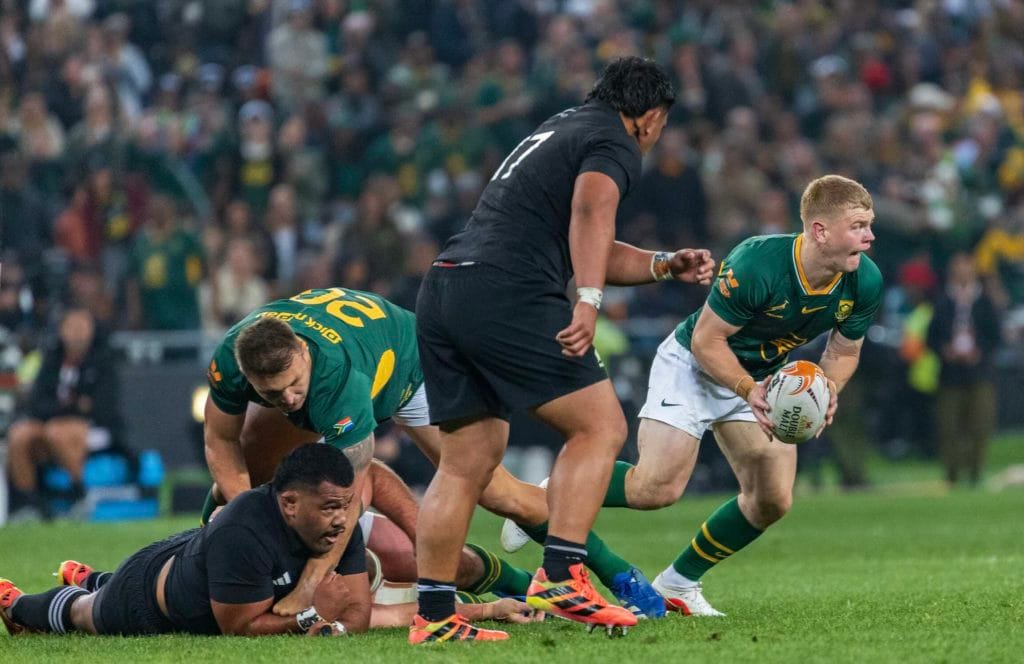
The Springboks spent much of Saturday chasing shadows, trailing until the 58th minute before finally wresting control from the All Blacks.

It was less victory parade and more street fight.

“We are happy tonight. It was epic. It was intense. I think the scoreboard at the end showed how close the game was. We’re just happy we won,” said Erasmus.

His honesty was brutal.

“They were definitely on top (in the first half). All of us I think envy the way they can handle the ball and they’re certainly brilliant at that. Luckily we went in level at halftime which gives you some hope.”

Then came the admission that will delight Bok fans and give New Zealand ammunition.

“I’m not sure what my heart rate was but we were certainly nervous. And I think they were nervous.”

The travelling circus now moves to America, with the fierce rivals sharing a flight before resuming hostilities.

Erasmus even joked about sharing a beer with All Blacks coach Dave Rennie.

“Hopefully me and Dave will have a beer. His will be a little bit more bitter and mine will be a little sweeter.”

The smiles, however, will disappear once camp opens.

“We assess the injuries; we start planning and it’s number one and two again. It’s the greatest rivalry and we play to try and win the series, and they will try and to draw the series. So, no, it’s going to be flipping important.”

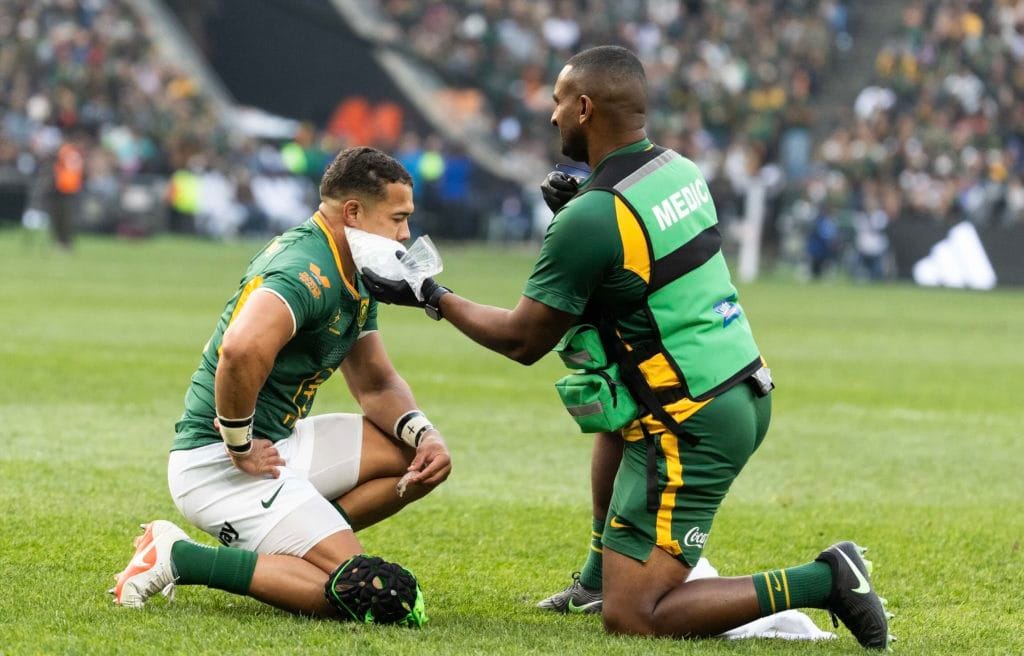
The Boks will be without Cheslin Kolbe after Erasmus revealed the electric wing fractured his jaw. Erasmus reveled that scrumhalf Herschel Jantjies will replace Kolbe for the trip to the USA.

Cheslin Kolbe suffered a broken jaw in the third test in Soweto Photo: SA Rugby

Carlu Sadie, Boan Venter, Ntuthuko Mchunu, Cobus Wiese and Ben-Jason Dixon will also stay behind.

Damian Willemse, Grant Williams and Canan Moodie are fit and will travel.

Erasmus knows the Boks escaped Soweto with more than skill.

“It’s massive, this is. You’re playing number one and two in the world and it switches one week to the next and it certainly lives up to that (hype), and I can tell you now, we’re not sitting here thinking we are flipping awesome. We’re thinking there was also a lot of luck that that went our way.”

So forget the coronation.

Forget the champagne.

Forget the trophy photographs.

For now.

The Boks have one punch left to throw.

So do the All Blacks.

Baltimore, buckle up.

The Greatest Rivalry is coming to town.

The quiet power of Siya Kolisi’s 55

By Adnaan Mohamed at the FNB Stadium in Soweto

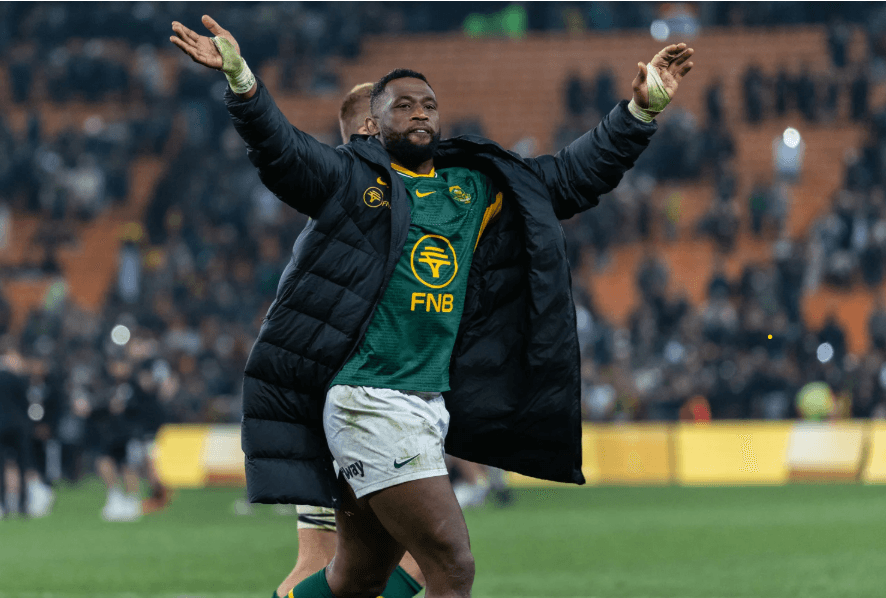
Siya Kolisi has never been particularly interested in making himself the story. On the night he became the most successful captain in Springboks history, that instinct was as powerful as ever.

The scoreboard at FNB Stadium said South Africa 29, New Zealand 24. The series said Springboks 2, All Blacks 1. The record books said something rather more extraordinary: 55 Test victories as captain, one more than the 54 accumulated by John Smit.

For most athletes, that would be the moment to pause, puff out the chest and allow history a little room to breathe.

Kolisi, characteristically, handed the oxygen to everyone else.

“If this were tennis it would be different, but this is a team sport. It shows the work Rassie [Erasmus] and his coaching staff put in,” the 35-year-old told Modern Athlete after the match.

“We’ve got so many leaders in this side that I really only have one job to do, which is focus on my own game.”

There is something almost disarming about the understatement.

Fifty-five victories as Springboks captain is not merely a statistic. It is a towering monument built across years of upheaval, triumph, scrutiny and expectation. It stretches beyond the rugby field into the improbable story of a boy from Zwide who became the face of a nation’s most recognisable sporting institution.

Yet Kolisi speaks about it as though he has merely completed another assignment.

That is perhaps the paradox of his leadership. His influence is enormous precisely because he rarely behaves as though it is.

The record came on a night when FNB Stadium became more than a rugby ground. Almost 88,000 people filled the Calabash for a match carrying the historical weight of Soweto and the emotional currency of a nation.

Kolisi understood the symbolism.

“It was really special. We always say we won’t just say thank you in words, but through our effort. We were tested in that first 25 minutes, they came out firing, and we had to dig deep to fight our way back into it.”

Then came the image that stayed with him: children running alongside the Springbok team bus, hoping for a glimpse of their heroes despite being unable to afford tickets.

“They can’t afford to come and watch us play, but seeing that, and understanding the history of this place, the young people who fought so that we could be sitting here today, that’s why we wanted this game here,” Kolisi said.

“That’s what we play for, not just the people who can afford it, but everyone.”

It is difficult to imagine a more revealing explanation of his captaincy.

The 55 wins belong to Kolisi. The meaning he attaches to them belongs to something larger.

Even the victory itself did not escape his scrutiny.

“I thought we played better in the first Test [at Ellis Park], we just didn’t convert our chances,” he said.

“There’s still so much more we can do. Our defence in particular can get better.”

His answer carried the familiar Kolisi mixture of humility and hunger. No grand declaration. No coronation. No invitation for the rugby gods to start carving his statue.

Only work.

“The way the coaches rotate the team and give other guys opportunities keeps everyone hungry. If you don’t get picked this week, you know your chance is coming. It also keeps us fresh so we’re not overplayed. It’s a group effort, and I’m really happy about that.”

And so, after 55 wins, the captain looks ahead rather than back.

“Playing together more consistently helps a great deal, and I’m looking forward to what we can build on next week [in Baltimore].”

History has caught up with Siya Kolisi. He appears in no hurry to stop running.

Springboks hold off All Blacks in Soweto thriller

Adnaan Mohamed at FNB Stadium, Soweto

The Springboks survived a fierce challenge from the All Blacks to win 29-24 at FNB Stadium on Saturday night, securing an unassailable lead in the four-Test series in front of a crowd of nearly 90 000.

It was a high-quality Test played at considerable pace, with both sides scoring four tries and momentum shifting repeatedly during a compelling contest.

For Springbok captain Siya Kolisi, the victory was another significant milestone. His 55th Test win as captain moved him clear as the most successful skipper in Springbok history.

New Zealand made the stronger start.

With Sacha Feinberg-Mngomezulu in the sin bin after being shown yellow for a deliberate knock-down, All Black captain Ardie Savea finished a sustained period of pressure by crashing over in the 10th minute.

Ruben Love missed the conversion, leaving New Zealand with a 5-0 lead.

The Boks responded through their traditional strengths: physical carries, quick ball and pressure at set piece.

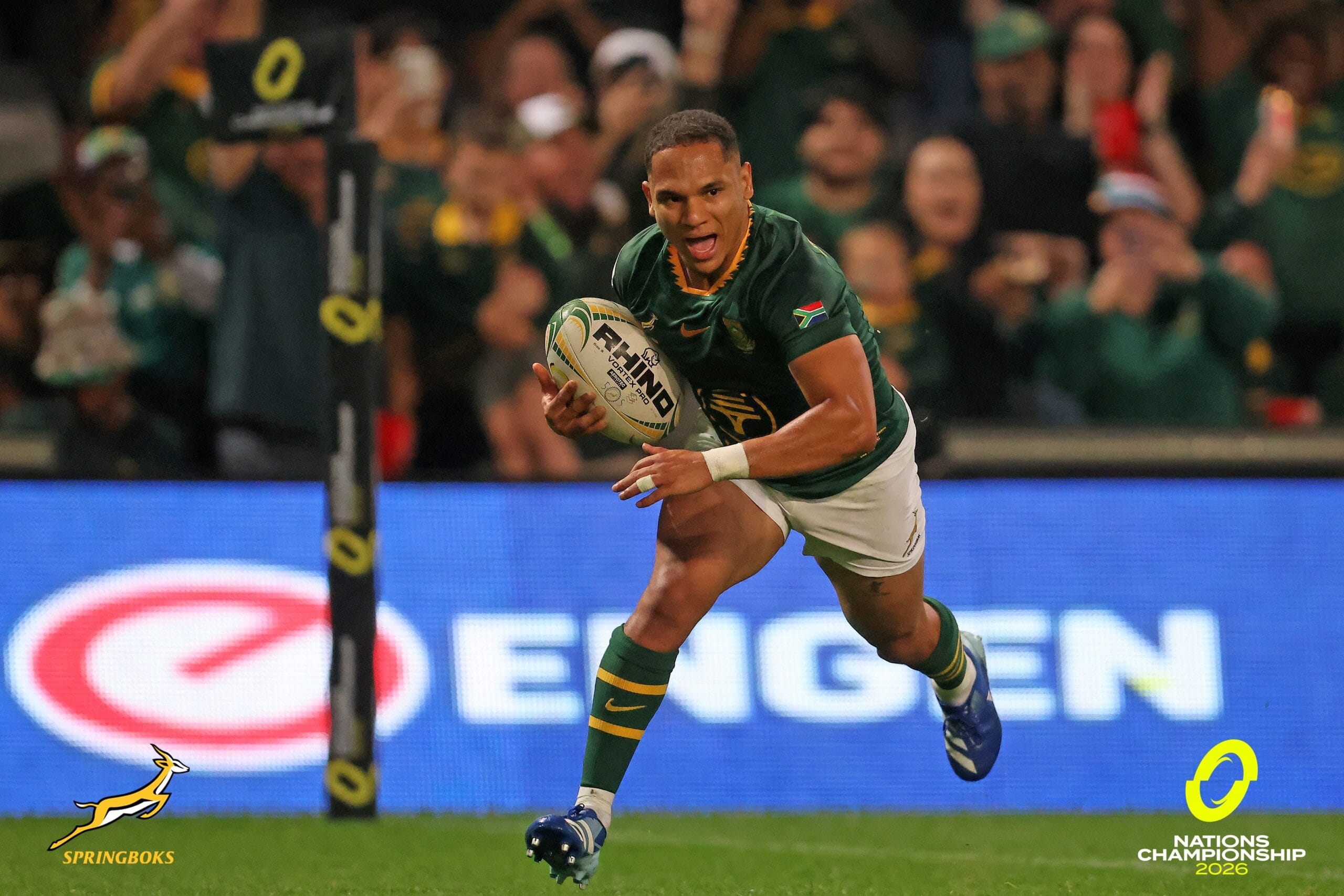
Cheslin Kolbe finished a well-worked attack 10 minutes later, with Feinberg-Mngomezulu converting to give South Africa a 7-5 lead. Kolbe was subsequently forced off for a head-injury assessment.

South Africa’s scrum then became an increasingly important factor.

The Boks applied sustained pressure against the New Zealand pack and were rewarded with a penalty try four minutes before half-time, extending their lead to 14-5.

New Zealand responded strongly after the break.

Savea scored his second try before Will Jordan added another, with Love converting to put the visitors 17-14 ahead.

The Boks needed a response and found it through Jesse Kriel.

The centre broke through the All Blacks’ defensive line to score, with Feinberg-Mngomezulu adding the conversion as South Africa regained the lead at 21-17.

Malcolm Marx then increased the pressure by powering over for the Boks’ fourth try.

A further penalty from Feinberg-Mngomezulu put South Africa 29-17 ahead and appeared to give the hosts sufficient breathing room.

New Zealand had other ideas.

The All Blacks continued to attack deep into the closing stages and replacement hooker Samisoni Taukei’aho scored after the final hooter. Damian McKenzie converted to reduce the deficit to five points, although there was no time for a further attack.

The 29-24 result completed the Boks’ series victory and extended their dominance in one of Test rugby’s defining rivalries.

Ethan Hooker was named Player of the Match after an influential performance for South Africa.

There is little time for either side to reflect.

The Springboks and All Blacks will board a chartered flight to Baltimore in the United States, where they will meet again in the fourth and final Test next week.

Earlier at FNB Stadium, New Zealand’s Black Ferns produced a commanding display to beat the Springbok Women 52-20.

The visitors scored eight tries and led 24-10 at half-time in the first meeting between the teams on African soil.

The result highlighted the Black Ferns’ experience and attacking efficiency, while the Springbok Women were unable to convert their dominance in certain areas, including the scrum, into sufficient attacking points.

For South Africa’s men, however, the night belonged to the Boks, who absorbed New Zealand’s pressure, capitalised on their set-piece advantage and held their nerve when the All Blacks launched their late assault.

SPRINGBOKS – Tries: Kurt-Lee Arendse, penalty try, Jesse Kriel, Malcolm Marx. Conversions: Sacha Feinberg-Mngomezulu (2). Penalty: Feinberg-Mngomezulu.
ALL BLACKS – Tries: Ardie Savea (2), Will Jordan, Samisoni Taukei’aho. Conversions: Ruben Love, Damian McKenzie.

Image Credit: x.com/Springboks

Soweto calls. Siya must answer.

By Adnaan Mohamed

The Calabash will roar. The rain may fall. And somewhere inside the thunder of 90 000 voices, Siya Kolisi will carry a piece of South African history onto the FNB Stadium battlefield.

For the Springbok captain, Saturday’s third Test against the All Blacks is bigger than a series decider.

It is personal.

It is political history without the politics.

And it is an opportunity to repay a debt to the people of Soweto whose sacrifices helped create the freedom that allowed Kolisi and assistant coach Mzwandile Stick to rise to the summit of South African sport.

“We’re thankful for the people connected to that place who fought for the freedom that lets me and him [assistant coach Mzwandile Stick] sit here today,” Kolisi said on Friday.

“Giving our best tomorrow, and using every opportunity we get, is part of us saying thank you.”

Those words will carry considerable weight when the Springboks emerge into the cauldron.

Kolisi spoke about Soweto’s sporting heartbeat, recalling the 1996 African Cup of Nations and the extraordinary connection between the stadium and its community.

He spoke, too, about homeless residents cheering the Springbok bus and locals sacrificing what little they have so others can experience the spectacle.

“It hasn’t always gone our way in Soweto, we didn’t win the first time we played here, but the numbers that show up at the stadium, and the vibe inside it, we feel it,” he said.

“We hope we can give them a good memory, not just with words but with our efforts tomorrow.”

History is also waiting for Kolisi personally.

Victory would give him 55 Test wins as Springbok captain, taking him beyond John Smit and into record territory.

Pieter-Steph du Toit, Jasper Wiese and Kolisi will also establish a new record for Tests played together as a Springbok loose trio.

Kolisi, though, refuses to make the occasion about himself.

“As for the wins record, that’s a team achievement, not mine personally. As long as we win, I’m happy, because it shows we’re building and moving forward as a group.”

That collective mindset will be tested by an All Blacks side with its own pride bruised after losing 33-26 in Cape Town.

New Zealand captain Ardie Savea knows exactly where the battle could be won.

The breakdown.

“Every rugby team is trying to hunt turnovers at the breakdown, and there’s no doubt the Springboks are strong there,” Savea said. “They did a good job keeping us out last week, and they’ll have to do it again this week.”

The All Blacks cannot afford another sluggish launch.

“You wouldn’t be an All Black if you weren’t confident by this point in the week, so we’re confident, but we also respect the threat the Springboks pose.”

“Last week they came out firing … we’d talked about starting well and didn’t quite deliver on that.”

Savea will also have to contend with his friend turned foe.

Kolisi’s thunderous tackle in Cape Town remains fresh in his memory.

“I told him, next time, tackle me frontwards, take me home,” Savea joked. “I was lying on the ground and all I could hear was my dad’s voice telling me to get up. So, I got up.”

Then the smile disappeared.

“Siya’s the same guy off the field, we get on well, but once you’re on the field you’re locked in, he’s the enemy out there. That’s footy, we’re going to try and smash each other tomorrow, then jump on the plane again afterwards.”

Savea likened the decider to State of Origin: “Game three, one apiece, here in Africa, so it’s a big one.”

He knows the All Blacks must be clinical.

“We have to be really clinical, accurate and disciplined. They’re world champions for a reason, and if you do that you won’t get it back.”

Kolisi expects the weather to be irrelevant.

“It won’t affect our game plan at all. The way we play is built for any weather.”

That is the challenge facing New Zealand.

Stop the Springbok juggernaut. Survive the Soweto storm. Silence the Calabash.

For Kolisi, the equation is simpler.

Give everything.

Give thanks.

Make history.

South Africa: Cheslin Kolbe, Kurt-Lee Arendse, Jesse Kriel, Damian de Allende, Ethan Hooker, Sacha Feinberg-Mngomezulu, Cobus Reinach, Jasper Wiese, Pieter-Steph du Toit, Siya Kolisi (captain), Ruan Nortje, Eben Etzebeth, Wilco Louw, Malcolm Marx, Ox Nche.

Replacements: Deon Fourie, Gerhard Steenekamp, Thomas du Toit, Lood de Jager, Andre Esterhuizen, Cameron Hanekom, Morne van den Berg, Manie Libbok.

New Zealand: Damian McKenzie, Will Jordan, Quinn Tupea, Jordie Barrett, Leroy Carter, Ruben Love, Cam Roigard, Ardie Savea (captain), Luke Jacobson, Peter Lakai, Sam Darry, Tupuo Vaa’i, Tyrel Lomax, Asafo Aumua, George Bower.

Replacements: Samisoni Taukei’aho, Xavier Numia, Fletcher Newell, Fabian Holland, Wallace Sititi, Kyle Preston, Anton Lienert-Brown, Josh Moorby.

Saturday, September 5 | FNB Stadium, Soweto | 17:10 SA time

Referee: Nika Amashukeli (Georgia)
Assistant referees: Angus Gardner (Australia), Christophe Ridley (England)
TMO: Eric Gauzins (France)

Springbok try machine KLA is back for Soweto clash

By Adnaan Mohamed

Kurt-Lee Arendse is back in the Springbok starting XV, and Rassie Erasmus is hoping the try-scoring machine can provide another spark when the All Blacks roll into the roaring cauldron of FNB Stadium on Saturday.

Arendse returns on the right wing for the third Castle Double Malt Rugby’s Greatest Rivalry Test after missing the 33-26 Cape Town victory.

Cheslin Kolbe moves to fullback following Damian Willemse’s injury, giving the Springboks a reshuffled back three with enough pace and mischief to keep New Zealand’s defence guessing.

For Arendse, it is an opportunity to remind everyone why his name remains synonymous with finishing.

The Bulls flyer has scored 25 tries in 33 Tests, a strike rate that makes him one of the most dangerous predators in the Springbok backline.

“Kurt-Lee was unlucky not to play last week after Cheslin recovered from his niggle, so we are pleased to see him back,” Erasmus said.

“He is a quality player and his 25 tries in 33 matches so far shows the type of player he is.”

Erasmus has otherwise opted for continuity after the Springboks levelled the four-Test series in Cape Town.

“It was always our plan to have a little more continuity in player combinations for this series, and we thought that the players who did the job for us last week really showed composure and did well to stick to the plan and what we wanted to achieve last week,” he said.

“Unfortunately, Damian Willemse took a knock in the first half and was not available for selection this weekend, and neither was Handre Pollard, and by sticking to these combinations and making one switch with Cheslin at fullback, we thought it would be the best for this match.”

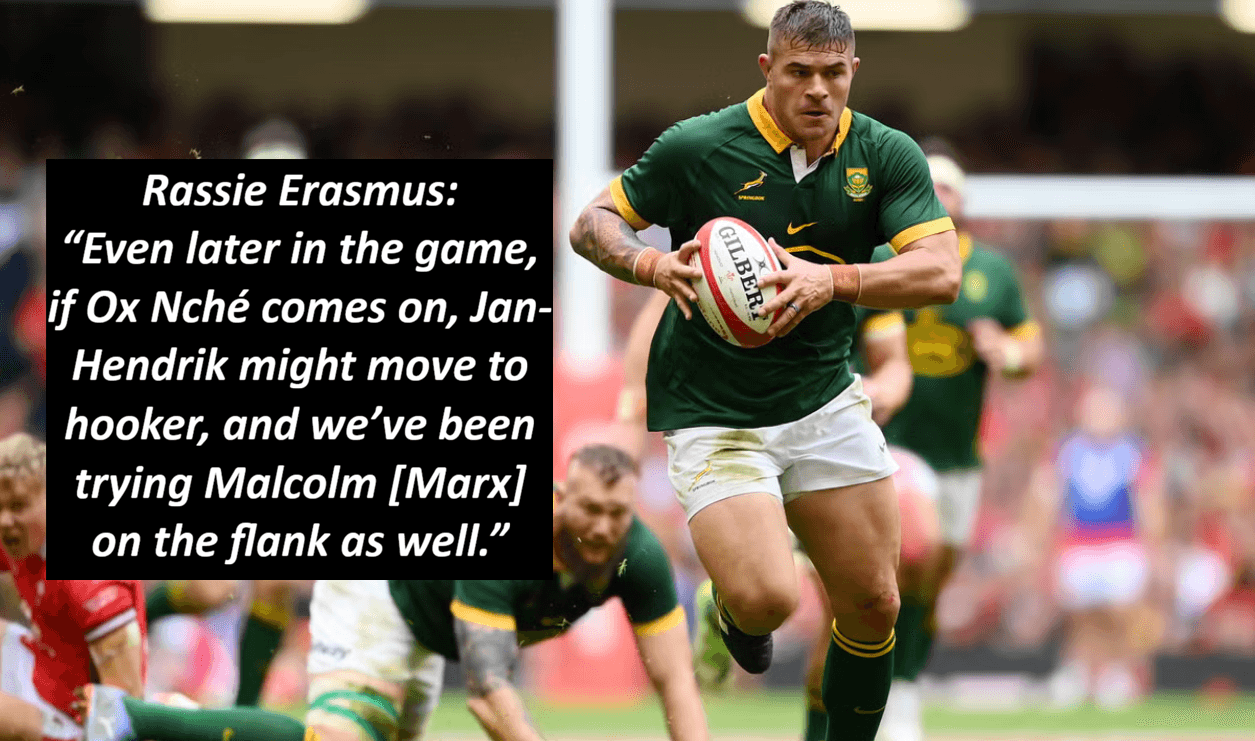
The front row has also been reset, with Ox Nche, Wilco Louw and Malcolm Marx returning to the starting lineup after Gerhard Steenekamp, Thomas du Toit and Deon Fourie started in Cape Town.

“We decided to change our front rows last week due to the weather conditions, and Johannesburg weather is different to Cape Town, so we thought this would be the best decision for us this weekend,” Erasmus said.

He added that the players moving to the bench remain vital weapons.

“Gerhard, Thomas, and Deon have played massive games for us, and at the same time know how to deal with pressure, and that is exactly what we need against a never-say-die team like the All Blacks, who play for the full 80-minutes.”

Erasmus expects New Zealand to respond with the fury of a wounded heavyweight.

“We know how it felt after the first match in Johannesburg, and such a result really galvanises a team, so we have no doubt that they will go full-out to win this Test match before the series finale in the USA next week,” he said.

“They are one of the two best teams in the world and based on experience, they never give up, as we saw last weekend, so this will undoubtedly be another epic encounter between the sides.”

The stakes are enormous.

“This game is going to be equally, if not more intense than the last two given the fact that the team that wins this match will be two games up in the series,” Erasmus said.

“That will make the clash in the USA the decider or game that could see the series finish in a draw, so there will be a different vibe around this match.”

And then there is FNB Stadium.

“We are excited that we will be playing at the FNB stadium, where on a good day there is an 80 000-strong crowd,” Erasmus said.

“With the vuvuzelas and passionate crowd there, we can hardly hear one another on the field, so we are all thrilled about this occasion.”

The final warning was unmistakably Erasmus.

“But make no mistake, this is going to be another intense battle between the two top teams in the world who are both looking to get an edge in the series, so we know what we have to do, and composure and accuracy are going to be vital for both sides.

For Arendse, the assignment is brutally simple.

Get the ball.

Find the gap.

Finish the job.

Cheslin Kolbe warns: All Blacks will come fighting in Soweto

By Adnaan Mohamed

Cheslin Kolbe expects the All Blacks to come out firing when the Rugby’s Greatest Rivalry series moves back to Johannesburg next weekend.

South Africa levelled the four-Test series at 1-1 with a hard-fought 33-26 victory at DHL Stadium on Saturday, with Kolbe’s flawless goal-kicking proving decisive as he contributed 18 points.

The Springboks now face another examination at the FNB Stadium in Soweto against a New Zealand side smarting from its first defeat of the year.

“When you lose, the team is always going to come back with a point to prove,” Kolbe said.

The third Test at FNB Stadium on 5 September presents the Boks with an opportunity to seize control of the series, but Kolbe believes there is plenty for Rassie Erasmus’ side to address before then.

“We need to go back on Monday and see where we didn’t capitalise on opportunities,” he said.

“New Zealand are a quality team; they attack well and they cut us open a few times. We definitely need to look at where we can improve and get better as a team.”

That assessment carries weight.

The Boks built a 24-14 half-time lead in Cape Town, yet the All Blacks fought back with four tries and were within seven points late in the contest. South Africa’s ability to close out the match under pressure was significant, but the defensive cracks New Zealand exposed will give the coaching staff plenty of video to pore over.

Kolbe also offered an insight into the mood around the Bok camp following their 33-16 defeat at Ellis Park.

“We could feel the atmosphere, not negativity but less energy, throughout the week because of the loss last week,” he said.

“As they always say, when we lose, it’s ‘n Blou Maandag [a Blue Monday]. We felt that, but we just wanted to rectify it.

“It wasn’t easy at all; we needed to stay in the fight. It’s going to be like that for the next two matches.”

Kolbe’s own contribution has added another string to his already crowded bow.

The Stormers-bound back credited his season in Japan, where he took responsibility for goal-kicking, as well as Springbok assistant coach Tony Brown, for helping improve his technique and consistency.

“This season in Japan, I had the responsibility of taking over the goal-kicking and that’s contributed to my style and technique.

“I can also give credit to the coaches in Japan, and Tony in the Springbok set-up is doing a few things for me so I can get more consistency.

“That’s the same for every rugby player; you always need to bring something new to the team … it’s contributing to the team’s success,” he said.

Asked how far he could kick a goal, Kolbe offered a typically cheeky response:

“I think most of the balls tonight were just over the crossbar!”

The joke was vintage Kolbe. His kicking, meanwhile, was anything but a laughing matter.

With the series delicately poised, the Boks have momentum. The All Blacks have motivation.

Soweto should have plenty of both.

‘Never believe Rassie’: Kirwan’s blunt Boks warning

By Adnaan Mohamed

Sir John Kirwan has called Rassie Erasmus’s underdog card before the Springboks’ second Rugby Greatest Rivalry Test against the All Blacks.

And the All Blacks legend’s verdict is brutally simple.

“Never. Don’t believe Rassie. Don’t believe Rassie.”

Kirwan, one of New Zealand’s most celebrated rugby figures, refuses to buy into any suggestion that the four-time world champions are suddenly the underdogs after their 33-16 defeat to the All Blacks at Ellis Park last weekend.

“They are four-time world champions. They’ve been an outstanding rugby team for four years,” Kirwan said.

“So they are world champions. We are the underdogs.”

There is a healthy dose of mischief in Kirwan’s assessment, although his respect for the Springboks is unmistakable.

He expects a vastly improved South African performance at DHL Stadium on Saturday, predicting Erasmus will turn to a more conservative tactical approach and use the kicking game to squeeze New Zealand deep into their own territory.

“I think the Springboks will be way better,” Kirwan said.

“I think they’ll be a bit more conservative tomorrow. I think their infield kicking game will be different. So I expect them to try and pin us into our own half.”

The All Blacks, however, will arrive in Cape Town with their own armoury sharpened.

“These guys are on a journey to get better every week, so I think it’s going to be a massive game,” Kirwan said.

“The pressure is on the world champions and I’m sure they’ll step up to that. There’d be a lot of fireworks.”


For Kirwan, Saturday’s Test could become a tactical heavyweight bout, with neither side willing to blink during the decisive exchanges.

“It’s a boxing match. They’re gonna win some rounds, you’re gonna win some rounds. But at this level, winning those critical moments is really, really important.”

Those moments, he warned, can arrive at any stage.

“Sometimes they come after five minutes. Sometimes they come in the 79th minute.”

Kirwan expects the contest to go down to the wire.

“I think it’ll be incredibly close tomorrow. I think it’ll come down to a few points.”

His description of rugby as “chess with contact” could prove particularly apt in Cape Town.

“You need to win the first 10 minutes, the last 10 minutes before halftime, first 10 minutes after halftime, and the last 10 minutes,” he said.

“It’s really important to start fast. It’s really important to try and imprint the way that you want to play on the opposition. The South African team will be trying to do the same.”

Kirwan is equally bullish about the identity of Dave Rennie’s All Blacks.

“What I’ve seen is that this All Black side is playing a style of rugby that I think suits our skill set and suits the type of athlete that we have.”

The Springboks’ selection changes, including the absence of Handré Pollard and the continued emergence of Sacha Feinberg-Mngomezulu, have also caught his eye.

Kirwan described Feinberg-Mngomezulu as “world class” and believes the young flyhalf will have benefited from the lessons of Ellis Park.

“I think Sacha is still a young man and last week he would have learned a lot and he’ll be better tomorrow.”

He also saluted South Africa’s diminutive dynamo brigade, particularly the skill and footwork of the country’s wings.

“When you see Damian, his footwork. I mean, some of these guys into contact have fantastic feet.”

Then came another Kirwan gem:

“Long live the small, fast winger.”

For Kirwan, the rivalry runs far deeper than tactics, rankings and Test statistics.

As an eight-year-old, he was allowed to stay up late to watch the All Blacks. New Zealand won plenty of matches in those days, although South Africa provided a particularly formidable obstacle.

“That whole rivalry, we don’t know who’s going to win,” he said.

“I think we have the same passion for the game. And I think that’s brought us together.”

Kirwan believes rugby has often carried a cultural weight beyond the field, particularly in South Africa and New Zealand.

“A lot of times in our country, the game’s been bigger than a game. I think Nelson Mandela did that.”

The former All Black has also embraced the South African welcome.

“The hospitality, South African hospitality is unbelievable. Food’s great, people are lovely. And so for us, it’s like being at home. Really appreciate it.”

The pleasantries can wait once the whistle blows.

For now, Kirwan has thrown the psychological ball firmly into Erasmus’s court.

Rassie can call them underdogs. Kirwan isn’t buying it.

Teams: 

South Africa: 15 Damian Willemse, 14 Cheslin Kolbe, 13 Jesse Kriel, 12 Damian de Allende, 11 Ethan Hooker, 10 Sacha Feinberg-Mngomezulu, 9 Cobus Reinach, 8 Jasper Wiese, 7 Pieter-Steph du Toit, 6 Siya Kolisi (captain), 5 Ruan Nortje, 4 Eben Etzebeth, 3 Wilco Louw, 2 Malcolm Marx, 1 Ox Nche.
Replacements: 16 Deon Fourie, 17 Gerhard Steenekamp, 18 Thomas du Toit, 19 Lood de Jager, 20 Andre Esterhuizen, 21 Cameron Hanekom, 22 Morne van den Berg, 23 Manie Libbok.

New Zealand: 15 Damian McKenzie, 14 Will Jordan, 13 Quinn Tupaea, 12 Jordie Barrett, 11 Leroy Carter, 10 Ruben Love, 9 Cam Roigard, 8 Ardie Savea (captain), 7 Luke Jacobson, 6 Simon Parker, 5 Tupou Vaa’i, 4 Fabian Holland, 3 Tyrel Lomax, 2 Codie Taylor, 1 George Bower.
Replacements: 16 Asafo Aumua, 17 Xavier Numia, 18 Fletcher Newell, 19 Patrick Tuipoluto, 20 Peter Lakai, 21 Kyle Preston, 22 Anton Lienert-Brown, 23 Josh Moorby

Date: Saturday, August 29
Venue: DHL Stadium, Cape Town
Kick-off: 17.10
Expected weather conditions: Partly cloudy with a low of 11°C and a high of 18°C. Rain is also expected around kick-off time.
Referee: Angus Gardner (Australia)
Assistant referees: Karl Dickson (England), Sam Grove-White (Scotland)
TMO: Brett Cronan (Australia)

Boks’ Cape Town Test rocked by Pollard fitness scare

By Adnaan Mohamed

The Springboks’ bid to claw their way back into Rugby’s Greatest Rivalry Series has been dealt another potential blow, with Handré Pollard reportedly set to miss Saturday’s second Test against the All Blacks at Cape Town Stadium.

According to Netwerk24, the experienced flyhalf is battling a calf injury and could be ruled out of the four-match series showdown.

Pollard was named to start on Monday, with Rassie Erasmus opting for the two-time World Cup winner’s experience of Cape Town conditions. His late fitness concern has thrown another spanner into the Springbok machinery at a time when every moving part needs to click.

Sacha Feinberg-Mngomezulu, who started at flyhalf in last weekend’s 33-16 defeat at Ellis Park before moving to the bench, and Manie Libbok are the leading candidates to step into the No 10 jersey.

Sacha Feinberg-Mngomezulu

Pollard’s 2026 campaign has already been punctuated by injury. He opened his season with a Man of the Match performance against Scotland on 11 July before a hamstring problem ruled him out of the Wales Test the following week. His latest appearance came in South Africa’s victory over Argentina in Mendoza almost a month ago.

Now, with the Boks’ series hopes dangling over the precipice, another injury cloud has gathered.

South Africa must win in Cape Town to prevent New Zealand from taking an unassailable 2-0 lead and effectively closing the door on a series victory. Another defeat would leave the Boks needing to win the remaining two Tests to force a draw.

Thomas du Toit insists the Ellis Park setback has already been packed away and dissected.

“I think the important thing for us was to park that game and take the learning as quickly as we can,” said the versatile prop.

The Springboks conducted their review on Monday, identifying what worked and what went wrong before turning their attention to the next assignment.

“We took on board the learnings, took the good stuff, worked on the bad and worst things of the game – it was as easy as that.”

Du Toit believes the Boks need every component firing, particularly with wet conditions potentially turning the contest into a territorial tug-of-war.

“Unfortunately, in this game you can’t only have one aspect of the game firing right for you.”

Scrums, kicking, attack, defence, entries into the 22 and finishing will all need to mesh into one formidable machine.

South Africa do have significant firepower returning. Siya Kolisi is back as captain, Pieter-Steph du Toit reaches his 100th Test, Ox Nche earns his 50th and Eben Etzebeth extends his record as the most-capped Springbok to 144 appearances.

The starting XV, with Kolisi included, boasts a remarkable 1 012 Test caps, the most experienced Springbok starting line-up ever selected. The forwards account for 584 caps and the backline 428, with another 204 caps among the replacements.

Deon Fourie could add another piece of history from the bench. Should he play, the 39-year-old will become the oldest Springbok Test player, overtaking Victor Matfield and Schalk Brits. It would also mark his first international appearance since the 2023 World Cup final, where South Africa edged the All Blacks 12-11.

New Zealand have reshaped their pack, with George Bower replacing Ethan de Groot, who remains under HIA protocols. Josh Lord makes way for Tupou Vaa’i in the second row, while Simon Parker starts at No 6. Leroy Carter and Josh Moorby have swapped positions in the backline.

The All Blacks hold the historical advantage, winning 64 of 111 Tests against South Africa, with 43 Springbok victories and four draws. New Zealand have scored 2 302 points and 253 tries to South Africa’s 1 866 points and 182 tries.

Recent form offers the Boks a glimmer of light. They have won five of the last seven meetings since August 2023 and beat New Zealand 18-12 in their most recent Cape Town encounter in 2024.

The stakes, however, are brutally simple.

The Boks need a response. They need composure. They need their big-game players to stand tall.

And if Pollard’s calf keeps him sidelined, another Springbok No 10 must step into the furnace.

Cape Town is waiting. The series is slipping. Saturday could be the night South Africa either reignites the rivalry or watches it burn away.

Probable Springbok selection if Pollard is ruled out

15 Damian Willemse, 14 Kurt-Lee Arendse, 13 Jesse Kriel, 12 Damian de Allende, 11 Ethan Hooker, 10 Sacha Feinberg-Mngomezulu/Manie Libbok, 9 Cobus Reinach, 8 Jasper Wiese, 7 Pieter-Steph du Toit, 6 Siya Kolisi (c), 5 Ruan Nortjé, 4 Eben Etzebeth, 3 Wilco Louw, 2 Malcolm Marx, 1 Ox Nché. Replacements: Deon Fourie, Gerhard Steenekamp, Thomas du Toit, Lood de Jager, André Esterhuizen, Cameron Hanekom, Morné van den Berg, Pollard’s replacement.

ALL BLACKS – 15 Damian McKenzie, 14 Will Jordan, 13 Quinn Tupaea, 12 Jordie Barrett, 11 Leroy Carter, 10 Ruben Love, 9 Cam Roigard, 8 Ardie Savea (c), 7 Luke Jacobson, 6 Simon Parker, 5 Tupou Vaa’i, 4 Fabian Holland, 3 Tyrel Lomax, 2 Codie Taylor, 1 George Bower. Replacements: 16 Asafo Aumua, 17 Xavier Numia, 18 Fletcher Newell, 19 Patrick Tuipulotu, 20 Peter Lakai, 21 Kyle Preston, 22 Anton Lienert-Brown, 23 Josh Moorby.

Match officials

Referee: Angus Gardner (Australia)
Assistant referees: Karl Dickson (England), Sam Grove-White (Scotland)
TMO: Brett Cronan (Australia)
FPRO: Eric Gauzins (France)

Kick-off: Saturday, 17:10
Venue: Cape Town Stadium

Aimee’s whistle of resilience, courage and ‘Sterkte” to the Boks

SUN CITY, NORTH WEST: From breaking barriers on the rugby field to facing breast cancer with extraordinary courage, Aimee Barrett-Theron continues to inspire. The most-capped female international referee in rugby history was named Technical Official of the Year at the South African Sport Awards. Her message to the Springboks ahead of their Cape Town clash with the All Blacks? “Sterkte.”

By Adnaan Mohamed

Aimee Barrett-Theron has spent years policing rugby’s most ferocious frontiers with a whistle, a stopwatch and nerves forged in the furnace of elite sport.

On Sunday night, 23 August, the trailblazing referee received another trophy for her extraordinary contribution, being named Technical Official of the Year at the 19th South African Sport Awards at Sun City Superbowl.

Her latest accolade came with an unmistakably human soundtrack. Barrett-Theron is halfway through treatment for breast cancer, temporarily away from the international rugby battlefield and drawing strength from the same discipline that carried her through some of the sport’s biggest arenas.

“The treatment’s going well. I’m about halfway through at the moment so it’s been quite a challenge not being on the field, but I’m still very much involved for coaching because I’m still very much involved here so it’s a tough time to be out there, but I’m still as supportive as I can,” she said.

The road back remains a marathon measured in courage rather than kilometres.

“Yeah, yeah, so a couple of tests and a lot of my friends out there referring I’d love to be supportive there but it’s 20% for the year,” Barrett-Theron said in the interview, reflecting on her curtailed involvement in officiating.

Her career has already smashed through several glass ceilings.

A former Springbok Women’s XVs and Sevens player, she swapped playing boots for the referee’s whistle and became the first woman to referee a men’s professional match in South Africa.

She has since taken charge of 52 international Tests, making her the most-capped female international referee in rugby history. Earlier in 2026, she became only the second woman ever to referee 50 Test matches.

Her CV reads like a roll of honour: the 2017 and 2025 Women’s Rugby World Cups, the Tokyo Olympics, the United Rugby Championship and the Women’s Six Nations.

Then came the diagnosis.

In July, Barrett-Theron announced her temporary departure from officiating after being diagnosed with breast cancer. She has confirmed the condition is treatable and is concentrating on treatment and recovery, with specialists guiding her through the process.

Rugby’s family responded with the force of a defensive line. World Rugby and SA Rugby leaders joined players, officials and supporters in sending messages of encouragement.

Her Sport Awards triumph added another medal to a career already heavy with milestones.

“It’s special to be able to get the trophy,” she said. “At the end of the day and to be recognised for the hard work that we put in”

Then came the question every South African wanted answered: could the Springboks beat the All Blacks at DHL Stadium on Saturday in the second Test of Rugby’s Greatest Rivalry?

For a moment, the referee’s hat came off.

“Yeah, when it comes to Springboks, I can take my referee hat off and I’d love the boys to have any positive results on the weekend.”

Her message to the Boks carried the warmth of a teammate standing beside the tunnel before kick-off.

“Yeah, just stack them on and good luck boys. Represents us the best you can. We know you’ve got it in you.”

And there was one final word, simple enough to fit on a dressing-room wall and strong enough to carry across the Cape Town wind:

“Sterkte.”

For Barrett-Theron, the whistle may be silent for now. Her voice remains firmly in the game.

South African sport has crowned her greatness. Rugby knows her resilience will be worth another standing ovation when she returns.

Under the glittering banner of “Crowned in Greatness”, the 19th South African Sport Awards delivered a night where champions, trailblazers and behind-the-scenes heroes took their bows.

Akani Simbine lead the winners at the 19th South African Sport Awards, with Prudence Sekgodiso, Pieter Coetze and Protea Test Cricket also honoured.

Simbine claimed Sport Star of the Year, adding another gleaming medal to an already formidable athletics legacy. The sprint king has spent years living on the razor’s edge of hundredths of a second, and this time the stopwatch gave way to the applause of a nation.

The Protea Men’s Test Cricket team pocketed Sport Team of the Year, another feather in Cricket South Africa’s cap after a campaign that demanded patience, character and plenty of backbone.

Prudence Sekgodiso was crowned Sportswoman of the Year, while swimmer Pieter Coetze took Sportsman of the Year. Athletics also supplied Coach of the Year Thabo Matebedi, ensuring the track-and-field brigade left Sun City with pockets bulging with silverware.

Young guns Bayanda Walaza, the Youth/Junior Sport Star of the Year, and the Men’s Under-20 Rugby Team, named Youth/Junior Sport Team of the Year, showed that the pipeline is pumping.

Bayanda Walaza, the Youth/Junior Sport Star of the Year with SA swim legend Chad le Clos

Simoné Kruger won Sportswoman of the Year with a Disability, while Puseletso Michael Mabote claimed Sportsman of the Year with a Disability for para athletics.

The evening’s unsung heroes received their own standing ovation. Anthony Moruthane was named Sport Administrator of the Year, Nqobile Kunene Sport Volunteer of the Year, and Khokho Association South Africa Recreation Body of the Year.

Cricket South Africa collected National Federation of the Year, while Rachel Makhura took Sports Media Journalist of the Year, with photographer Skhu Nkomphela winning Sport Visual Journalist of the Year.

And then came the lifetime tributes, a reminder that sporting greatness is built over generations. Siya Vabaza-Booi, Selwyn Nathan and Veli Nhlapo received the Steve Tshwete Lifetime Achievement honour.

The Andrew Mlangeni Green Jacket went to William Mtolo, Teenage Dladla, Prof. Mlungisi Ngubane and Patson Banda, while Rayno Nel, Tasneem Solomons and Temba Bavuma were recognised for Excellence.

It was a night when South African sport looked in the mirror and saw its past, present and future staring back.

The crown fitted. The champions roared. And the sporting heartbeat kept thumping.

Why Springboks-All Blacks rivalry is bigger than rugby

Rugby’s Greatest Rivalry carries influence well beyond the playing field.

SA Rugby president Mark Alexander welcomed NZ Rugby president Erin Rush to Cape Town ahead of Saturday’s Test at DHL Stadium, highlighting the enduring relationship between two nations that have collectively won 70% of Rugby World Cups.

Erin Rush was elected first female president of NZ Rugby in 134 years. Photo: John Cowpland / action press

Rush, New Zealand Rugby’s first female president, has also brought a remarkable playing and broadcasting career into the governance arena.

Cape Town now prepares for another chapter in one of sport’s most enduring rivalries.

By Adnaan Mohamed

South Africa and New Zealand have spent more than a century throwing rugby thunderbolts at each other. On Wednesday morning, the latest chapter of that fierce sporting relationship began with handshakes, smiles and a shared flight into Cape Town.

South African Rugby president Mark Alexander welcomed his New Zealand counterpart Erin Rush at Cape Town International Airport ahead of Saturday’s second Rugby’s Greatest Rivalry Test between the Springboks and All Blacks at DHL Stadium.

The two presidents travelled together after witnessing New Zealand’s 33-16 victory over the Springboks at Ellis Park on Saturday. Their rugby roadshow continued at the same venue on Tuesday night, where the All Blacks edged the Lions 42-35 in a breathless spectacle featuring 11 tries.

Coach Dave Rennie’s side produced six tries, with Cash van Rooyen’s charges crossing five times. The thrilling contest crackled like a loose ball at a hotly contested breakdown, with the All Blacks eventually stealing victory in the final minute.

For Rush, South Africa’s welcome has been every bit as memorable as the rugby. After the All Blacks victory in the first Test, she expects the pressure and intensity of the rivalry to reach new heights for the rest of the series.

“It’s been amazing. There’s a lot at stake,” said Rush.

“Firstly, I want to say thank you to South Africa Rugby and the people of South Africa for their generous hospitality. Also for bringing such intense anticipation and a huge match-up on the field. It is so exciting and we’ve got so many of our supporters here who are enjoying it too.”

Her response came after Alexander pointed out the strong historical bond between New Zealand and South Africa.

“Yeah, thank you,” Rush replied.

Alexander then welcomed his New Zealand counterpart with the warmth of an old rugby handshake.

“We welcome Erin [Rush] and the All Blacks the old foe here in Cape Town. We’re great friends and always bring the best out of each other,” said Alexander.

“The one thing about rugby, it brings people together. And the two nations have got a long history, you know.”
Then came the statistic that gives this rivalry its heavyweight status.

“Between the two of us, we won 70% of the World Cups hosted to date. So, it is the greatest rivalry. And that’s why we’ve got the best two teams in the world competing in the next couple of weeks in South Africa.”

Rush arrives in the Mother City carrying a remarkable rugby story of her own. The 56-year-old became New Zealand Rugby’s first female president in May 2026, securing a two-year tenure after being elected by NZR’s affiliate members and succeeding former All Black Matthew Cooper.

Her rugby CV reads like a long-running Test match. Rush was Black Fern No. 113, making her international debut in 2003 at 33, only weeks after giving birth. She captained Wellington Pride, earned 100 caps for the province and played club rugby for Wellington FC.

Her pioneering streak began even earlier. In 1998, she co-commentated the first Black Ferns Test broadcast live on television during the World Cup final.

Black Fern #113 – Erin Rush Image Credit: AllBlacks.com

She served as NZR vice-president from 2024 to 2026 before taking the presidency. Her current role includes attending board meetings, travelling with national squads, welcoming international guests and presenting medals, with no board voting rights attached to the ambassadorial position.

Now, Cape Town becomes the next set piece in a rivalry that has shaped rugby’s folklore.

Saturday’s Test promises another heavyweight collision. Alexander and Rush have already shared the flight, the hospitality and the rugby spectacle. Come kick-off, friendship will have to make room for the fiercest handshake in world rugby.

The rivalry is ready to rumble