Rassie Erasmus hits back at All Blacks slow-play claims

Adnaan Mohamed

The first Test of Rugby’s Greatest Rivalry Series has already produced its opening skirmish.

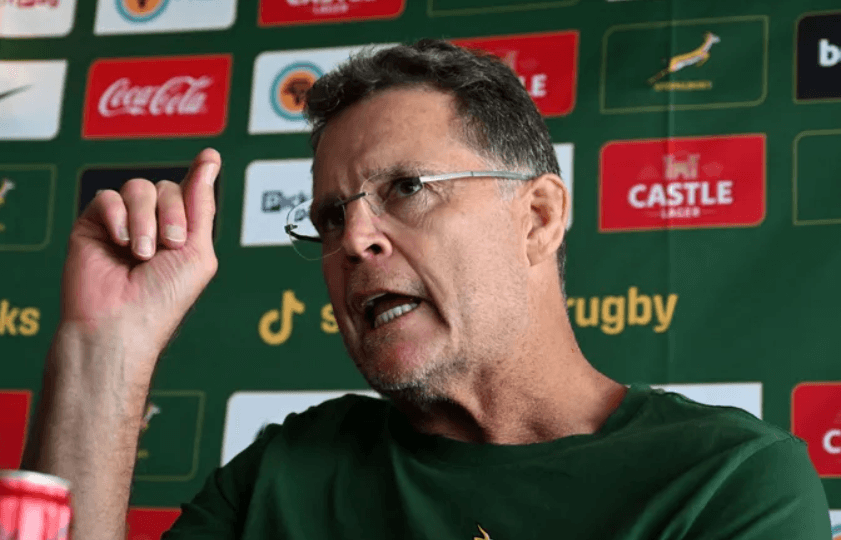
Springbok coach Rassie Erasmus has dismissed suggestions that South Africa deliberately slows the game at set pieces, insisting his team will stick to its systems when the All Blacks arrive at 10bet Ellis Park on Saturday.

“There are always three truths: New Zealand’s truth, the truth people believe, and our truth,” Erasmus said.

The comments come as the pre-Test needle begins to prick. New Zealand has promoted a high-intensity, multi-phase style, with suggestions that the Springboks could seek to disrupt that rhythm.

Erasmus is having none of it.

“In our last two games against New Zealand in Auckland and Wellington, people can go and look at those games and ask were we slowing those down. They beat us in Auckland, and we got a good result in Wellington.”

For Erasmus, Test rugby is not about satisfying outside narratives but more about surviving the furnace when pressure reaches boiling point.

“We believe there’s a certain way to win big games and we think it will be a grind.”

That grind could become the defining feature of Saturday’s opening act.

“When you’re under pressure and you attack, it’s tough to maintain cohesion,” Erasmus said. “We will try to find a balance when games are really tight, but we have a system to fall back on that protects the players.”

Tony Brown’s influence has also helped shape the Boks’ attacking approach.

“Since Tony Brown, former All Black flyhalf and current Springbok assistant coach, has been with us, we feel as though we’ve been on the right track.”

SA Rugby laws advisor Jaco Peyper then entered the fray, offering a technical explanation of the much-discussed 30-second set-piece law.

“The law is very clear. From the moment the referee puts his foot down to mark the spot, not from the whistle, there is 30 seconds to form a lineout or scrum.”

Peyper said teams could manage the moments before the mark is made within the laws, while opponents who are ready to play can apply pressure.

“There’s nothing in the law that says you can’t idle before the mark is given.”

He also pointed out that teams can disrupt tempo through repeated infringements at breakdowns and mauls.

The whistle, in other words, could become a metronome for a Test where every second matters.

Peyper has full confidence in the officials appointed for the four-Test series, particularly England’s Matthew Carley, who will referee Saturday’s opener.

“You’re going to have a firm referee. Someone who deals decisively at the breakdown and is very strong on anything negative or cynical. And he does not get influenced by the home crowd.”

That could be music to the ears of both coaching boxes.

Erasmus expects the All Blacks to bring a blue-chip attacking blueprint to Johannesburg.

“You can see it on social media. They’re advocating a high intensity, running game, with multi-phase attacks. And when you analyse it, it definitely shows in the stats.”

Dave Rennie, who Erasmus previously faced during his Munster days, adds another tactical layer to the contest.

“The big battle is going to be when they have the ball, they’ll have total control of what they do with it, and when we have the ball, we’ll have total control of what we do with it.”

The biggest concern for Erasmus is the All Blacks’ breakdown work.

“What concerns us most is how physical and brutal they are at the breakdown. They take the ball through so many phases and then they put in a well-timed grubber kick. Their attacking kicks are as dangerous as when they have ball-in-hand.”

Away from the tactical chessboard, Erasmus admitted the Springboks are embracing the occasion.

“We all appreciate and respect what this series means,” he said.

“I’d love it if the people at Ellis Park create the same atmosphere as that which the people did in Cape Town. The haka was heard 100%, which makes it something special.”

The Springbok coach also knows the All Blacks remain capable of delivering a sting.

“We know how good the All Blacks are. Since 2018, when they were leading the world, we’ve always wondered when they’re going to beat us again, and they will beat us again in future, but hopefully not this weekend.”

Erasmus will name his team on Thursday, with captain Siya Kolisi and prop Ox Nche the only injury concerns.

“The only two doubtful players are Siya and Ox, who are coming along well,” he said. “I wouldn’t say either is confirmed out, but if they get through training today it could go either way. Apart from those two, everybody else is available.”

The All Blacks are also expected to unveil a few tactical surprises.

“They’ll have plans they didn’t show in the Nations Championship, little things, such as lineout variations, maybe a front peel or back peel move, and there are things that have caught us out before.”

The stage is set.

The talking has started.

Now Ellis Park gets the final word.

South Africa face New Zealand at 17h10 on Saturday, with the match live on SuperSport.
Bomb Squad powers Springboks past spirited Scotland

By Adnaan Mohamed

Championship-winning teams often reveal their true character when momentum hangs in the balance. The Springboks did exactly that on Saturday, producing a clinical second-half display to defeat Scotland 42-28 in a gripping Nations Championship Test at Loftus Versfeld.

With the scores locked at 14-14 at halftime, South Africa leaned on the qualities that have become synonymous with the world champions. Physicality, depth and composure gradually wore down a fearless Scottish outfit that refused to surrender until the final whistle.

The Springboks crossed for six tries to Scotland’s four, although head coach Rassie Erasmus, who marked his record-breaking 55th Test in charge of the national side, will know there is still room for refinement.

South Africa’s defensive system leaked opportunities throughout the contest, allowing Scotland to build confidence with ball in hand. Gregor Townsend’s side arrived intent on playing ambitious rugby, keeping possession through multiple phases while stretching the Springbok defence from touchline to touchline.

Much of that enterprise stemmed from the influential partnership of Finn Russell and captain Sione Tuipulotu. Russell controlled the tempo with trademark vision and precision, while Tuipulotu consistently won the gainline and inspired the visitors with an outstanding all-round display.

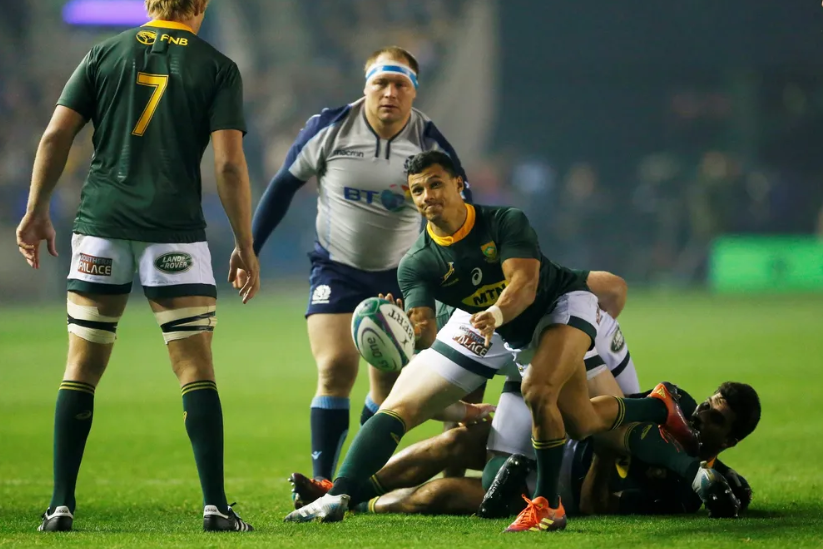
The Springboks struck first through scrumhalf Embrose Papier. Making his first Test appearance in eight years, the Bulls playmaker spotted space around the ruck before skipping through for a memorable try in the 17th minute.

South Africa doubled their advantage moments later. Lock Cobus Wiese launched a powerful charge from the restart before No 8 Evan Roos finished the movement with authority. Handré Pollard converted both tries to establish what appeared to be a comfortable 14-0 lead.

Scotland’s response reflected the resilience that has become a hallmark of Townsend’s side.

Tighthead prop Zander Fagerson powered over after sustained pressure close to the line before Russell and Tuipulotu combined brilliantly to create space for fullback Kyle Rowe. Russell’s conversion levelled the scores as the halftime siren sounded.

The turning point arrived shortly after the restart.

Replacement lock Ben-Jason Dixon received a yellow card for dangerous head contact, leaving South Africa temporarily reduced to 14 players. Erasmus responded by introducing his renowned Bomb Squad earlier than anticipated.

The impact was immediate.

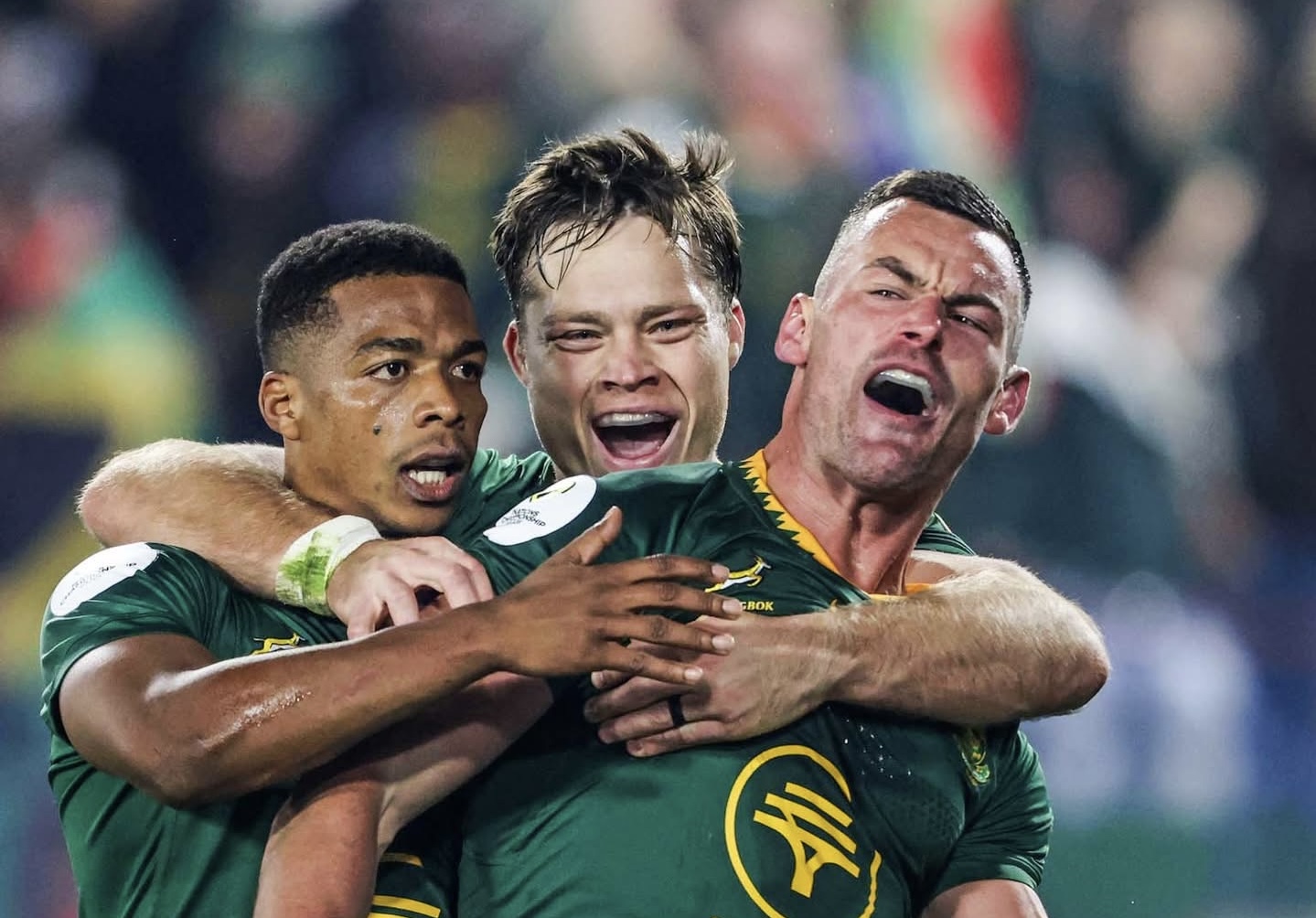
The Springbok pack tightened its grip through relentless carries and dominant set-piece play. Replacement loose forward Elrigh Louw crashed over before Damian Willemse finished a flowing attack following excellent interplay with Edwill van der Merwe.

Young prop Zachary Porthen then celebrated a dream Test debut by powering over for his maiden international try, underlining South Africa’s remarkable production line of forward talent.

Scotland continued to fight with admirable determination. Russell sparked another attacking wave that produced quickfire tries from Josh Bayliss and Ben White, briefly reducing the deficit to seven points and ensuring a tense finale.

The Springboks, however, responded like champions.

Centre Jesse Kriel crossed for the decisive sixth try, allowing South Africa to close out another important Test victory in front of an appreciative Pretoria crowd.

Pollard added five conversions before Quan Horn completed the scoring.

The result extended South Africa’s winning momentum while highlighting both the squad’s enviable depth and its appetite for improvement. The Bomb Squad once again demonstrated why it remains one of the most influential tactical weapons in international rugby, transforming a finely balanced contest into another memorable Springbok triumph.

Point Scorers

South Africa 42 (14): Tries: Embrose Papier, Evan Roos, Elrigh Louw, Damian Willemse, Zachary Porthen, Jesse Kriel. Conversions: Handré Pollard (5), Quan Horn.

Scotland 28 (14): Tries: Zander Fagerson, Kyle Rowe, Josh Bayliss, Ben White. Conversions: Finn Russell (4).

Eight years later, Papier gets his Scottish sequel

There are few better storytellers than rugby. Eight years after making his first Springbok start against Scotland on a wet Murrayfield evening, Embrose Papier is preparing to face the same opponents again. This time, the stage is Loftus Versfeld. The jersey still carries the same weight. The man wearing it has changed completely.

The Clanwilliam-born scrumhalf returns to the Springbok starting line-up carrying far more than seven Test caps. He brings eight seasons of perseverance, frustration and relentless self-belief after watching South Africa conquer the rugby world from the outside.

When Papier burst onto the international scene in 2018 as a fearless 21-year-old, he appeared destined to become the Boks’ long-term No 9. Rugby, however, had other ideas.

A conveyor belt of elite scrumhalves, including Faf de Klerk, Cobus Reinach and Jaden Hendrikse, kept the Bulls playmaker waiting while the Springboks collected back-to-back Rugby World Cup titles.

Instead of fading into the background, Papier rebuilt his game.

His outstanding United Rugby Championship campaign left Rassie Erasmus with little choice. Twelve tries, six assists, 15 clean breaks, 27 defenders beaten and more than 500 metres gained transformed him from an outside contender into an irresistible selection.

The timing could hardly be more fitting.

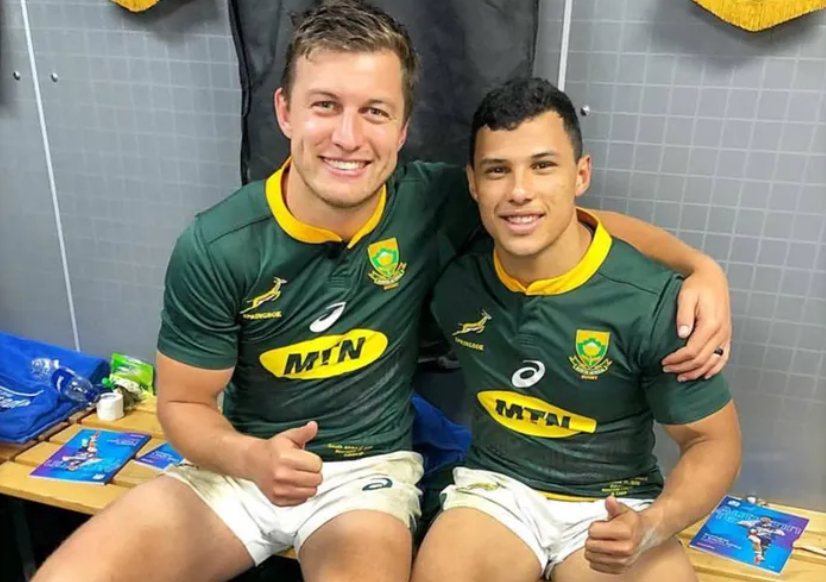
Papier will reunite with Handre Pollard, his halfback partner on that memorable Murrayfield night when South Africa defeated Scotland 26-20.

Handre Pollard and Embrose Papier will start for the Boks against Scotland again on Saturday at Loftus after eight years. Photo: Springboks

“I think there are always nerves before a Test match, but I’m super excited for the opportunity,” Papier said this week.

We all know Handre has a lot of experience. We’ve spent a lot of time together on the pitch and I’m excited to go into this game with him.

“We need to pitch up on the day and give it everything.”

His familiarity with Scotland stretches beyond international rugby.

After five United Rugby Championship seasons with the Bulls, Papier knows many of Scotland’s players through bruising encounters with Glasgow Warriors and Edinburgh. He even crossed for a crucial try against Glasgow in last season’s URC semi-final.

For Erasmus, the recall is built on form rather than sentiment.

“Firstly, I thought he played really well this season,” the Springbok coach said.

“Sometimes it’s not because the player is not playing well enough or is not Springbok class. There are other players performing really well.

“He gathered form and now gets the opportunity at home with Handre, where they’ve played a lot of rugby.”

Paper occasionally writes the perfect ending.

Papier still has to do that himself.

Saturday offers more than another Test appearance. It is an opportunity to show that careers are rarely defined by the doors that close, but by the courage to keep knocking until one opens again.

Images: x.com/springboks

Can England finally crack the Springboks code?

By Adnaan Mohamed

England have been here before. Close enough to see victory. Close enough to believe. Close enough to feel the Springboks wobble.

Then South Africa find another gear.

It has become a familiar script in one of rugby’s richest rivalries. England ask difficult questions, the Springboks absorb the pressure and somehow emerge with the answer that matters most.

Saturday’s opening Nations Championship Test at Ellis Park offers Steve Borthwick’s side another opportunity to prove they have bridged that stubborn gap. They could hardly have picked a sterner examination.

Johannesburg does not welcome visitors with open arms. The altitude drains lungs, the crowd feeds every collision and the Springboks have turned Ellis Park into one of world rugby’s least hospitable addresses.

Rassie Erasmus’ side arrive riding a nine-match winning streak and carrying the confidence of back-to-back Rugby Championship titles. Momentum has become their travelling companion and complacency remains unwelcome.

“The goal is to win,” Erasmus said this week.

Simple words. Typical Springboks.

His selection reflects a squad built for every occasion. Damian Willemse and Cheslin Kolbe celebrate their 50th Tests in a backline packed with proven match winners. Jesse Kriel and Damian de Allende remain one of international rugby’s most reliable midfield pairings, while Manie Libbok gets another chance to orchestrate an attack that can shift from controlled to chaotic in a heartbeat.

Up front, the Springboks possess enough muscle to move mountains.

Ox Nche, Malcolm Marx and Thomas du Toit anchor a front row that thrives on confrontation, with Eben Etzebeth, Siya Kolisi and Jasper Wiese providing the relentless edge that has become South Africa’s trademark.

Then comes the Bomb Squad.

Fresh legs. Fresh power. Fresh problems.

England know exactly what awaits.

George Martin has welcomed the physical battle after returning from injury, while Fin Smith shoulders the responsibility of steering England around one of rugby’s toughest venues. Immanuel Feyi-Waboso’s return offers genuine attacking spark, Tommy Freeman arrives in outstanding form and Henry Pollock is expected to inject his trademark energy from the bench after already making himself public enemy number one among many South African supporters.

Borthwick believes his squad is ready.

“Playing South Africa at Ellis Park is one of the great Tests in world rugby,” he said.

He is right.

England have enough quality to ask questions of the world champions. Their backline carries pace, their forwards have embraced the challenge and their confidence has steadily grown despite an underwhelming Six Nations campaign.

The problem is that Ellis Park rarely rewards promise.

The Springboks know exactly how they want to play. Dominate the set piece. Win the gain line. Squeeze territory. Turn pressure into points.

It is an approach forged through experience and sharpened by success.

England may remain within touching distance for long stretches, much like they have in recent meetings. History suggests that when the contest reaches its defining moments, South Africa usually discover another level.

Prediction: Springboks by 12.

Teams:

South Africa: 15 Damian Willemse, 14 Cheslin Kolbe, 13 Jesse Kriel, 12 Damian De Allende, 11 Kurt-Lee Arendse, 10 Manie Libbok, 9 Grant Williams, 8 Jasper Wiese, 7 Pieter-Steph Du Toit, 6 Siya Kolisi (captain), 5 Ruan Nortje, 4 Eben Etzebeth, 3 Thomas Du Toit, 2 Malcolm Marx, 1 Ox Nche.
Replacements: 16 Jan-Hendrik Wessels, 17 Gerhard Steenekamp, 18 Zachary Porthen, 19 Marco van Staden, 20 Cameron Hanekom, 21 Cobus Reinach, 22 Andre Esterhuizen, 23 Canan Moodie.

England: 15 George Furbank, 14 Immanuel Feyi-Waboso, 13 Tommy Freeman, 12 Seb Atkinson, 11 Cadan Murley, 10 Fin Smith, 9 Jack van Poortvliet, 8 Ben Earl, 7 Tom Curry, 6 Ollie Chessum, 5 George Martin, 4 Alex Coles, 3 Joe Heyes, 2 Jamie George (captain), 1 Ellis Genge.
Replacements: 16 Luke Cowan-Dickie,17 Beno Obano, 18 Asher Opoku-Fordjour, 19 Charlie Ewels, 20 Guy Pepper, 21 Henry Pollock, 22 Alex Mitchell, 23 Marcus Smith.

Date: Saturday, July 4
Venue: Ellis Park, Johannesburg
Kick-off: 17.40
Referee: James Doleman (New Zealand)
Assistant referees: Andrew Brace (Ireland) & Pierre Brousset (France)
TMO: Richard Kelly (New Zealand)

Images: x.com/Springboks