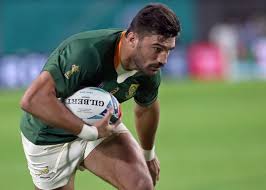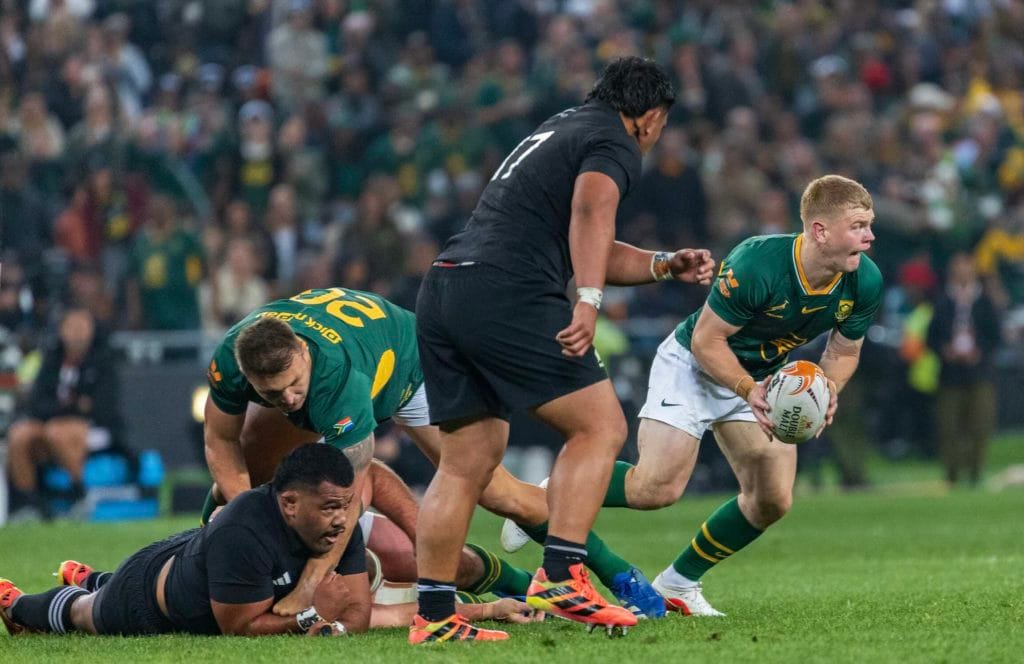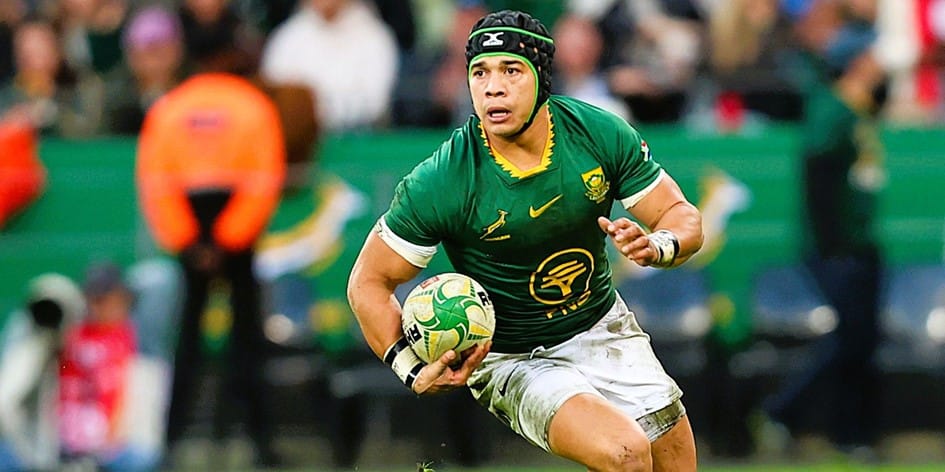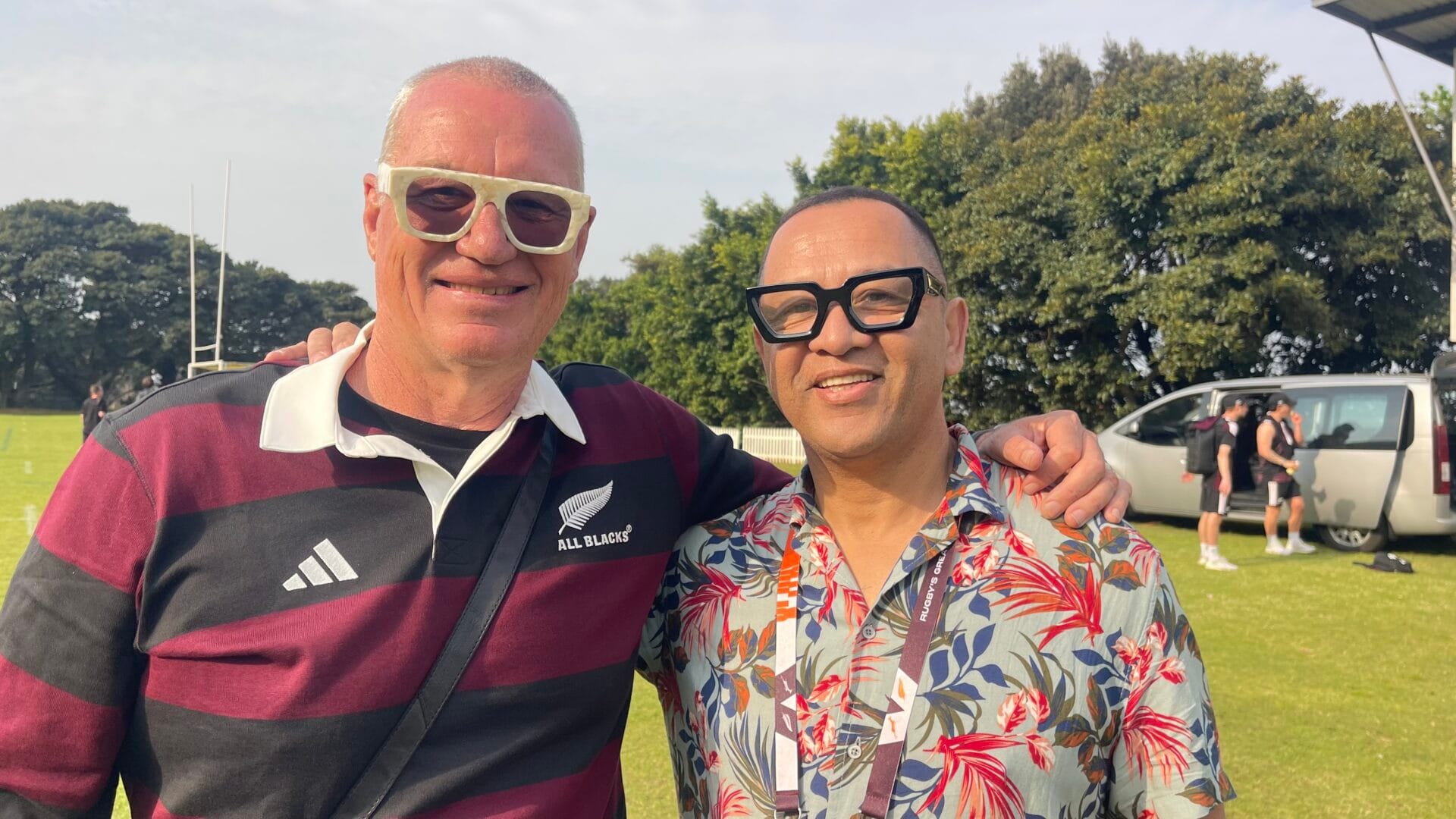



Damian de Allende reveals secret behind Springboks’ defensive strength

Damian de Allende says preparation remains the foundation of the Springboks’ defensive system as they prepare to face the All Blacks for a fourth consecutive weekend.

The experienced centre has spent much of his career operating in the most congested part of the rugby field, but says there is no preference when it comes to his defensive assignments.

“For me personally, I just defend what’s in front of me. That’s the way we get coached,” De Allende said.

“Sometimes I’ll have to defend the forward, and most of the time I’ll have to defend against the backs, but I really don’t mind it.”

De Allende has faced some of the world’s leading midfielders during his career, including Ma’a Nonu, Conrad Smith and Sonny Bill Williams, as well as South Africans such as Franz Steyn and André Esterhuizen.

His current assessment of Jordie Barrett is particularly telling.

“At the moment, the one guy that really does stand out for me is Jordie Barrett,” he said.

“I think his skill set is incredible. He’s got the ability to do everything on the field at the moment.”

The pair have gone head-to-head during the first three Tests of the series, giving De Allende an opportunity to study one of New Zealand’s most versatile players.

“It’s been a real pleasure,” he said.

“I’ve always liked to learn a lot on the field, especially playing against my opposition. I feel like I’ve learnt a lot from Jordie Barrett on the field and it’s been incredible to play against him.”

De Allende believes the All Blacks’ attacking patterns require the Springboks to be disciplined and well prepared.

“For us on defence, it’s the preparation,” he said.

“And like Eben said earlier, it’s the work our coaches do in the background and they give to us. It’s from there the analysis.”

Jesse Kriel has also become an important figure in the defensive system.

“He’s one of our defence leaders, he’s the one that takes control over it a lot,” De Allende said.

“And the way he speaks about defence, the way he’s proud about it, he brings that across a lot and he gets all the players to buy into believing in what we’re doing is correct.”

There is still room for instinct once the match begins.

“Sometimes on the field it is instinct because there’s times on the field where we have to make split-second decisions,” he said.

“And sometimes you get it right and sometimes you get it wrong.”

But De Allende put a figure on the importance of preparation.

“I think 90% of the things go into preparation and what we plan for and what we expect to see from the All Blacks.”

The physical demands of the series have been significant, particularly in the midfield, where De Allende has battled New Zealand’s centres across three Tests.

He described the contest as one of the toughest of his career while acknowledging the quality of the opposition.

“Every Test match is tough. You play against world-class centres, no matter what country you play against.”

He also wished injured All Black Quinn Tupaea a speedy recovery.

De Allende believes experience has become another advantage for a Springbok squad containing several players with more than 100 Test caps.

“I think experience is quite important,” he said.

“There’s still a big sense of responsibility, not just individually but I think collectively, to make sure that we keep representing South Africa well and to the best of our ability.”

Age, he believes, has brought a greater appreciation of the work required to remain at Test level.

“I know we are getting a bit older but for me personally it feels like we’re working a lot harder than what we did when we were a bit younger.”

That work ethic, De Allende believes, explains why the experienced core remains capable of competing with the world’s best.

“I think that is why we’re still playing at such a high-class level, and I think that is still why we’re very competitive, and we can still compete with the best in the world.”

In Baltimore, the Springboks will need that preparation, experience and defensive discipline once again.

The All Blacks have already tested every seam in the green-and-gold wall. One final examination awaits.

Rassie’s Baltimore Battle Squad!

By Adnaan Mohamed

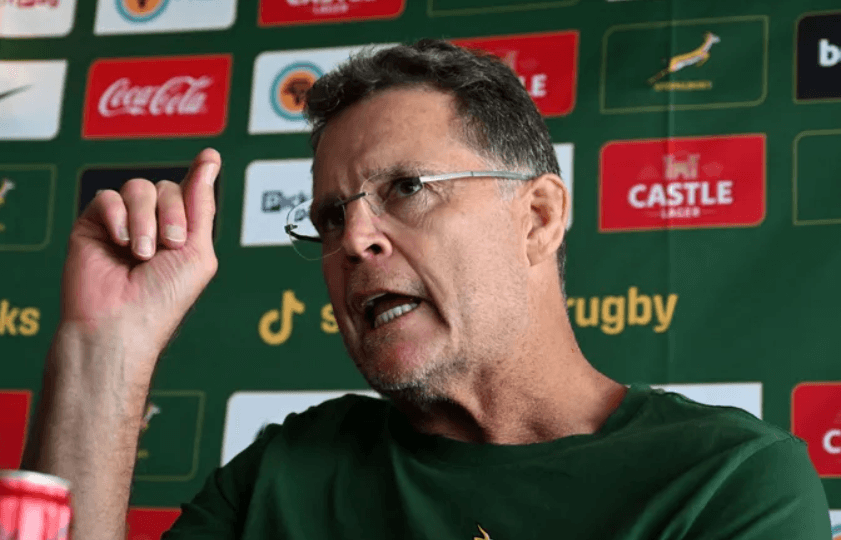
Rassie Erasmus has loaded the Springbok cannon, pointed it at Baltimore and declared war on the All Blacks’ hopes of stealing the Rugby’s Greatest Rivalry crown.

With South Africa leading 2-1, the Bok boss has resisted wholesale tinkering and unleashed a battle-hardened XV for Saturday night’s winner-takes-the-trophy showdown at M&T Bank Stadium.

The message from the Bok camp is brutally simple: hold the line, finish the job, lift the cup.

Damian Willemse returns at fullback after recovering from his niggle, while Morne van den Berg is promoted from impact sub to starting scrumhalf. Cheslin Kolbe’s injury has forced the backline change, while Cobus Reinach brings his experience off the bench as the Boks prepare for another heavyweight slugfest with their oldest rivals.

Erasmus has backed the warriors who dragged South Africa into the series lead through two pulsating Tests, banking on continuity as the All Blacks sharpen their swords for one final assault, The Bok coach resisted the temptation to tear up a winning blueprint after two bruising victories, trusting the squad that has weathered the All Black storm and emerged with a 2-1 advantage.

“We feel that the team is well settled and all the players delivered in their respective roles in the last two matches, so we believe selecting the same matchday squad, and naming Damian back in his regular position, makes sense for the closing match of the series,” said Erasmus.

“These players also know exactly what to expect from a very determined All Blacks team, who will give everything to draw the series this weekend.”

Willemse returns after missing the Johannesburg Test through a niggle, bringing 54 caps and a box of attacking tricks to the No 15 jersey.

“Damian started the first two Tests and had it not been for a niggle last week, he would have also started that match, so it’s good to have him back. He is a quality player, and he knows the guys around him very well, so it will simply be a matter of him picking up where he left off before last week.”

Van den Berg gets his chance after an electric cameo last weekend.

“Morne, meanwhile, made a fantastic impact when he took the field last week, and he deserves a chance to start, so Cobus switches to the bench where he will add experience and skill in this vital match.”

The All Blacks are expected to arrive with their pride sharpened into a spear. Erasmus knows the decider could become an 80-minute street fight dressed in rugby jerseys.

“We have faced the All Blacks three weeks in a row, and just like us, they are a proud team who showed last week that they will never stop fighting until the final whistle, so we are under no illusions about the magnitude of the challenge ahead this weekend.

“That said, we are equally determined to finish the series strongly and give everything to lift the trophy, and the players are excited about the match.

“We have no doubt that it’s going to be another epic encounter that will require a full-blown 80-minute effort on attack and defence, so we will manage the players well this week to ensure that they are ready physically and mentally for Saturday.”

The starting XV carries a colossal 927 Test caps, with 600 among the forwards and 327 in the backline. The bench adds another 277.

The trophy is tantalisingly close, the Kiwi comeback machine is expected to arrive with its engine screaming, and Baltimore is about to become the latest battlefield in rugby’s most combustible rivalry.

One Bok victory crowns South Africa inaugural Rugby’s Greatest Rivalry champions. One All Black victory blows the series wide open and sends the decider into rugby folklore.

Springboks:
15 Damian Willemse, 14 Kurt-Lee Arendse, 13 Jesse Kriel, 12 Damian de Allende, 11 Ethan Hooker, 10 Sacha Feinberg-Mngomezulu, 9 Morne van den Berg, 8 Jasper Wiese, 7 Pieter-Steph du Toit, 6 Siya Kolisi (captain), 5 Ruan Nortje, 4 Eben Etzebeth, 3 Wilco Louw, 2 Malcolm Marx, 1 Ox Nche.

Replacements: Deon Fourie, Gerhard Steenekamp, Thomas du Toit, Lood de Jager, Andre Esterhuizen, Cameron Hanekom, Cobus Reinach, Manie Libbok.

Stats and facts:

Springbok record against New Zealand:

Played: 113, Won: 45, Lost: 64, Drawn: 4. Points for: 1 928; Points against: 2 352; Tries scored: 188; Tries conceded: 261. Win %: 39,8%.

Miscellaneous:

  • Eben Etzebeth will extend his record as the most capped Springbok player of all time to 146 caps when he takes the field.
  • The loose trio of Siya Kolisi, Pieter-Steph du Toit, and Jasper Wiese will extend the record they set last week to overtake Francois Louw, Willem Alberts, and Duane Vermeuelen (17) as the loose trio with the most Test starts to 19 matches.
  • The Springboks have only played three Test matches in the USA in history where they defeated the USA 38-7 in 1981 and 43-10 in 2001, while they suffered a narrow 22-20 defeat against Wales in Washington DC in 2018, which was Erasmus’ first Test in charge as head coach.
  • This match will mark the first Springbok Test in history to be played in Baltimore.
  • Jasper Wiese requires only one more Test match appearance after this encounter to join the group of players who have earned 50Test caps.
  • The Springboks have won seven of the last nine matches against the All Blacks dating back to August 2023.
  • The 2031 Rugby World Cup will be hosted in the USA.
  • The total Test caps in the Springbok starting line-up is 927.There are 327 caps in the backline, with 600 caps among the forwards. On the bench, there are a further 277 caps.
  • The average caps per player in the backline is 47, the forwards 75, while the players on the bench average 35.

Cheslin Kolbe warns: All Blacks will come fighting in Soweto

By Adnaan Mohamed

Cheslin Kolbe expects the All Blacks to come out firing when the Rugby’s Greatest Rivalry series moves back to Johannesburg next weekend.

South Africa levelled the four-Test series at 1-1 with a hard-fought 33-26 victory at DHL Stadium on Saturday, with Kolbe’s flawless goal-kicking proving decisive as he contributed 18 points.

The Springboks now face another examination at the FNB Stadium in Soweto against a New Zealand side smarting from its first defeat of the year.

“When you lose, the team is always going to come back with a point to prove,” Kolbe said.

The third Test at FNB Stadium on 5 September presents the Boks with an opportunity to seize control of the series, but Kolbe believes there is plenty for Rassie Erasmus’ side to address before then.

“We need to go back on Monday and see where we didn’t capitalise on opportunities,” he said.

“New Zealand are a quality team; they attack well and they cut us open a few times. We definitely need to look at where we can improve and get better as a team.”

That assessment carries weight.

The Boks built a 24-14 half-time lead in Cape Town, yet the All Blacks fought back with four tries and were within seven points late in the contest. South Africa’s ability to close out the match under pressure was significant, but the defensive cracks New Zealand exposed will give the coaching staff plenty of video to pore over.

Kolbe also offered an insight into the mood around the Bok camp following their 33-16 defeat at Ellis Park.

“We could feel the atmosphere, not negativity but less energy, throughout the week because of the loss last week,” he said.

“As they always say, when we lose, it’s ‘n Blou Maandag [a Blue Monday]. We felt that, but we just wanted to rectify it.

“It wasn’t easy at all; we needed to stay in the fight. It’s going to be like that for the next two matches.”

Kolbe’s own contribution has added another string to his already crowded bow.

The Stormers-bound back credited his season in Japan, where he took responsibility for goal-kicking, as well as Springbok assistant coach Tony Brown, for helping improve his technique and consistency.

“This season in Japan, I had the responsibility of taking over the goal-kicking and that’s contributed to my style and technique.

“I can also give credit to the coaches in Japan, and Tony in the Springbok set-up is doing a few things for me so I can get more consistency.

“That’s the same for every rugby player; you always need to bring something new to the team … it’s contributing to the team’s success,” he said.

Asked how far he could kick a goal, Kolbe offered a typically cheeky response:

“I think most of the balls tonight were just over the crossbar!”

The joke was vintage Kolbe. His kicking, meanwhile, was anything but a laughing matter.

With the series delicately poised, the Boks have momentum. The All Blacks have motivation.

Soweto should have plenty of both.

‘Never believe Rassie’: Kirwan’s blunt Boks warning

By Adnaan Mohamed

Sir John Kirwan has called Rassie Erasmus’s underdog card before the Springboks’ second Rugby Greatest Rivalry Test against the All Blacks.

And the All Blacks legend’s verdict is brutally simple.

“Never. Don’t believe Rassie. Don’t believe Rassie.”

Kirwan, one of New Zealand’s most celebrated rugby figures, refuses to buy into any suggestion that the four-time world champions are suddenly the underdogs after their 33-16 defeat to the All Blacks at Ellis Park last weekend.

“They are four-time world champions. They’ve been an outstanding rugby team for four years,” Kirwan said.

“So they are world champions. We are the underdogs.”

There is a healthy dose of mischief in Kirwan’s assessment, although his respect for the Springboks is unmistakable.

He expects a vastly improved South African performance at DHL Stadium on Saturday, predicting Erasmus will turn to a more conservative tactical approach and use the kicking game to squeeze New Zealand deep into their own territory.

“I think the Springboks will be way better,” Kirwan said.

“I think they’ll be a bit more conservative tomorrow. I think their infield kicking game will be different. So I expect them to try and pin us into our own half.”

The All Blacks, however, will arrive in Cape Town with their own armoury sharpened.

“These guys are on a journey to get better every week, so I think it’s going to be a massive game,” Kirwan said.

“The pressure is on the world champions and I’m sure they’ll step up to that. There’d be a lot of fireworks.”


For Kirwan, Saturday’s Test could become a tactical heavyweight bout, with neither side willing to blink during the decisive exchanges.

“It’s a boxing match. They’re gonna win some rounds, you’re gonna win some rounds. But at this level, winning those critical moments is really, really important.”

Those moments, he warned, can arrive at any stage.

“Sometimes they come after five minutes. Sometimes they come in the 79th minute.”

Kirwan expects the contest to go down to the wire.

“I think it’ll be incredibly close tomorrow. I think it’ll come down to a few points.”

His description of rugby as “chess with contact” could prove particularly apt in Cape Town.

“You need to win the first 10 minutes, the last 10 minutes before halftime, first 10 minutes after halftime, and the last 10 minutes,” he said.

“It’s really important to start fast. It’s really important to try and imprint the way that you want to play on the opposition. The South African team will be trying to do the same.”

Kirwan is equally bullish about the identity of Dave Rennie’s All Blacks.

“What I’ve seen is that this All Black side is playing a style of rugby that I think suits our skill set and suits the type of athlete that we have.”

The Springboks’ selection changes, including the absence of Handré Pollard and the continued emergence of Sacha Feinberg-Mngomezulu, have also caught his eye.

Kirwan described Feinberg-Mngomezulu as “world class” and believes the young flyhalf will have benefited from the lessons of Ellis Park.

“I think Sacha is still a young man and last week he would have learned a lot and he’ll be better tomorrow.”

He also saluted South Africa’s diminutive dynamo brigade, particularly the skill and footwork of the country’s wings.

“When you see Damian, his footwork. I mean, some of these guys into contact have fantastic feet.”

Then came another Kirwan gem:

“Long live the small, fast winger.”

For Kirwan, the rivalry runs far deeper than tactics, rankings and Test statistics.

As an eight-year-old, he was allowed to stay up late to watch the All Blacks. New Zealand won plenty of matches in those days, although South Africa provided a particularly formidable obstacle.

“That whole rivalry, we don’t know who’s going to win,” he said.

“I think we have the same passion for the game. And I think that’s brought us together.”

Kirwan believes rugby has often carried a cultural weight beyond the field, particularly in South Africa and New Zealand.

“A lot of times in our country, the game’s been bigger than a game. I think Nelson Mandela did that.”

The former All Black has also embraced the South African welcome.

“The hospitality, South African hospitality is unbelievable. Food’s great, people are lovely. And so for us, it’s like being at home. Really appreciate it.”

The pleasantries can wait once the whistle blows.

For now, Kirwan has thrown the psychological ball firmly into Erasmus’s court.

Rassie can call them underdogs. Kirwan isn’t buying it.

Teams: 

South Africa: 15 Damian Willemse, 14 Cheslin Kolbe, 13 Jesse Kriel, 12 Damian de Allende, 11 Ethan Hooker, 10 Sacha Feinberg-Mngomezulu, 9 Cobus Reinach, 8 Jasper Wiese, 7 Pieter-Steph du Toit, 6 Siya Kolisi (captain), 5 Ruan Nortje, 4 Eben Etzebeth, 3 Wilco Louw, 2 Malcolm Marx, 1 Ox Nche.
Replacements: 16 Deon Fourie, 17 Gerhard Steenekamp, 18 Thomas du Toit, 19 Lood de Jager, 20 Andre Esterhuizen, 21 Cameron Hanekom, 22 Morne van den Berg, 23 Manie Libbok.

New Zealand: 15 Damian McKenzie, 14 Will Jordan, 13 Quinn Tupaea, 12 Jordie Barrett, 11 Leroy Carter, 10 Ruben Love, 9 Cam Roigard, 8 Ardie Savea (captain), 7 Luke Jacobson, 6 Simon Parker, 5 Tupou Vaa’i, 4 Fabian Holland, 3 Tyrel Lomax, 2 Codie Taylor, 1 George Bower.
Replacements: 16 Asafo Aumua, 17 Xavier Numia, 18 Fletcher Newell, 19 Patrick Tuipoluto, 20 Peter Lakai, 21 Kyle Preston, 22 Anton Lienert-Brown, 23 Josh Moorby

Date: Saturday, August 29
Venue: DHL Stadium, Cape Town
Kick-off: 17.10
Expected weather conditions: Partly cloudy with a low of 11°C and a high of 18°C. Rain is also expected around kick-off time.
Referee: Angus Gardner (Australia)
Assistant referees: Karl Dickson (England), Sam Grove-White (Scotland)
TMO: Brett Cronan (Australia)

Why Springboks-All Blacks rivalry is bigger than rugby

Rugby’s Greatest Rivalry carries influence well beyond the playing field.

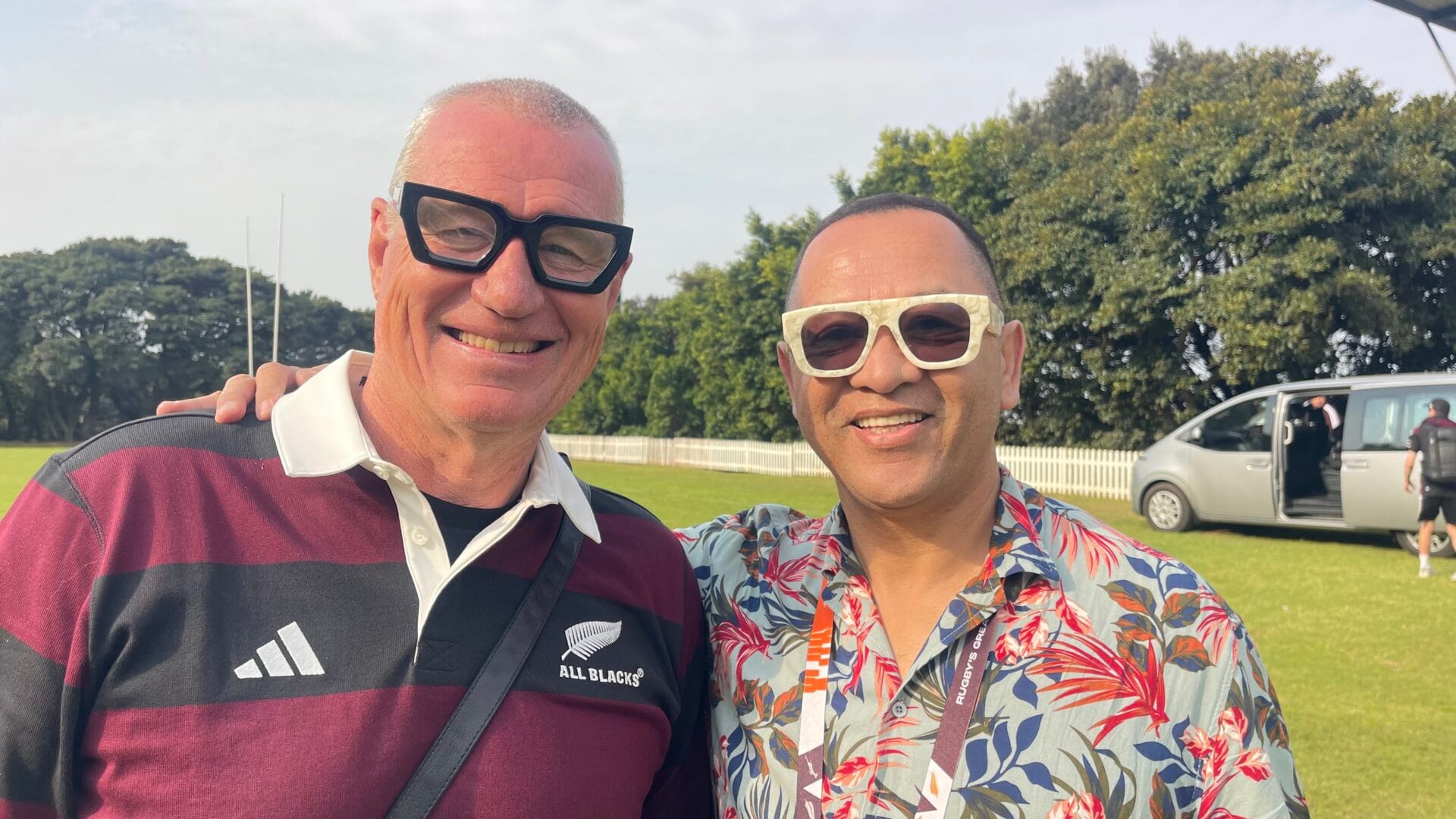
SA Rugby president Mark Alexander welcomed NZ Rugby president Erin Rush to Cape Town ahead of Saturday’s Test at DHL Stadium, highlighting the enduring relationship between two nations that have collectively won 70% of Rugby World Cups.

Erin Rush was elected first female president of NZ Rugby in 134 years. Photo: John Cowpland / action press

Rush, New Zealand Rugby’s first female president, has also brought a remarkable playing and broadcasting career into the governance arena.

Cape Town now prepares for another chapter in one of sport’s most enduring rivalries.

By Adnaan Mohamed

South Africa and New Zealand have spent more than a century throwing rugby thunderbolts at each other. On Wednesday morning, the latest chapter of that fierce sporting relationship began with handshakes, smiles and a shared flight into Cape Town.

South African Rugby president Mark Alexander welcomed his New Zealand counterpart Erin Rush at Cape Town International Airport ahead of Saturday’s second Rugby’s Greatest Rivalry Test between the Springboks and All Blacks at DHL Stadium.

The two presidents travelled together after witnessing New Zealand’s 33-16 victory over the Springboks at Ellis Park on Saturday. Their rugby roadshow continued at the same venue on Tuesday night, where the All Blacks edged the Lions 42-35 in a breathless spectacle featuring 11 tries.

Coach Dave Rennie’s side produced six tries, with Cash van Rooyen’s charges crossing five times. The thrilling contest crackled like a loose ball at a hotly contested breakdown, with the All Blacks eventually stealing victory in the final minute.

For Rush, South Africa’s welcome has been every bit as memorable as the rugby. After the All Blacks victory in the first Test, she expects the pressure and intensity of the rivalry to reach new heights for the rest of the series.

“It’s been amazing. There’s a lot at stake,” said Rush.

“Firstly, I want to say thank you to South Africa Rugby and the people of South Africa for their generous hospitality. Also for bringing such intense anticipation and a huge match-up on the field. It is so exciting and we’ve got so many of our supporters here who are enjoying it too.”

Her response came after Alexander pointed out the strong historical bond between New Zealand and South Africa.

“Yeah, thank you,” Rush replied.

Alexander then welcomed his New Zealand counterpart with the warmth of an old rugby handshake.

“We welcome Erin [Rush] and the All Blacks the old foe here in Cape Town. We’re great friends and always bring the best out of each other,” said Alexander.

“The one thing about rugby, it brings people together. And the two nations have got a long history, you know.”
Then came the statistic that gives this rivalry its heavyweight status.

“Between the two of us, we won 70% of the World Cups hosted to date. So, it is the greatest rivalry. And that’s why we’ve got the best two teams in the world competing in the next couple of weeks in South Africa.”

Rush arrives in the Mother City carrying a remarkable rugby story of her own. The 56-year-old became New Zealand Rugby’s first female president in May 2026, securing a two-year tenure after being elected by NZR’s affiliate members and succeeding former All Black Matthew Cooper.

Her rugby CV reads like a long-running Test match. Rush was Black Fern No. 113, making her international debut in 2003 at 33, only weeks after giving birth. She captained Wellington Pride, earned 100 caps for the province and played club rugby for Wellington FC.

Her pioneering streak began even earlier. In 1998, she co-commentated the first Black Ferns Test broadcast live on television during the World Cup final.

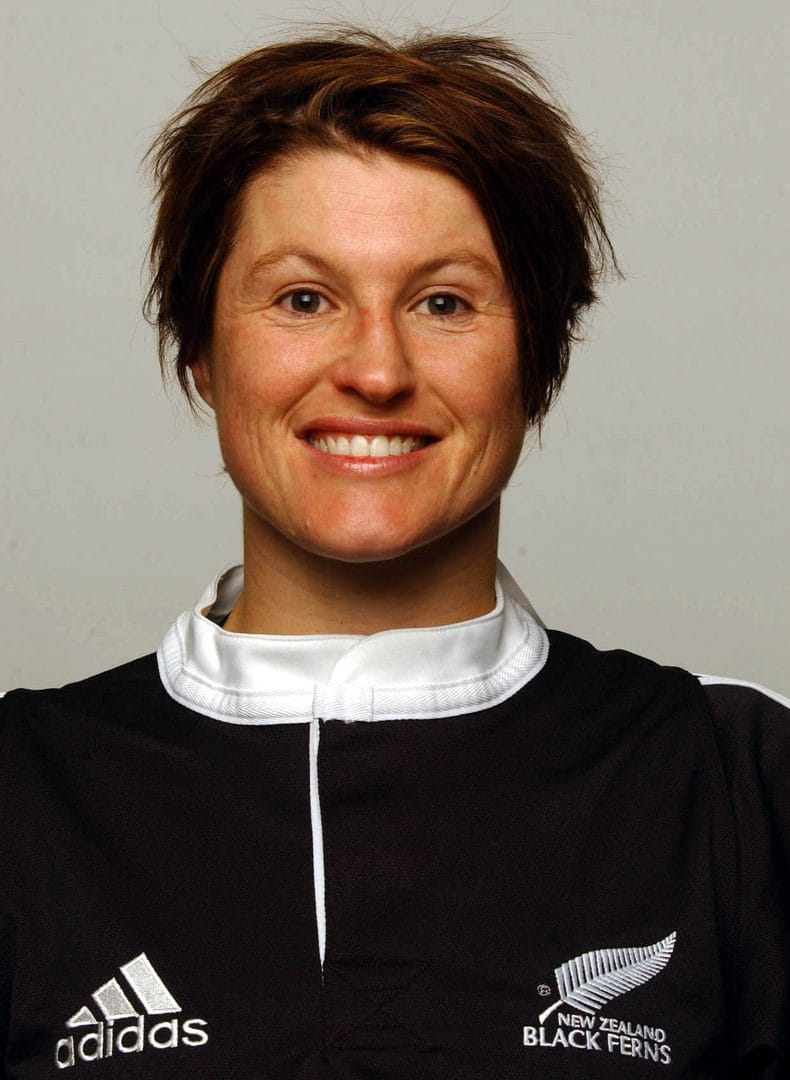
Black Fern #113 – Erin Rush Image Credit: AllBlacks.com

She served as NZR vice-president from 2024 to 2026 before taking the presidency. Her current role includes attending board meetings, travelling with national squads, welcoming international guests and presenting medals, with no board voting rights attached to the ambassadorial position.

Now, Cape Town becomes the next set piece in a rivalry that has shaped rugby’s folklore.

Saturday’s Test promises another heavyweight collision. Alexander and Rush have already shared the flight, the hospitality and the rugby spectacle. Come kick-off, friendship will have to make room for the fiercest handshake in world rugby.

The rivalry is ready to rumble

Springboks ready to turn Ellis Park into a rugby war zone

By Adnaan Mohamed

The stage is set. The old enemies are back. And the Springboks are ready to throw everything into the opening punch of the Rugby’s Greatest Rivalry.

When South Africa face New Zealand at 10bet Ellis Park on Saturday, it will be the first of four Tests between the heavyweight rivals in a series that promises enough drama to keep rugby fans glued to their screens.

Springbok assistant coach Mzwandile Stick knows exactly what is coming.

“Playing four games in one season against the All Blacks is always going to be a great challenge,” Stick said.

“These are moments that we live for. The closest thing to the Greatest Rivalry in terms of a series where every game counts is probably the British & Irish Lions series, or the knockout stages of the World Cup, and our mindset for these games will draw on those experiences.”

The Boks are under no illusion about the size of the challenge.

“We know it’s going to be a tough challenge. The All Blacks are in a good space and have been playing very well,” said Stick.

“But from our side, we also want to keep improving and evolving, and we will never be comfortable. It doesn’t get tougher than playing against the All Blacks four weeks in a row, and we are excited about it.”

That is fighting talk from a team preparing to enter a rugby pressure cooker.

Ellis Park brings the emotion

Captain Pieter-Steph du Toit, who will earn his 99th Test cap, is relishing the occasion.

“It’s a very different tournament,” he said. “To be involved in a series like this and have New Zealand play in South Africa, and also playing four games in a row is a massive honour and privilege.”

For Du Toit, Ellis Park carries memories bigger than rugby.

“It’s an awesome stadium for us and it’s close to my heart,” he said.

“When you stand there and sing the anthem and see the supporters behind the Springboks, it’s unbelievable. And of course, the 1995 Rugby World Cup was won there as well, so it’s a very special place for our country.”

Then comes the haka.

Du Toit says the Boks now have a deeper appreciation of what the ritual means to the All Blacks.

“I would never say we’d be relaxed, but it’s a massive honour to face the haka,” he said.

“We’ll face the haka with respect and we’ll accept the challenge.”

De Allende gets his flowers

Saturday will also belong to Damian de Allende, who becomes only the 10th Springbok to reach 100 Tests.

Stick believes the centre’s milestone deserves a standing ovation.

“For a guy like Damian de Allende, who has been with us through the ups and downs, and had to cope with a lot of people saying he wasn’t good enough to play for the Springboks, is amazing,” Stick said.

“He’s one of those guys who does the dirty work without anyone seeing it, so for him to play his 100th Test match is a great achievement for him and his family.”

Du Toit remembers watching De Allende during his Stormers days.

“I just saw this beast in the way he carried the ball and his work on defence,” he said.

“I have so much respect for him, the way he carries himself on and off the field, and how he’s grown as a person. It’s great to see people progress in life.”

Boks know where the battle will be won

Stick expects the All Blacks to bring serious heat at scrum and lineout time.

“We know New Zealand is going to bring it in terms of intensity,” he said.

“They’ll also look for gaps with their skilful players, so I’d say the key would be to stay alert and not get caught out.”

In other words, one defensive nap could become an All Blacks party.

The whistle blows at 17h10, with the match live on SuperSport. Limited tickets remain available.

Ellis Park is ready.

The rivalry is awake.

And the Boks are knocking on the door.

Teams

South Africa: 15 Damian Willemse, 14 Cheslin Kolbe, 13 Jesse Kriel, 12 Damian de Allende, 11 Kurt-Lee Arendse, 10 Sacha Feinberg-Mngomezulu, 9 Grant Williams, 8 Jasper Wiese, 7 Pieter-Steph du Toit (captain), 6 Paul de Villiers, 5 Ruan Nortje, 4 Eben Etzebeth, 3 Wilco Louw, 2 Malcolm Marx, 1 Ox Nche.
Replacements: 16 Jan-Hendrik Wessels, 17 Gerhard Steenekamp, 18 Zachary Porthen, 19 Cobus Wiese, 20 Andre Esterhuizen, 21 Marco van Staden, 22 Cobus Reinach, 23 Manie Libbok.

New Zealand: 15 Damian McKenzie, 14 Will Jordan, 13 Quinn Tupaea, 12 Jordie Barrett, 11 Josh Moorby, 10 Ruben Love, 9 Cam Roigard, 8 Ardie Savea (captain), 7 Luke Jacobson, 6 Tupou Vaa’i, 5 Fabian Holland, 4 Josh Lord, 3 Tyrel Lomax, 2 Codie Taylor, 1 Ethan de Groot.
Replacements: 16 Asafo Aumua, 17 George Bower, 18 Fletcher Newell, 19 Anton Segner, 20 Peter Lakai, 21 Kyle Preston, 22 Anton Lienert-Brown, 23 Leroy Carter.

Date: Saturday, August 22
Venue: 10bet Ellis Park, Johannesburg
Kick-off: 17.10 (Sunday, August 22)
Referee: Matthew Carley (England)
Assistant referees: Karl Dickson (England), Nika Amashukeli (Georgia)
TMO: Mike Adamson (Scotland)

Rassie Erasmus hits back at All Blacks slow-play claims

Adnaan Mohamed

The first Test of Rugby’s Greatest Rivalry Series has already produced its opening skirmish.

Springbok coach Rassie Erasmus has dismissed suggestions that South Africa deliberately slows the game at set pieces, insisting his team will stick to its systems when the All Blacks arrive at 10bet Ellis Park on Saturday.

“There are always three truths: New Zealand’s truth, the truth people believe, and our truth,” Erasmus said.

The comments come as the pre-Test needle begins to prick. New Zealand has promoted a high-intensity, multi-phase style, with suggestions that the Springboks could seek to disrupt that rhythm.

Erasmus is having none of it.

“In our last two games against New Zealand in Auckland and Wellington, people can go and look at those games and ask were we slowing those down. They beat us in Auckland, and we got a good result in Wellington.”

For Erasmus, Test rugby is not about satisfying outside narratives but more about surviving the furnace when pressure reaches boiling point.

“We believe there’s a certain way to win big games and we think it will be a grind.”

That grind could become the defining feature of Saturday’s opening act.

“When you’re under pressure and you attack, it’s tough to maintain cohesion,” Erasmus said. “We will try to find a balance when games are really tight, but we have a system to fall back on that protects the players.”

Tony Brown’s influence has also helped shape the Boks’ attacking approach.

“Since Tony Brown, former All Black flyhalf and current Springbok assistant coach, has been with us, we feel as though we’ve been on the right track.”

SA Rugby laws advisor Jaco Peyper then entered the fray, offering a technical explanation of the much-discussed 30-second set-piece law.

“The law is very clear. From the moment the referee puts his foot down to mark the spot, not from the whistle, there is 30 seconds to form a lineout or scrum.”

Peyper said teams could manage the moments before the mark is made within the laws, while opponents who are ready to play can apply pressure.

“There’s nothing in the law that says you can’t idle before the mark is given.”

He also pointed out that teams can disrupt tempo through repeated infringements at breakdowns and mauls.

The whistle, in other words, could become a metronome for a Test where every second matters.

Peyper has full confidence in the officials appointed for the four-Test series, particularly England’s Matthew Carley, who will referee Saturday’s opener.

“You’re going to have a firm referee. Someone who deals decisively at the breakdown and is very strong on anything negative or cynical. And he does not get influenced by the home crowd.”

That could be music to the ears of both coaching boxes.

Erasmus expects the All Blacks to bring a blue-chip attacking blueprint to Johannesburg.

“You can see it on social media. They’re advocating a high intensity, running game, with multi-phase attacks. And when you analyse it, it definitely shows in the stats.”

Dave Rennie, who Erasmus previously faced during his Munster days, adds another tactical layer to the contest.

“The big battle is going to be when they have the ball, they’ll have total control of what they do with it, and when we have the ball, we’ll have total control of what we do with it.”

The biggest concern for Erasmus is the All Blacks’ breakdown work.

“What concerns us most is how physical and brutal they are at the breakdown. They take the ball through so many phases and then they put in a well-timed grubber kick. Their attacking kicks are as dangerous as when they have ball-in-hand.”

Away from the tactical chessboard, Erasmus admitted the Springboks are embracing the occasion.

“We all appreciate and respect what this series means,” he said.

“I’d love it if the people at Ellis Park create the same atmosphere as that which the people did in Cape Town. The haka was heard 100%, which makes it something special.”

The Springbok coach also knows the All Blacks remain capable of delivering a sting.

“We know how good the All Blacks are. Since 2018, when they were leading the world, we’ve always wondered when they’re going to beat us again, and they will beat us again in future, but hopefully not this weekend.”

Erasmus will name his team on Thursday, with captain Siya Kolisi and prop Ox Nche the only injury concerns.

“The only two doubtful players are Siya and Ox, who are coming along well,” he said. “I wouldn’t say either is confirmed out, but if they get through training today it could go either way. Apart from those two, everybody else is available.”

The All Blacks are also expected to unveil a few tactical surprises.

“They’ll have plans they didn’t show in the Nations Championship, little things, such as lineout variations, maybe a front peel or back peel move, and there are things that have caught us out before.”

The stage is set.

The talking has started.

Now Ellis Park gets the final word.

South Africa face New Zealand at 17h10 on Saturday, with the match live on SuperSport.

The Chef’s final recipe: Yaqeen Ahmed stirs belief as Junior Boks prepare for France

By Adnaan Mohamed

Great flyhalves rarely force a contest. They read it, season it and serve it at precisely the right moment. Junior Springbok flyhalf Yaqeen Ahmed has spent the World Rugby Under-20 Championship doing exactly that. Better known as “The Chef” since his schooldays at Wynberg Boys’ High School, the 19-year-old Stormers playmaker earned the nickname for his knack for serving up moments that leave defences looking undercooked.

On Saturday evening in Tbilisi, Ahmed hopes the final dish on South Africa’s menu will be a successful title defence against France.

Yet, if the gifted flyhalf has learnt anything during this campaign, it is that no memorable meal is prepared by one person alone.

“Our coaching staff and medical team have been awesome in preparing us, not only for this match, but for the entire time that we’ve been together,” Ahmed said.

“They make it a really good environment for us, and all the boys are so focused and disciplined in their preparation and recovery.”

Ahmed’s words offer an insight into what has become the defining ingredient of this Junior Springbok side. Talent has carried them to a World Rugby Under-20 Championship final, though collective purpose has kept them there. Every training session, recovery block and technical meeting has strengthened a culture where contribution matters more than individual acclaim.

“It is really a team effort every day that we spend together. Those who are not in the team help the coaches prepare the guys who are playing.

“We motivate and push each other, and we keep learning and improving with each session, whether that’s a training session or a technical meeting.”

For a flyhalf often recognised for calm decision-making and clinical execution, Ahmed’s focus remains strikingly simple. The tournament has been distilled into one final challenge.

“We have 80 minutes left of this campaign, and we will give it our absolute best. Personally, I’m very grateful to be here as part of this group representing our country and the Junior Boks.”

Captain Siphosethu Mnebele, preparing for his second World Rugby Under-20 Championship, echoed head coach Kevin Foote’s insistence that the occasion itself has never become the team’s focus.

Junior Springbok captain Siphosethu Mnebele and his French counterpart, Lucas Andjisseramatchi, will face off in the JWC final Photo: SA Rugby

“We are well prepared for the final match, and we are all excited to represent South Africa in the final,” said the dynamic hooker.

“This is a new group, essentially, and our focus is only on the game and nothing else.

“Our focus is to be ready to take on a very good French side who have demonstrated their abilities by reaching the final.”

The final will carry an emotional weight beyond the pursuit of another world title.

The Junior Springboks will wear black armbands in memory of former South African Under-18 prop Luqobo Makwedini, who died on 10 July after collapsing at the end of a training session with his French club, AS Béziers Hérault.

If Ahmed is indeed The Chef, Saturday’s final will demand more than creative flair. France will bring physicality, pace and tactical precision. South Africa’s response will require composure under pressure, disciplined execution and unwavering trust in the collective.

Championships are seldom won through a single flash of brilliance. They are assembled piece by piece, like a carefully prepared meal where every ingredient serves a purpose. The Junior Springboks have spent weeks refining their recipe. Now comes the final tasting.

Eighty minutes remain to discover whether Ahmed and his teammates have cooked up another world title.

France U20: 15 Axel Guillaud, 14 Paul Zwiler, 13 Adrien Drault, 12 Bastien Rasal, 11 Melvyn Rates, 10 Luka Keletaona, 9 Baptiste Tilloles, 8 Elyjah Ibsaiene, 7 Lucas Andjisseramatchi (captain), 6 Raphael Audebert, 5 Romeo Bonnard Martin, 4 Baptiste Veschambre, 3 Alexandre Langlois, 2 Gabin Garault, 1 Matheo Frisach.
Replacements: 16 Elia Masi, 17 Edouard Jabea Njocke, 18 Mael Turpin, 19 Leo Michaux, 20 Bobby Bissu, 21 Valentin Hutteau, 22 Diego Jurd, 23 Hugo Avogardo.

South Africa U20: 15 Alzeadon Felix, 14 Cheswill Jooste, 13 Markus Muller, 12 Ethan Adams, 11 Khuthadzo Rasivhaga, 10 Yaqeen Ahmed, 9 Hendré Schoeman, 8 Wasi Vyambwera, 7 Luke Cannon, 6 Risima Khosa, 5 JD Hattingh, 4 Heinrich Theron, 3 Danie Kruger, 2 Siphosethu Mnebelele (captain), 1 Oliver Reid.
Replacements: 16 Liam van Wyk, 17 Rambo Kubheka, 18 Luan van der Berg, 19 Jaythen Orange, 20 Thomas Beling, 21 Gert Kemp, 22 Jayden Brits, 23 Samuel Badenhorst.

Referee: Reuben Keane (Australia)
Assistant referees: George Selwood (England), Gonzalo de Achaval (Argentina)
TMO: Paulo Duarte (Portugal)

Can England finally crack the Springboks code?

By Adnaan Mohamed

England have been here before. Close enough to see victory. Close enough to believe. Close enough to feel the Springboks wobble.

Then South Africa find another gear.

It has become a familiar script in one of rugby’s richest rivalries. England ask difficult questions, the Springboks absorb the pressure and somehow emerge with the answer that matters most.

Saturday’s opening Nations Championship Test at Ellis Park offers Steve Borthwick’s side another opportunity to prove they have bridged that stubborn gap. They could hardly have picked a sterner examination.

Johannesburg does not welcome visitors with open arms. The altitude drains lungs, the crowd feeds every collision and the Springboks have turned Ellis Park into one of world rugby’s least hospitable addresses.

Rassie Erasmus’ side arrive riding a nine-match winning streak and carrying the confidence of back-to-back Rugby Championship titles. Momentum has become their travelling companion and complacency remains unwelcome.

“The goal is to win,” Erasmus said this week.

Simple words. Typical Springboks.

His selection reflects a squad built for every occasion. Damian Willemse and Cheslin Kolbe celebrate their 50th Tests in a backline packed with proven match winners. Jesse Kriel and Damian de Allende remain one of international rugby’s most reliable midfield pairings, while Manie Libbok gets another chance to orchestrate an attack that can shift from controlled to chaotic in a heartbeat.

Up front, the Springboks possess enough muscle to move mountains.

Ox Nche, Malcolm Marx and Thomas du Toit anchor a front row that thrives on confrontation, with Eben Etzebeth, Siya Kolisi and Jasper Wiese providing the relentless edge that has become South Africa’s trademark.

Then comes the Bomb Squad.

Fresh legs. Fresh power. Fresh problems.

England know exactly what awaits.

George Martin has welcomed the physical battle after returning from injury, while Fin Smith shoulders the responsibility of steering England around one of rugby’s toughest venues. Immanuel Feyi-Waboso’s return offers genuine attacking spark, Tommy Freeman arrives in outstanding form and Henry Pollock is expected to inject his trademark energy from the bench after already making himself public enemy number one among many South African supporters.

Borthwick believes his squad is ready.

“Playing South Africa at Ellis Park is one of the great Tests in world rugby,” he said.

He is right.

England have enough quality to ask questions of the world champions. Their backline carries pace, their forwards have embraced the challenge and their confidence has steadily grown despite an underwhelming Six Nations campaign.

The problem is that Ellis Park rarely rewards promise.

The Springboks know exactly how they want to play. Dominate the set piece. Win the gain line. Squeeze territory. Turn pressure into points.

It is an approach forged through experience and sharpened by success.

England may remain within touching distance for long stretches, much like they have in recent meetings. History suggests that when the contest reaches its defining moments, South Africa usually discover another level.

Prediction: Springboks by 12.

Teams:

South Africa: 15 Damian Willemse, 14 Cheslin Kolbe, 13 Jesse Kriel, 12 Damian De Allende, 11 Kurt-Lee Arendse, 10 Manie Libbok, 9 Grant Williams, 8 Jasper Wiese, 7 Pieter-Steph Du Toit, 6 Siya Kolisi (captain), 5 Ruan Nortje, 4 Eben Etzebeth, 3 Thomas Du Toit, 2 Malcolm Marx, 1 Ox Nche.
Replacements: 16 Jan-Hendrik Wessels, 17 Gerhard Steenekamp, 18 Zachary Porthen, 19 Marco van Staden, 20 Cameron Hanekom, 21 Cobus Reinach, 22 Andre Esterhuizen, 23 Canan Moodie.

England: 15 George Furbank, 14 Immanuel Feyi-Waboso, 13 Tommy Freeman, 12 Seb Atkinson, 11 Cadan Murley, 10 Fin Smith, 9 Jack van Poortvliet, 8 Ben Earl, 7 Tom Curry, 6 Ollie Chessum, 5 George Martin, 4 Alex Coles, 3 Joe Heyes, 2 Jamie George (captain), 1 Ellis Genge.
Replacements: 16 Luke Cowan-Dickie,17 Beno Obano, 18 Asher Opoku-Fordjour, 19 Charlie Ewels, 20 Guy Pepper, 21 Henry Pollock, 22 Alex Mitchell, 23 Marcus Smith.

Date: Saturday, July 4
Venue: Ellis Park, Johannesburg
Kick-off: 17.40
Referee: James Doleman (New Zealand)
Assistant referees: Andrew Brace (Ireland) & Pierre Brousset (France)
TMO: Richard Kelly (New Zealand)

Images: x.com/Springboks

Dr Insaaf Levy set to make Springbok Women history

By Adnaan Mohamed

In the narrow cobbled lanes of Dorp Street in Bo-Kaap, rugby flows through the neighbourhood like the south-easter whipping around Table Mountain. On Saturdays, the streets empty. Families gather around televisions or pack into club grounds. The game lives in the rhythm of the community.

Now one of its daughters is carrying that heartbeat onto the international stage.

Insaaf Levy is preparing to become the first qualified medical doctor to represent the senior Springbok Women side at the Rugby Africa Women’s Cup in Nairobi.

Insaaf Levy when she is not on the rugby field Image: Instagram

At 23, Levy already moves through life with the composure of a seasoned scrumhalf guiding forwards around the park. In March, she completed her medical degree at the University of Cape Town while continuing to sharpen her craft for DHL Western Province Women.

Balancing medicine and elite rugby is like trying to defend a five-metre scrum with one shoulder. The physical and mental demands rarely leave space to breathe. Yet Levy navigated both worlds with the precision of a long spiral pass fired into the chest of a charging runner.

Her rise to the national squad under head coach Swys de Bruin feels significant far beyond rugby.

Insaaf Levy in action on the rugby field Image: Instagram

This is a story stitched together by family, community and relentless repetition.

Levy grew up in one of Cape Town’s richest rugby bloodlines. Her father, Labeeb Levy, is a respected Stormers skills coach and current Stormers XXIII head coach. Her maternal grandfather, the late Sedick Sieed, remains a revered figure in Cape rugby circles from the Saru era.

Inside the Levy household, rugby conversations arrive as naturally as dinner.

“We always talking about rugby in our household,” Levy said.

“My dad would go from a normal conversation about literally anything else. He would think about something he saw and then the conversation just switches.”

That constant education shaped her rugby intelligence long before provincial colours arrived.

At seven years old, Levy began playing touch rugby and quickly emerged as one of the country’s brightest talents. She represented South Africa at the Youth Touch World Cup in Malaysia in 2018 and later featured at senior Touch World Cups in Malaysia and England. Her sporting versatility stretched further into netball, where she represented the Western Province U21 side while studying medicine.

Every layer of that journey helped fashion the calm, instinctive scrumhalf now standing on the edge of Springbok selection.

“As a scrumhalf, passing has been my main focus since I was younger,” Levy explained.

“My dad would say come after supper you have to pass 500 balls left and right, then you can go do what you want.”

Those repetitions became the bricks of her game. Her passing now zips across the field like a ball skimming off wet turf under floodlights.

Levy studies the craft obsessively. She admires Antoine Dupont and Aaron Smith for their control of tempo and tactical awareness, while drawing local inspiration from Felicia Jacobs.

Yet rugby in Bo-Kaap is never an individual story.

Haashim Pead and Insaaf levy firing passes on a tennis court in Bo-Kaap as children

The same streets that nurtured Levy also shaped rising Junior Springbok scrumhalf Haashim Pead. Video clips of the pair as children firing passes on a tennis court now feel like snapshots of a community producing talent with assembly-line consistency.

The rugby roots run even deeper through her younger sister, Nuha Levy, a gifted flyhalf already excelling for South Africa Women U18 and DHL Western Province Women U20. Earlier this month, Nuha steered WP to the national U20 Women’s Week title in Alberton.

Together, the sisters carry the tantalising possibility of one day becoming a Springbok halfback pairing forged in Bo-Kaap’s rugby furnace.

Nuha and her sister Insaaf Levy could one day play together for the Springbok Women Image: Instagram

For Levy, however, identity stretches beyond sport.

She speaks proudly about her late grandfathers, Sedick Sieed and Tahir Levy, whose influence grounded her in service and humility.

“Papa [Tahir Levy] selflessly dedicated his entire life to serve his community as an activist and social worker,” she said.

That spirit of service now shapes both halves of her life.

“Studying medicine while playing rugby was tough to manage,” Levy admitted.

“Now that I am qualified and working, I am looking forward to not only serving the ball from the base of a scrum but also being of service to my community as a doctor.”

Swys de Bruin, head coach of the Springbok Women Image: SA Rugby

De Bruin believes those qualities elevate her value within the squad.

“Insaaf earned this opportunity through consistency, game understanding and work ethic,” he said.

“She reads space very well; she has a calm temperament under pressure and her decision-making around the breakdown impressed us throughout the season.”

South Africa’s Rugby Africa Women’s Cup campaign against Madagascar, Uganda and Kenya is another building block ahead of a demanding international season that includes Tests against the USA and the Black Ferns.

Among the new faces in green and gold, Levy’s story carries special resonance.

Not because she is a doctor.

Not because she comes from rugby royalty.

Her journey matters because it expands what young girls in South African rugby can imagine for themselves.

Dr Insaaf Levy at work as a doctor Image: Instagram

Like a scrumhalf spotting daylight around a crowded ruck, Dr Insaaf Levy has carved a lane entirely her own.

And from the colourful streets of Bo-Kaap to the bright lights of Nairobi, South African rugby is preparing to watch history arrive at pace.

Springbok Women fixtures

  • 23 May: South Africa vs Madagascar
  • 27 May: South Africa vs Uganda
  • 31 May: South Africa vs Kenya

All matches take place at the RFUEA Sports Grounds in Nairobi.

The match against Madagscar on Saturday starts at 13h00 SA time on Saturday and will be broadcast live on Rugbypass.