

Eben Etzebeth Red-Card Fury Overshadows Bok Brilliance in Cardiff Rout

By Adnaan Mohamed

The Springboks’ 73–0 evisceration of Wales in Cardiff should have been remembered purely as a victory of ruthless precision, a night when Rassie Erasmus’ men turned the Principality Stadium into a eleven-try scrapyard.

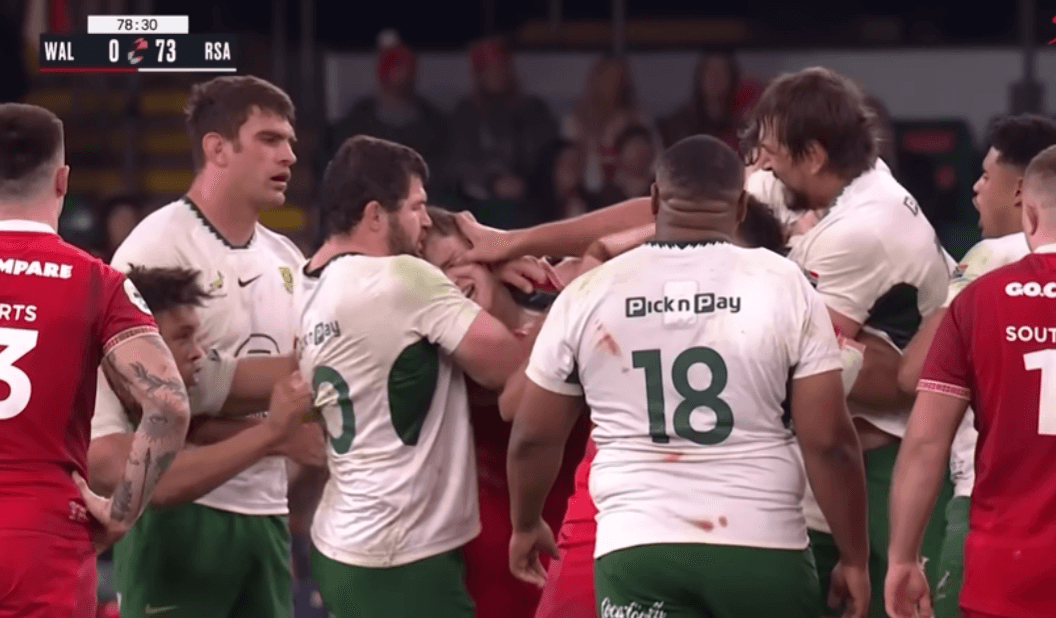
Instead, the Test has been plunged into global debate after Eben Etzebeth, the most-capped Springbok in history, was shown a red card for alleged eye-gouging. This incident that happened just before the final whistle to mercifully end the Welsh carnage, has dominated headlines from Cape Town to Cardiff.

While the Boks celebrated an unbeaten season and a flawless November tour, the image of Etzebeth leaving the field cast a long, uncomfortable shadow. Critics, former internationals, fans and pundits have fired up social platforms, arguing everything from “stone-cold red” to “unintentional and harsh.”

The timing was especially jarring: a night designed to honour Springbok milestones became a night consumed by disciplinary outrage.

Coach Rassie Erasmus did not try to sugar-coat it.

“It didn’t look good, and I thought it was a justified red card,” he admitted.

A rare moment where Erasmus openly conceded a fault on an evening when everything else went right.

Reinach Reaches 50: A Milestone Deserving More Light

Lost beneath the Etzebeth storm was a story that deserved to headline the night: Cobus Reinach finally reaching his 50th Test, a feat 11 years in the making.

The 35-year-old Bok scrumhalf, who buzzed around the breakdown like a hornet with a fresh battery pack, called the honour a dream fulfilled.

“It’s always special just to put on the Springbok jersey… If it’s cap one or cap 140 like Eben, it’s special.

But playing my 50th Test was definitely great,” he said.

“It’s every boy’s dream to play for the Springboks and having done that 50 times is unreal. It’s a privilege and something I’ll always be thankful for.”

That this milestone arrived during a historic win, and in a season where the Boks finished world No.1, made it sweeter.

“It wasn’t just about the end-of-year tour. It was about the whole season,” Reinach reflected.
“We learned and adapted more than previously, and I think we grew immensely as a team.”

The veteran scrumhalf, still as sharp as a new studs-on-soft-ground boot, even dared to dream further.

“I definitely want to play another one or maybe two World Cups,” he smiled.

“I feel good… it’s just my hairline moving back a little, and my beard getting thicker.”

His gratitude extended to the beating heart of Bok rugby: the supporters.

“From London to Wales, France, Ireland… thank you. We are one. We can’t do what we do without you.”

A Night of Dual Narratives: Dominance and Disruption

The Etzebeth incident ignited a worldwide rugby firestorm precisely because the Test was so lopsided. At 73–0, the Springboks were in full command. The back-to-back World Champions were ruthless, clinical, and controlled, suffocating Wales like a python tightening with every carry.

But the red card, shown late in the second half, shifted the conversation from dominance to controversy. Analysts have already begun dissecting angles, freeze-frames and intent, with disciplinary hearings expected to become the next battleground.

Yet, amid the noise, Reinach’s golden milestone, the Boks’ unbeaten tour, and their world No.1 finish remain significant markers of a team still evolving and still hungry. Reinach himself summed it up best:

“The way we work for each other and how tight-knit we are is special. If we keep that, there’s a lot more in the tank.”

Reinach’s Golden Milestone and Rassie’s Clever End-of-Year Chess Move

By Adnaan Mohamed

There’s a reason the Springboks never really feel “under-strength” even when half the squad is scattered across Europe, Japan and club rugby obligations. South Africa, more than any other rugby nation, has turned adversity into opportunity, disruption into design. And this week in Cardiff, as the Boks close out their season against Wales, that philosophy takes centre stage.

Saturday marks more than just the end of the Outgoing Tour. It marks a moment of quiet, powerful significance in a year defined by rotation, regeneration, and ruthless forward-thinking.

Because while the headlines will rightly celebrate Cobus Reinach’s 50th Test, the deeper story is how Rassie Erasmus is using this final match of the year to subtly tighten the screws on South Africa’s long-term blueprint.

Let’s dive in.

1. Reinach at 50: A Triumph of Perseverance Over Spotlight

At 35, Cobus Reinach reaching his milestone half-century is a testament to patience in an era obsessed with instant stardom.

He’s never been the loudest, the flashiest, nor the headline-grabber. Instead, he has been the Springbok who always arrives when needed, slips into the system seamlessly, and changes the tempo with a veteran’s calm.

Rassie’s admiration was heartfelt:

“Cobus is a true team man… he’s grabbed every opportunity with both hands.”

There’s something beautifully poetic about Reinach not starting on the day he reaches 50 caps, but sitting quietly on the bench.

He will be the lone backline reserve among seven hulking forwards. It captures his role perfectly: the dependable firefighter, trusted when the match burns hottest.

This is not just a milestone. It is a tribute.

2. The Selection Puzzle: Rassie Turns Limitations Into Leverage

Test matches outside the international window are usually a nightmare for southern hemisphere coaches. Erasmus lost a dozen frontline stars to club commitments – Handre Pollard, Malcolm Marx, Cheslin Kolbe, Jesse Kriel, and Pieter-Steph du Toit among them. Many coaches would be forced into damage control.

Rassie?
He sees a laboratory.

This is where South African rugby’s conveyor belt gets tested in fire. 49 players have earned Test caps this year alone. It’s a staggering number, but one rooted in planning, not panic.

“We’ve been rotating players all year… many of these combinations are fully settled.”

There is no “second-string Springboks.”

There are only Springboks in different phases of readiness.

3. The 7–1 Split Isn’t a Gamble – It’s a Statement

The rugby world still blinks when seeing a team sheet with seven forwards on the bench. But to the Boks, it’s as natural as breathing.

This week’s 7–1 split is partly forced by availability, but it also reinforces the core of South African Test identity: win the collisions, control the set piece, choke the opponents’ oxygen.

Wales, even in a rebuilding phase, are happiest in the trenches. A weaker team would try to outplay them.
South Africa plan to outmuscle them.

Rassie explained it plainly:

“Our pack has performed incredibly well… and we believe it will be a key area of the match.”

This is Rassie’s selection strategy.

4. Quiet Evolution: The Next Generation of Boks Steps Forward

Gerhard Steenekamp, Johan Grobbelaar, Zachary Porthen, Asenathi Ntlabakanye are not household names yet, but they are seen as the building blocks of South Africa’s post-2027 pack.

Steenekamp starting his first Test is no coincidence. The Boks’ current front-row titans will not be around forever. Rassie is not waiting until 2026 to find their successors.

Erasmus is making changes early, deliberately, and unapologetically.

This Wales Test is seen as an investment.

5. The Bigger Picture: Wales, Rankings and the RWC Draw

Wales arrive with their own headaches and absentees, but they’re dangerous precisely because of it. Young players with everything to prove, veterans trying to hold onto jerseys, and a home crowd hungry for a scalp.

And then there’s the looming Rugby World Cup draw next week.

For both teams, the rankings matter. Momentum matters. Perception matters.

Rassie expects an ambush:

“They’ll come out firing… they’ll give everything to finish on a high note.”

This will not be a polite end-of-year handshake.
It’s a cage fight with diplomatic flags.

6. What This Match Really Represents

This final Test of 2025 can arguably be seen as a microcosm of South African rugby philosophy:

  • Celebrate the unsung (Reinach).
  • Trust the young (Steenekamp, Ntlabakanye, Porthen).
  • Prepare for the future early (49 players used).
  • Double down on identity (the 7–1 split).
  • Stay unpredictable (mixing stalwarts with debutants).
  • Never fear disruption – weaponise it.

If the Boks win, they end the year with a statement.
If they lose, they still walk away with priceless data.

Either way, South Africa wins something.

On Saturday night, as Reinach steps onto the field for the 50th time, he’ll do so as the embodiment of everything this Bok season has stood for: quiet excellence, depth, resilience and relentless preparation for the future.

South Africa are building towards 2027. And Reinach’s milestone, achieved with humility, hunger and heart. It reminds us what really powers the Springbok machine: people who show up, again and again, long after the spotlight has moved on.

Springbok Front-Row Boost for Tour Finale

By Adnaan Mohamed

The Springboks have bolstered their touring front row with the arrival of seasoned hooker Bongi Mbonambi and powerful prop Ntuthuko Mchunu, who will link up with the squad in Ireland on Sunday as Rassie Erasmus sharpens his blades for the final two Tests of the Outgoing Tour.

Mbonambi, a trusted warhorse from the Rugby Championship trenches, was on Erasmus’ standby list, while Mchunu last donned the green and gold against Portugal in Bloemfontein, but both now thunder back into the Bok scrum as reinforcements ahead of battles with Ireland and Wales.

“This is a longer tour than usual, and we have two big matches lined up against Ireland and Wales, which prompted the decision to call up Bongi and Ntuthuko,” said Erasmus.

“Both players have done the job for us on the international stage, so we are excited to have them in the group.

“Several players will not be eligible for selection for the final Test on tour against Wales, as the match falls outside of the international window, so it makes sense to call up the players now to get back into the swing of things with us at training this week, while at the same time increasing the depth we have within the squad for our next challenge against Ireland.”

The Springboks will shift camp from Italy to Dublin on Sunday, where preparations begin in earnest on Monday. With reinforcements ready and the tour’s heaviest collisions still to come, the Bok machine is tightening its bolts for an Irish onslaught that promises to be as unforgiving as winter steel.

Source: SA Rugby

Rassie’s Springboks Gears Up for Gruelling Northern Tour

By Adnaan Mohamed

Springbok coach Rassie Erasmus jetted off to London on Sunday, bracing for a five-week European tour that promises to test every sinew and synapse of the world champions.

The full squad will regroup in the UK on Monday morning, ready to tackle a sequence of five Test matches that reads like a gauntlet of rugby heavyweights.

The Boks kick off their campaign against Japan at Wembley Stadium on 1 November, before locking horns with France in Paris, Italy in Turin, Ireland in Dublin, and Wales in Cardiff. Each encounter will present a fresh challenge in vastly different conditions.

Erasmus, ever the strategist, knows that touring Europe in November is no spring picnic. It’s more like a muddy, cold-weather arm wrestle, where slick southern flair must survive in the trenches.

“We are excited about the tour and to measure ourselves against some of the best teams in the world,” he said before departure.

“A lot of hard work has been put in behind the scenes since the Rugby Championship, and hopefully this will set us in good standing to build on our season so far.”

The Bok mentor is acutely aware of the curveballs awaiting his squad. This includes the heavy air, damp pitches, and bruising opposition. But he believes his players are well-prepared for the north’s wintry grind.

“The conditions are vastly different in the UK and Europe to South Africa this time of the year,” Erasmus noted.

“But fortunately, most of the players have been exposed to those conditions either during their United Rugby Championship tours or by playing for overseas clubs.

“The time zone is also very similar to South Africa, which means we can slot back into full Test mode immediately from our first training session on Monday.”

If the schedule looks daunting on paper, Erasmus embraces it like a seasoned flanker facing down a charging number eight.

He knows the mental battle will be just as fierce as the physical one. It’s been 10 years since Japan caused one of the biggests upsets in the rugby world when the Brave Blossoms beat the Springboks at the Rugby World Cup in Brighton in England in 2015.

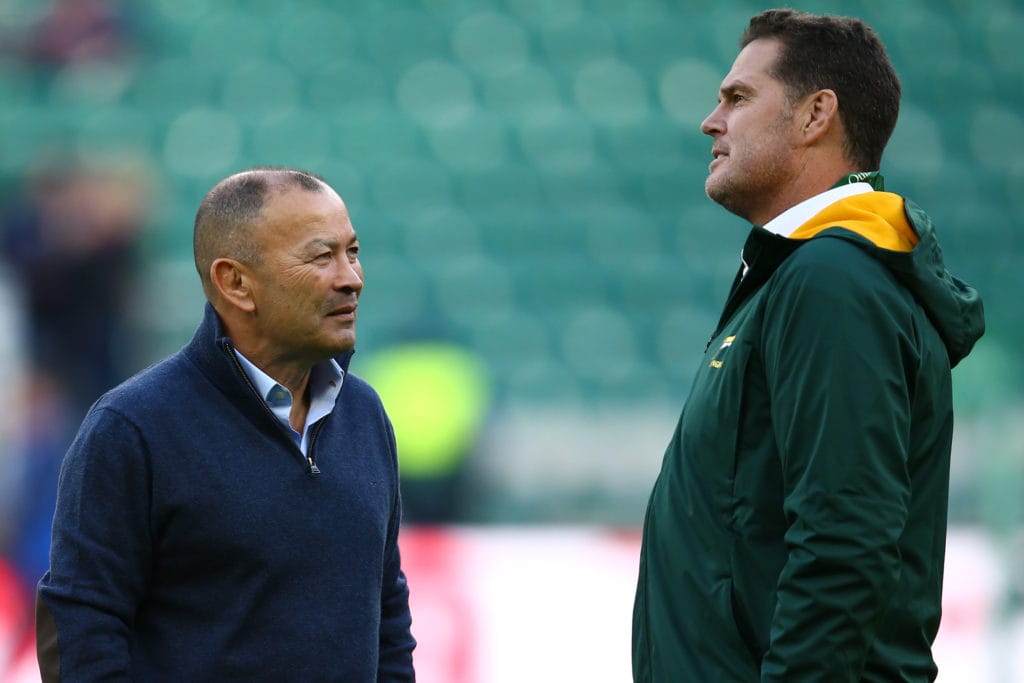
Coaches, Eddie Jones (Japan) and Rassie Erasmus (South Africa), will be going head-to-head at Wembley Stadium. Photo: Steve Haag/Gallo Images

“Japan have been improving steadily over the last few years, and they defeated us a few years ago, so we have no doubt they will come out guns blazing next Saturday and throw everything at us,” he said.

France and Ireland, both top-four sides, loom as potential tour-defining tests.

“The last time we faced France in Paris was in the Rugby World Cup quarter-final, and that result will psyche them up going into the match against them,” said Erasmus.

“They are also ranked fourth in the world currently, and Ireland third, and we all know how tough matches at the Aviva Stadium are against them.”

He also expects spirited resistance from Italy and Wales. These two teams have plenty to prove on home turf.

“Italy put up a brave fight against us in Pretoria, and that will give them confidence going into our match in Turin. Wales will also be up for the challenge after recovering from a tough few years earlier this season, so we need to be ready mentally and physically each week to get the desired results.”

For Erasmus, the tour is a measure of mettle, a proving ground for depth, discipline, and determination.

“It won’t be easy,” he concluded, “but we have a quality group of players, and we know what they are capable of doing when we stick to our structures and play to our potential on the day.”