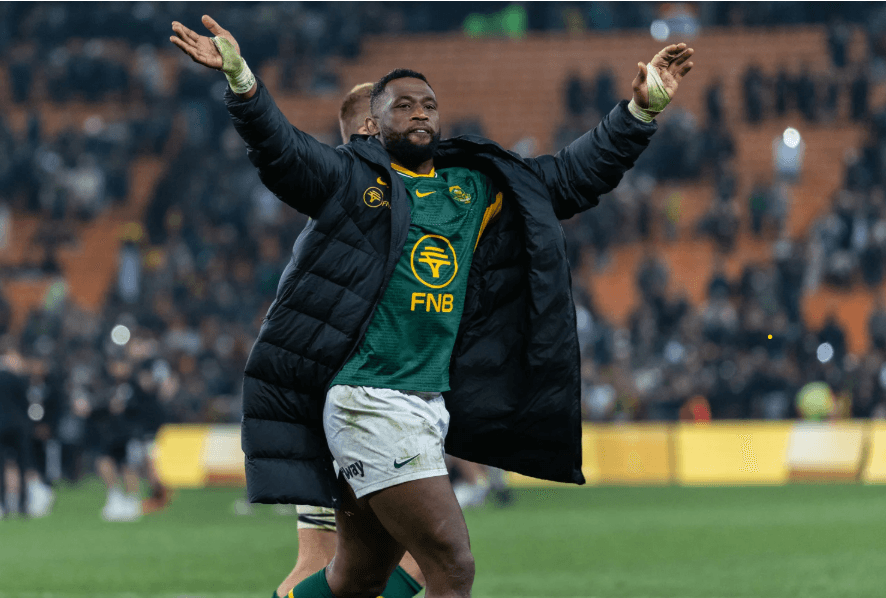
The quiet power of Siya Kolisi’s 55

By Adnaan Mohamed at the FNB Stadium in Soweto

Siya Kolisi has never been particularly interested in making himself the story. On the night he became the most successful captain in Springboks history, that instinct was as powerful as ever.

The scoreboard at FNB Stadium said South Africa 29, New Zealand 24. The series said Springboks 2, All Blacks 1. The record books said something rather more extraordinary: 55 Test victories as captain, one more than the 54 accumulated by John Smit.

For most athletes, that would be the moment to pause, puff out the chest and allow history a little room to breathe.

Kolisi, characteristically, handed the oxygen to everyone else.

“If this were tennis it would be different, but this is a team sport. It shows the work Rassie [Erasmus] and his coaching staff put in,” the 35-year-old told Modern Athlete after the match.

“We’ve got so many leaders in this side that I really only have one job to do, which is focus on my own game.”

There is something almost disarming about the understatement.

Fifty-five victories as Springboks captain is not merely a statistic. It is a towering monument built across years of upheaval, triumph, scrutiny and expectation. It stretches beyond the rugby field into the improbable story of a boy from Zwide who became the face of a nation’s most recognisable sporting institution.

Yet Kolisi speaks about it as though he has merely completed another assignment.

That is perhaps the paradox of his leadership. His influence is enormous precisely because he rarely behaves as though it is.

The record came on a night when FNB Stadium became more than a rugby ground. Almost 88,000 people filled the Calabash for a match carrying the historical weight of Soweto and the emotional currency of a nation.

Kolisi understood the symbolism.

“It was really special. We always say we won’t just say thank you in words, but through our effort. We were tested in that first 25 minutes, they came out firing, and we had to dig deep to fight our way back into it.”

Then came the image that stayed with him: children running alongside the Springbok team bus, hoping for a glimpse of their heroes despite being unable to afford tickets.

“They can’t afford to come and watch us play, but seeing that, and understanding the history of this place, the young people who fought so that we could be sitting here today, that’s why we wanted this game here,” Kolisi said.

“That’s what we play for, not just the people who can afford it, but everyone.”

It is difficult to imagine a more revealing explanation of his captaincy.

The 55 wins belong to Kolisi. The meaning he attaches to them belongs to something larger.

Even the victory itself did not escape his scrutiny.

“I thought we played better in the first Test [at Ellis Park], we just didn’t convert our chances,” he said.

“There’s still so much more we can do. Our defence in particular can get better.”

His answer carried the familiar Kolisi mixture of humility and hunger. No grand declaration. No coronation. No invitation for the rugby gods to start carving his statue.

Only work.

“The way the coaches rotate the team and give other guys opportunities keeps everyone hungry. If you don’t get picked this week, you know your chance is coming. It also keeps us fresh so we’re not overplayed. It’s a group effort, and I’m really happy about that.”

And so, after 55 wins, the captain looks ahead rather than back.

“Playing together more consistently helps a great deal, and I’m looking forward to what we can build on next week [in Baltimore].”

History has caught up with Siya Kolisi. He appears in no hurry to stop running.
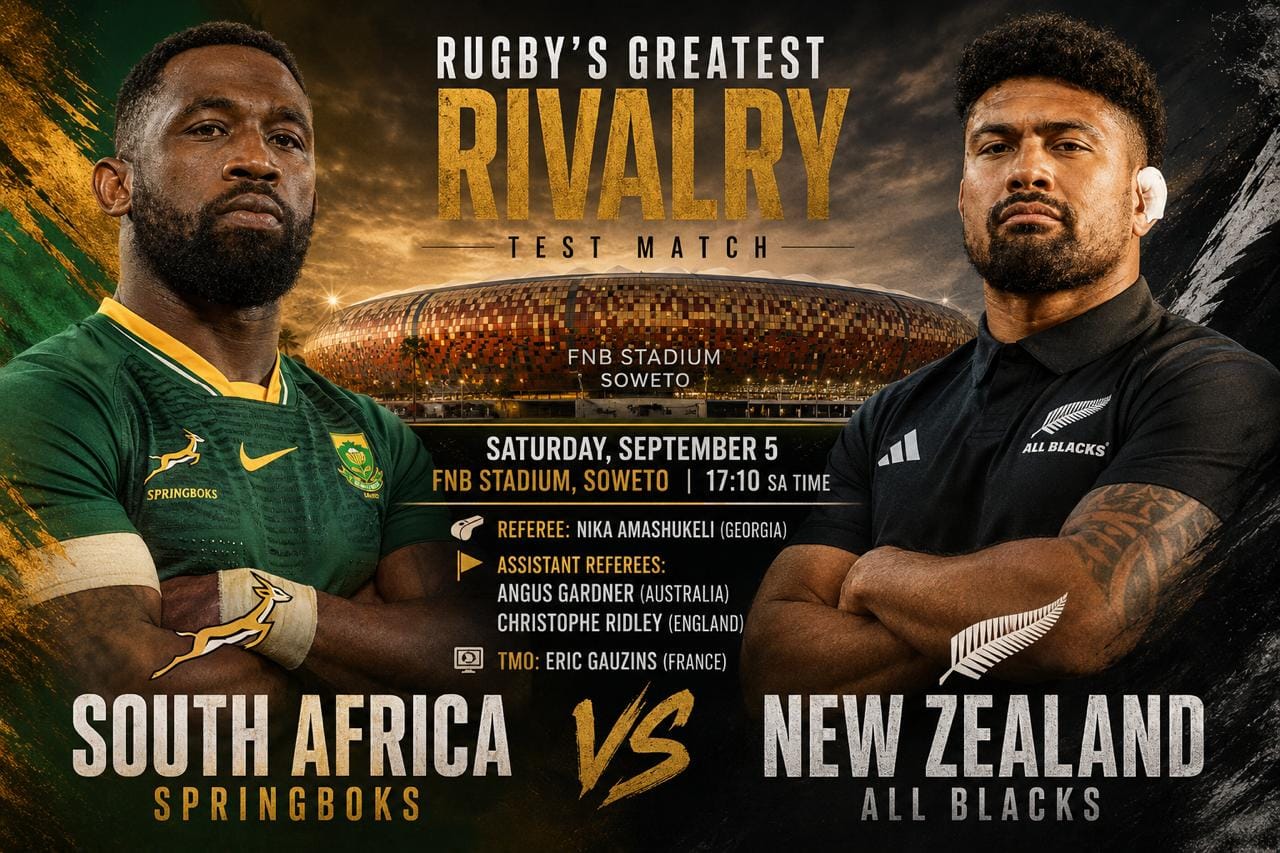
Soweto calls. Siya must answer.

By Adnaan Mohamed

The Calabash will roar. The rain may fall. And somewhere inside the thunder of 90 000 voices, Siya Kolisi will carry a piece of South African history onto the FNB Stadium battlefield.

For the Springbok captain, Saturday’s third Test against the All Blacks is bigger than a series decider.

It is personal.

It is political history without the politics.

And it is an opportunity to repay a debt to the people of Soweto whose sacrifices helped create the freedom that allowed Kolisi and assistant coach Mzwandile Stick to rise to the summit of South African sport.

“We’re thankful for the people connected to that place who fought for the freedom that lets me and him [assistant coach Mzwandile Stick] sit here today,” Kolisi said on Friday.

“Giving our best tomorrow, and using every opportunity we get, is part of us saying thank you.”

Those words will carry considerable weight when the Springboks emerge into the cauldron.

Kolisi spoke about Soweto’s sporting heartbeat, recalling the 1996 African Cup of Nations and the extraordinary connection between the stadium and its community.

He spoke, too, about homeless residents cheering the Springbok bus and locals sacrificing what little they have so others can experience the spectacle.

“It hasn’t always gone our way in Soweto, we didn’t win the first time we played here, but the numbers that show up at the stadium, and the vibe inside it, we feel it,” he said.

“We hope we can give them a good memory, not just with words but with our efforts tomorrow.”

History is also waiting for Kolisi personally.

Victory would give him 55 Test wins as Springbok captain, taking him beyond John Smit and into record territory.

Pieter-Steph du Toit, Jasper Wiese and Kolisi will also establish a new record for Tests played together as a Springbok loose trio.

Kolisi, though, refuses to make the occasion about himself.

“As for the wins record, that’s a team achievement, not mine personally. As long as we win, I’m happy, because it shows we’re building and moving forward as a group.”

That collective mindset will be tested by an All Blacks side with its own pride bruised after losing 33-26 in Cape Town.

New Zealand captain Ardie Savea knows exactly where the battle could be won.

The breakdown.

“Every rugby team is trying to hunt turnovers at the breakdown, and there’s no doubt the Springboks are strong there,” Savea said. “They did a good job keeping us out last week, and they’ll have to do it again this week.”

The All Blacks cannot afford another sluggish launch.

“You wouldn’t be an All Black if you weren’t confident by this point in the week, so we’re confident, but we also respect the threat the Springboks pose.”

“Last week they came out firing … we’d talked about starting well and didn’t quite deliver on that.”

Savea will also have to contend with his friend turned foe.

Kolisi’s thunderous tackle in Cape Town remains fresh in his memory.

“I told him, next time, tackle me frontwards, take me home,” Savea joked. “I was lying on the ground and all I could hear was my dad’s voice telling me to get up. So, I got up.”

Then the smile disappeared.

“Siya’s the same guy off the field, we get on well, but once you’re on the field you’re locked in, he’s the enemy out there. That’s footy, we’re going to try and smash each other tomorrow, then jump on the plane again afterwards.”

Savea likened the decider to State of Origin: “Game three, one apiece, here in Africa, so it’s a big one.”

He knows the All Blacks must be clinical.

“We have to be really clinical, accurate and disciplined. They’re world champions for a reason, and if you do that you won’t get it back.”

Kolisi expects the weather to be irrelevant.

“It won’t affect our game plan at all. The way we play is built for any weather.”

That is the challenge facing New Zealand.

Stop the Springbok juggernaut. Survive the Soweto storm. Silence the Calabash.

For Kolisi, the equation is simpler.

Give everything.

Give thanks.

Make history.

South Africa: Cheslin Kolbe, Kurt-Lee Arendse, Jesse Kriel, Damian de Allende, Ethan Hooker, Sacha Feinberg-Mngomezulu, Cobus Reinach, Jasper Wiese, Pieter-Steph du Toit, Siya Kolisi (captain), Ruan Nortje, Eben Etzebeth, Wilco Louw, Malcolm Marx, Ox Nche.

Replacements: Deon Fourie, Gerhard Steenekamp, Thomas du Toit, Lood de Jager, Andre Esterhuizen, Cameron Hanekom, Morne van den Berg, Manie Libbok.

New Zealand: Damian McKenzie, Will Jordan, Quinn Tupea, Jordie Barrett, Leroy Carter, Ruben Love, Cam Roigard, Ardie Savea (captain), Luke Jacobson, Peter Lakai, Sam Darry, Tupuo Vaa’i, Tyrel Lomax, Asafo Aumua, George Bower.

Replacements: Samisoni Taukei’aho, Xavier Numia, Fletcher Newell, Fabian Holland, Wallace Sititi, Kyle Preston, Anton Lienert-Brown, Josh Moorby.

Saturday, September 5 | FNB Stadium, Soweto | 17:10 SA time

Referee: Nika Amashukeli (Georgia)
Assistant referees: Angus Gardner (Australia), Christophe Ridley (England)
TMO: Eric Gauzins (France)