
Springbok coaches welcome wins but identify key areas for improvement

By Adnaan Mohamed

The scoreboards at Nelson Mandela Bay Stadium painted a picture of dominance on Saturday, but Springbok coach Rassie Erasmus and SA A coach Mzwandile Stick were far more interested in the details hidden beneath the numbers.

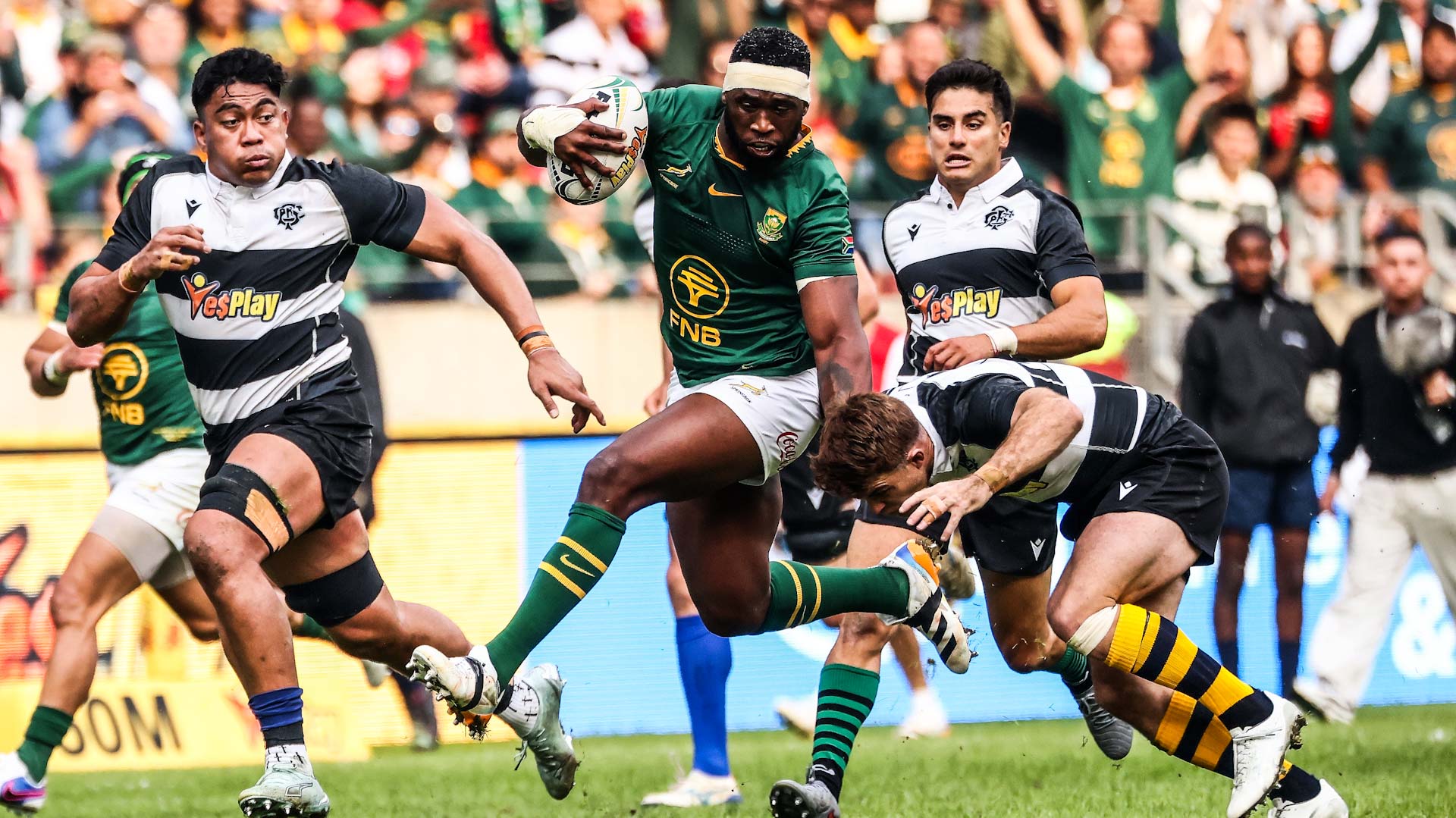
The Springboks opened their season with an emphatic 80-31 victory over the Barbarians, while SA A brushed aside Zimbabwe 40-0. Despite the convincing results, both coaches identified areas requiring urgent attention before the Nations Championship begins in two weeks.

Erasmus praised the Springboks’ attacking output but admitted their discipline and defensive consistency left room for improvement.

“Our discipline wasn’t great, and they (the Barbarians) scored tries in quick succession, so yellow cards were not ideal,” said Erasmus.

The Bok coach pointed to the realities of a squad reconnecting after several months apart.

“But we have to remind ourselves that it’s been six or seven months since we’ve played together, and some guys were new in the mix, while we also didn’t know when the DHL Stormers or Vodacom Bulls players would be available at some stage, which are all aspects we have to keep in mind.

“To score 80 points is nice, but the Barbarians were thrown together quite late, and had only three training sessions, which makes them difficult to analyse. They scored four or five great tries, so we need to eliminate those defensive lapses and be better as a unit when we play against England.”

One concern for Erasmus was the injury suffered by experienced lock Franco Mostert, who was forced from the field.

“I’m worried about his ankle. He’ll go for scans tomorrow, so hopefully it’s not too bad.”

Springbok captain Siya Kolisi echoed his coach’s assessment, saying the match provided valuable evidence of what is working and what still needs attention.

“I thought a lot of what we wanted to get through, we did, but also, when things didn’t work, and we went against the plan, we learned lessons there,” said Kolisi.

“I always have to watch the game again to get a good assessment about things, but I already know some of the mistakes we made and the areas we need to fix. There were opportunities where I thought we could have controlled things better.”

Earlier in the day, SA A delivered a disciplined defensive display against a determined Zimbabwe side preparing for the 2027 Rugby World Cup in Australia.

Stick admitted the performance was not without frustration despite the clean-sheet victory.

“We knew it was going to be a big challenge because the majority of our players have never played together, so it was a new team, and Zimbabwe tried to challenge us by keeping ball in hand and playing direct rugby. I enjoyed the way they played.

“That said, for us, the goal was to see whether the players could execute what we’ve been working on over the past two weeks, and it was sometimes frustrating when the points weren’t coming.

“In the first half, we were unlucky, with two tries disallowed – once where a player went into touch, and another when a player was slightly in front of the kick. But from my side, the way the guys stayed in the fight, even when we were under pressure, was great, and we managed to keep a clean sheet.”

SA A captain Vincent Tshituka paid tribute to Zimbabwe’s intensity and ambition.

“We played against a desperate side, and we expected that. We knew the Zimbabwe players would be motivated and would want to prove a point against world-class opposition, and it showed.”

South Africa’s opening victories delivered plenty of encouragement. Erasmus and Stick know tougher examinations await, and both coaches left Gqeberha with a notebook full of positives and a to-do list that remains far from complete.

Images: X.com/Springboks

Franco Mostert Cleared as Rugby’s Referees Enter Full Circus Mode

Opinion – Adnaan Mohamed

Welcome to another breathtaking episode of Rugby Officials Gone Wild, where referees improvise, TMOs hallucinate, and World Rugby’s disciplinary panels sweep up the mess like long-suffering parents at a children’s birthday party.

This week’s headliner? Springbok lock Franco Mostert sent off in Turin after referee James Doleman and his French TMO partner squinted at a replay and dramatically declared “clear head contact” and “always illegal”, which we now know was about as accurate as a prop attempting a chip-and-chase.

On Wednesday, actual functioning adults on the disciplinary panel calmly overturned the red card, downgrading it to a yellow and effectively telling the match officials:

“You were wrong. Spectacularly wrong. Please stop embarrassing yourselves at this altitude.”

But wait, the chaos gets better. Not only was Mostert’s dismissal wrong, but Harry Hockings’ red card was ALSO declared incorrect by a separate independent panel.

That’s right: two red cards, two panels, zero functioning officiating moments. Rugby’s governance is starting to feel like a group project where one guy does the work and the rest just show up with snacks.

And Rassie Erasmus? Eddie Jones? Oh, they were THRILLED.
Both stormed into their press conferences like two coaches who’d just watched their debit orders bounce. Steam, fire, smoke signals, everything short of interpretive dance.

Meanwhile, the bunker review system, the expensive technological safety net installed specifically to stop this exact variety of nonsense, was NOT USED.
Not consulted.
Not even glanced at.
They left it sitting there like a lonely gym bike in January.

Instead, Doleman and his TMO opted for the “wing it and pray” method: a bold, innovative approach with a near-perfect failure rate.

The ruling now exposes rugby’s head-contact framework as a full-blown Picasso painting: abstract, confusing, and open to interpretation by anyone with enough confidence and a whistle.

One weekend a player gets red for breathing too aggressively; the next weekend someone performs a WWE finishing move and walks away with a warning.

And through it all, the Springboks just keep winning, like a team powered entirely by spite and trauma.

Two weekends.
Two red cards for the No. 5 jersey.
Two matches with 14 men for ridiculous lengths of time.
Two victories.

France? Beaten with 40+ minutes a man down.
Italy? Smashed with 65+ minutes one man short, AND fielding fringe players.
The message?
“Give us 14, give them 15 – see who cries first.”

Now South Africans are coping the only way they know how:
By laughing at the officiating until it cries back.

With Mostert cleared, he’s available for the showdown in Dublin, a place where the Boks haven’t won since the world last took Blackberry phones seriously.

The last time the Boks were on the winning side in Ireland was 13 years go. The Irish have won four of the last five against South Africa, including that World Cup group-stage arm wrestle in 2023.

The Boks name their team Thursday. And if fate has a sense of humour, the referee will keep his red card in his pocket this weekend, or at least try to.

But with the way things are going in rugby’s officiating universe, expect anything: a red card for tying your boots too slowly; a yellow for “intent to run upright”; a penalty for existing in the wrong postcode.

Sit tight.
The circus continues.
And the clowns, unfortunately, are still in charge.

Two Weeks, Two Reds, One Relentless Springbok Spirit

By Adnaan Mohamed

For the second week in a row, the Springboks walked into a northern-hemisphere storm and refused to be blown over.

Another early red card, another No 5 lock gone, yet the world champions simply bent, adjusted and found a new way to win, beating Italy 32–14 in Turin with the kind of grit that can only be forged in chaos.

Franco Mostert’s 12th-minute red card echoed Lood de Jager’s fate against France a week earlier. Same number on the jersey. Same sinking moment. Same response: the Boks shifted shape like a scrum rearranging itself in a gale, and played as though the missing man had simply been absorbed into their collective heartbeat.

Captain Siya Kolisi said the team has learned to solve problems while sprinting.

“We went through it last weekend, and this week we went through the same thing. So, we make plans in the game as we go along because such things happen,” he said.

“The biggest thing that we were asked this week is to show our ‘Africanness’ and that’s about making plans because there are always stumbles… They (the coaches) are always prepared for any scenario, and even the guys who are not playing sit and make plans and decisions.”

Kolisi admitted the emotional sting was real:

“It doesn’t make it easy for us… seeing a guy like Franco sitting there, we could see the hurt in his eyes. But I really love the way this team is able to stand up and fight.”

Rassie Erasmus, visibly exasperated, didn’t hide his frustration.

“It is what it is. What I say can’t make a difference,” he said. “It’s sad that our captain had to make that sacrifice twice in a week.”

The Bok coach questioned how much lower a two-metre lock can physically tackle.

“Losing two locks in two games now for going lower than they can go… it’s tough to understand,” Erasmus said. “We don’t know how to coach guys to go lower, especially when someone is on his knees.”

Yet amid the frustration, he applauded his team’s ability to morph on demand.

“Yes, we have a way to adapt,” he said. “That certainly makes us tighter as a team… I’m happy with the result, but still sad for the players who have to take the brunt for something that happened by accident.”

Three wins from three, two red cards navigated, and a squad that keeps inventing new ways to survive the storm. The Boks now head to Ireland, hardened once more by fire and fallout.

Featured Photo: Andre Esterhuizen/ https://x.com/springboks

Source: SA Rugby