Aimee’s whistle of resilience, courage and ‘Sterkte” to the Boks

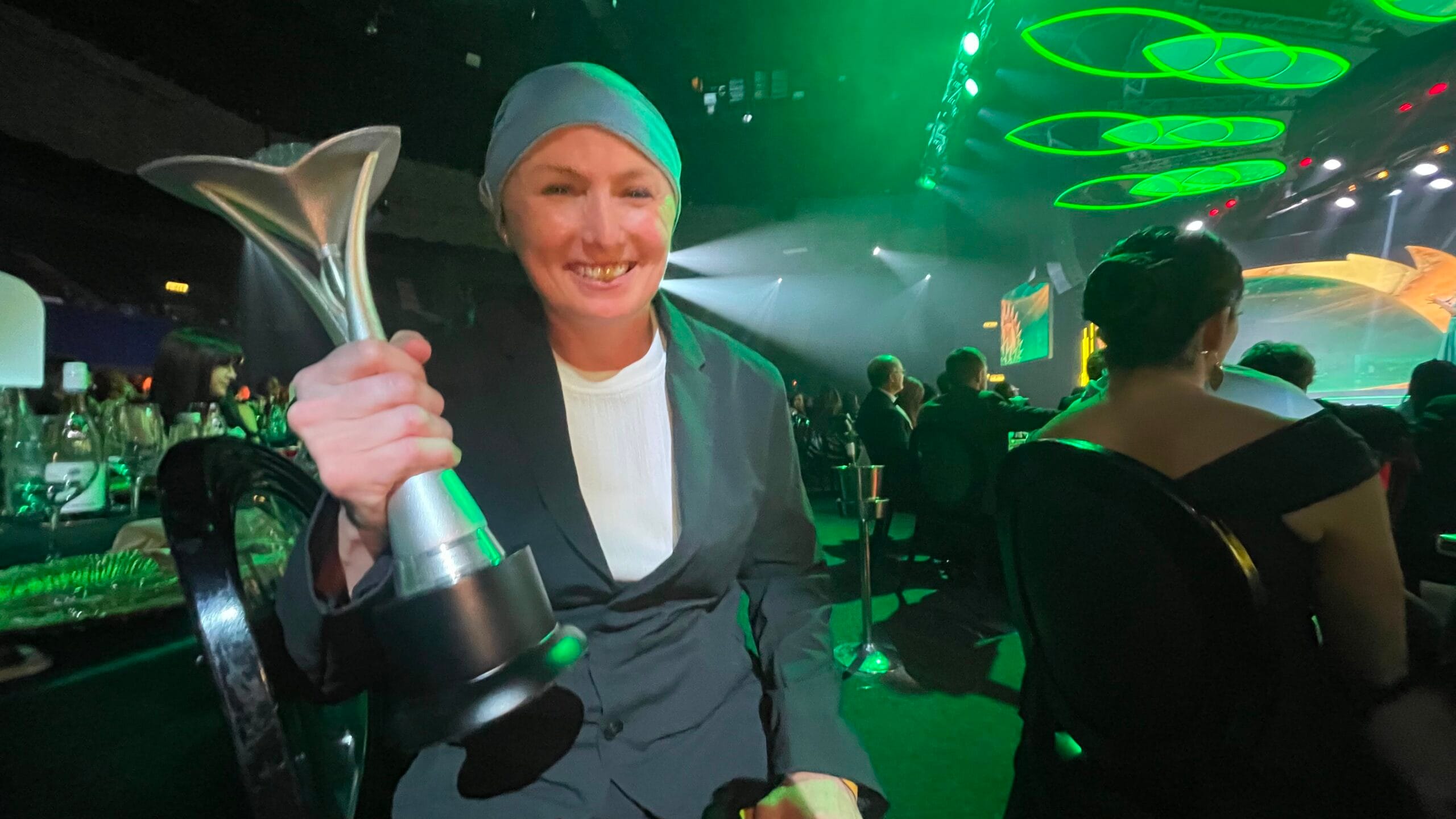
SUN CITY, NORTH WEST: From breaking barriers on the rugby field to facing breast cancer with extraordinary courage, Aimee Barrett-Theron continues to inspire. The most-capped female international referee in rugby history was named Technical Official of the Year at the South African Sport Awards. Her message to the Springboks ahead of their Cape Town clash with the All Blacks? “Sterkte.”

By Adnaan Mohamed

Aimee Barrett-Theron has spent years policing rugby’s most ferocious frontiers with a whistle, a stopwatch and nerves forged in the furnace of elite sport.

On Sunday night, 23 August, the trailblazing referee received another trophy for her extraordinary contribution, being named Technical Official of the Year at the 19th South African Sport Awards at Sun City Superbowl.

Her latest accolade came with an unmistakably human soundtrack. Barrett-Theron is halfway through treatment for breast cancer, temporarily away from the international rugby battlefield and drawing strength from the same discipline that carried her through some of the sport’s biggest arenas.

“The treatment’s going well. I’m about halfway through at the moment so it’s been quite a challenge not being on the field, but I’m still very much involved for coaching because I’m still very much involved here so it’s a tough time to be out there, but I’m still as supportive as I can,” she said.

The road back remains a marathon measured in courage rather than kilometres.

“Yeah, yeah, so a couple of tests and a lot of my friends out there referring I’d love to be supportive there but it’s 20% for the year,” Barrett-Theron said in the interview, reflecting on her curtailed involvement in officiating.

Her career has already smashed through several glass ceilings.

A former Springbok Women’s XVs and Sevens player, she swapped playing boots for the referee’s whistle and became the first woman to referee a men’s professional match in South Africa.
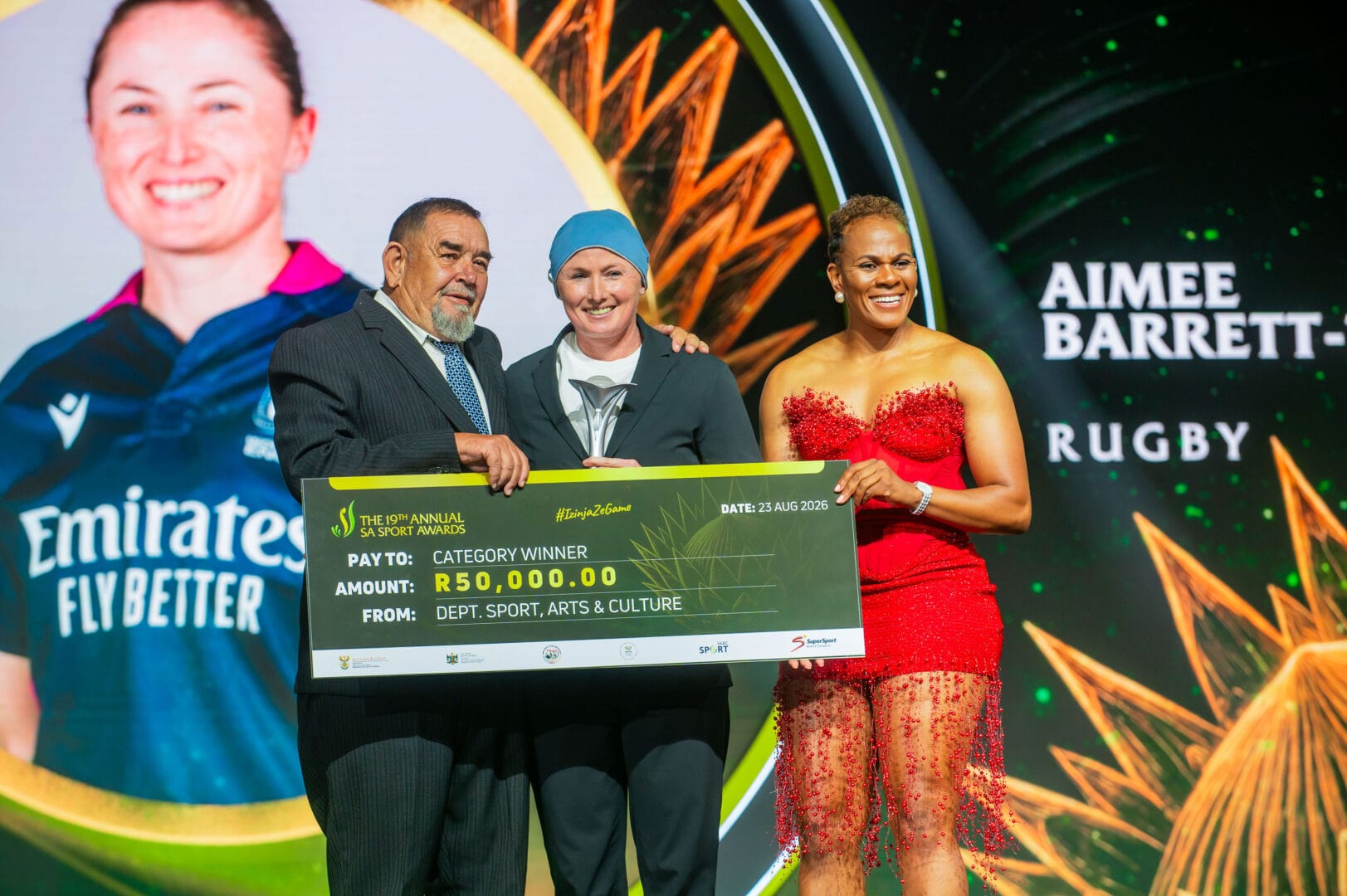
She has since taken charge of 52 international Tests, making her the most-capped female international referee in rugby history. Earlier in 2026, she became only the second woman ever to referee 50 Test matches.

Her CV reads like a roll of honour: the 2017 and 2025 Women’s Rugby World Cups, the Tokyo Olympics, the United Rugby Championship and the Women’s Six Nations.

Then came the diagnosis.

In July, Barrett-Theron announced her temporary departure from officiating after being diagnosed with breast cancer. She has confirmed the condition is treatable and is concentrating on treatment and recovery, with specialists guiding her through the process.

Rugby’s family responded with the force of a defensive line. World Rugby and SA Rugby leaders joined players, officials and supporters in sending messages of encouragement.

Her Sport Awards triumph added another medal to a career already heavy with milestones.

“It’s special to be able to get the trophy,” she said. “At the end of the day and to be recognised for the hard work that we put in”

Then came the question every South African wanted answered: could the Springboks beat the All Blacks at DHL Stadium on Saturday in the second Test of Rugby’s Greatest Rivalry?

For a moment, the referee’s hat came off.

“Yeah, when it comes to Springboks, I can take my referee hat off and I’d love the boys to have any positive results on the weekend.”

Her message to the Boks carried the warmth of a teammate standing beside the tunnel before kick-off.

“Yeah, just stack them on and good luck boys. Represents us the best you can. We know you’ve got it in you.”

And there was one final word, simple enough to fit on a dressing-room wall and strong enough to carry across the Cape Town wind:

“Sterkte.”

For Barrett-Theron, the whistle may be silent for now. Her voice remains firmly in the game.

South African sport has crowned her greatness. Rugby knows her resilience will be worth another standing ovation when she returns.

Under the glittering banner of “Crowned in Greatness”, the 19th South African Sport Awards delivered a night where champions, trailblazers and behind-the-scenes heroes took their bows.

Akani Simbine lead the winners at the 19th South African Sport Awards, with Prudence Sekgodiso, Pieter Coetze and Protea Test Cricket also honoured.
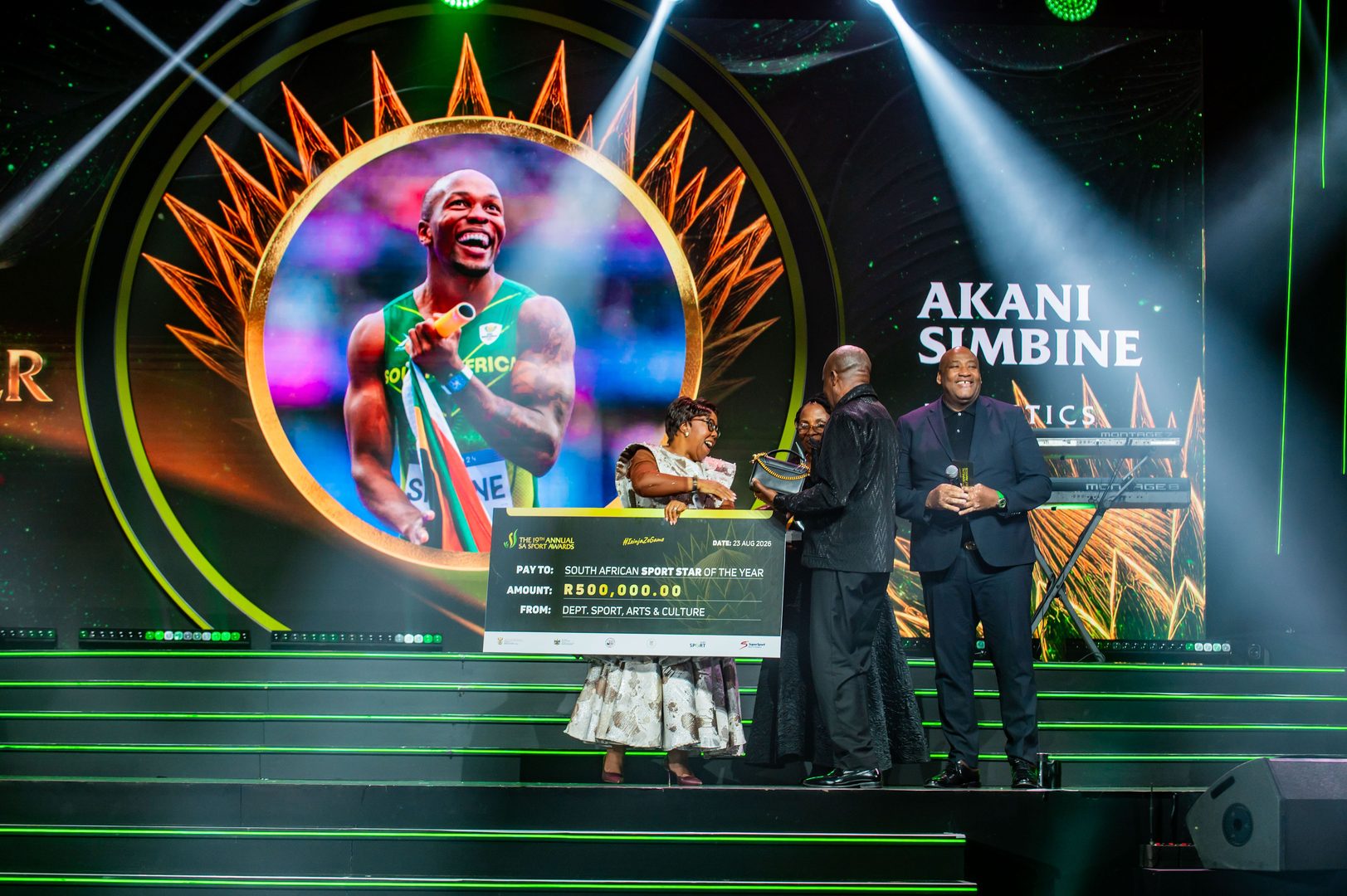
Simbine claimed Sport Star of the Year, adding another gleaming medal to an already formidable athletics legacy. The sprint king has spent years living on the razor’s edge of hundredths of a second, and this time the stopwatch gave way to the applause of a nation.

The Protea Men’s Test Cricket team pocketed Sport Team of the Year, another feather in Cricket South Africa’s cap after a campaign that demanded patience, character and plenty of backbone.

Prudence Sekgodiso was crowned Sportswoman of the Year, while swimmer Pieter Coetze took Sportsman of the Year. Athletics also supplied Coach of the Year Thabo Matebedi, ensuring the track-and-field brigade left Sun City with pockets bulging with silverware.

Young guns Bayanda Walaza, the Youth/Junior Sport Star of the Year, and the Men’s Under-20 Rugby Team, named Youth/Junior Sport Team of the Year, showed that the pipeline is pumping.
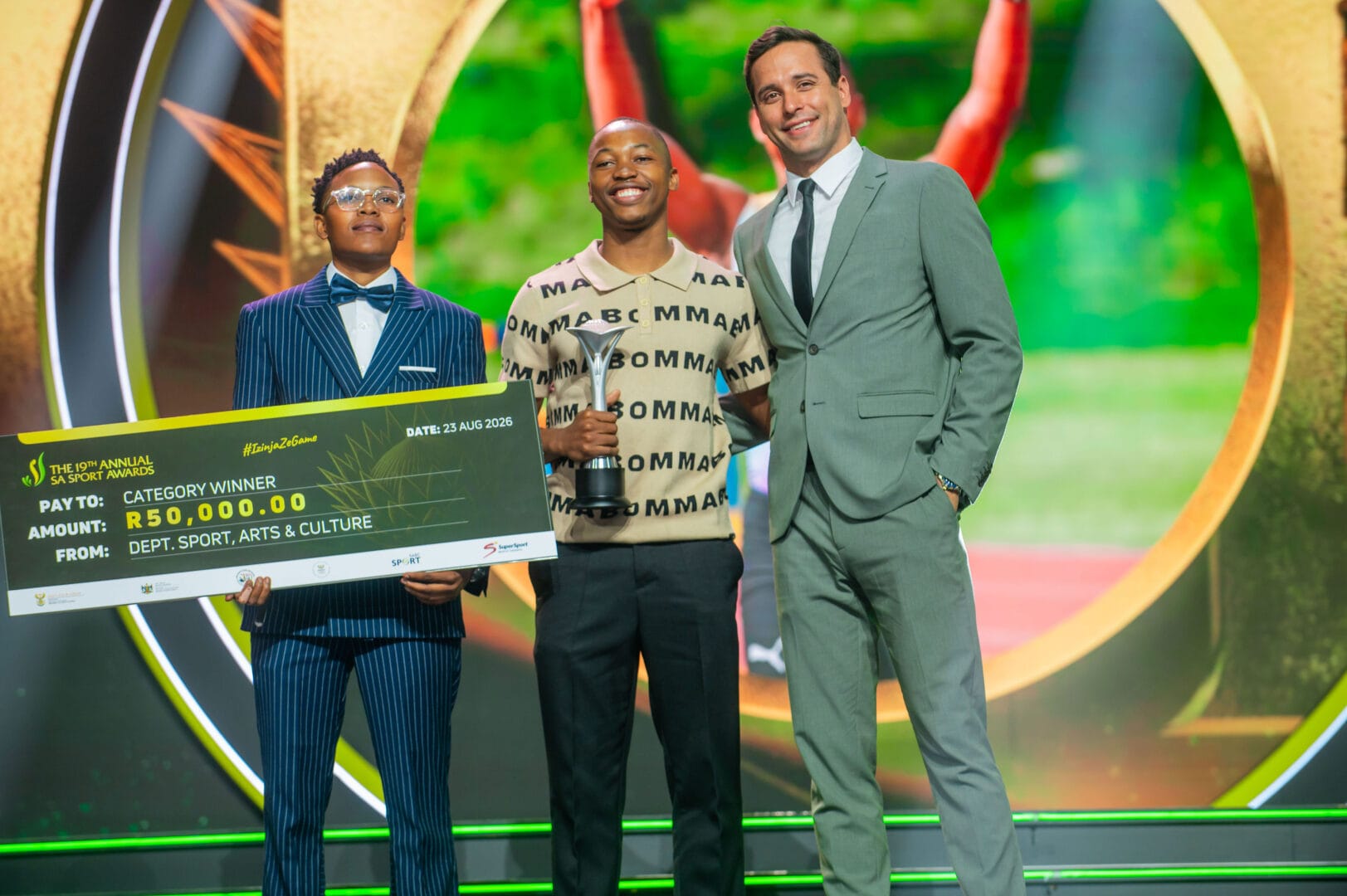
Bayanda Walaza, the Youth/Junior Sport Star of the Year with SA swim legend Chad le Clos

Simoné Kruger won Sportswoman of the Year with a Disability, while Puseletso Michael Mabote claimed Sportsman of the Year with a Disability for para athletics.

The evening’s unsung heroes received their own standing ovation. Anthony Moruthane was named Sport Administrator of the Year, Nqobile Kunene Sport Volunteer of the Year, and Khokho Association South Africa Recreation Body of the Year.

Cricket South Africa collected National Federation of the Year, while Rachel Makhura took Sports Media Journalist of the Year, with photographer Skhu Nkomphela winning Sport Visual Journalist of the Year.

And then came the lifetime tributes, a reminder that sporting greatness is built over generations. Siya Vabaza-Booi, Selwyn Nathan and Veli Nhlapo received the Steve Tshwete Lifetime Achievement honour.

The Andrew Mlangeni Green Jacket went to William Mtolo, Teenage Dladla, Prof. Mlungisi Ngubane and Patson Banda, while Rayno Nel, Tasneem Solomons and Temba Bavuma were recognised for Excellence.

It was a night when South African sport looked in the mirror and saw its past, present and future staring back.

The crown fitted. The champions roared. And the sporting heartbeat kept thumping.

Why Springboks-All Blacks rivalry is bigger than rugby

Rugby’s Greatest Rivalry carries influence well beyond the playing field.

SA Rugby president Mark Alexander welcomed NZ Rugby president Erin Rush to Cape Town ahead of Saturday’s Test at DHL Stadium, highlighting the enduring relationship between two nations that have collectively won 70% of Rugby World Cups.

Erin Rush was elected first female president of NZ Rugby in 134 years. Photo: John Cowpland / action press

Rush, New Zealand Rugby’s first female president, has also brought a remarkable playing and broadcasting career into the governance arena.

Cape Town now prepares for another chapter in one of sport’s most enduring rivalries.

By Adnaan Mohamed

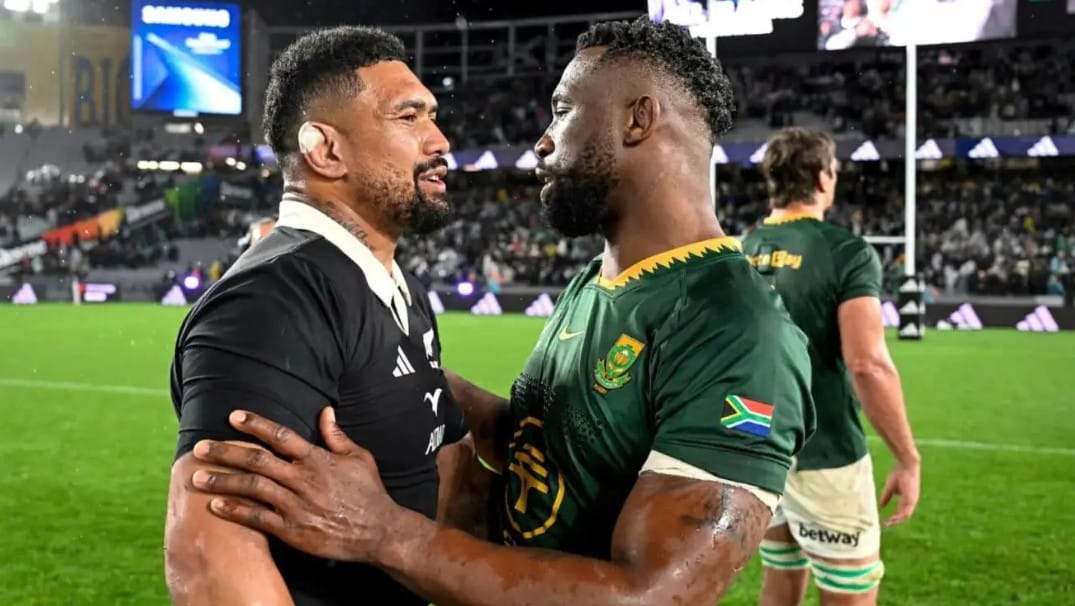
South Africa and New Zealand have spent more than a century throwing rugby thunderbolts at each other. On Wednesday morning, the latest chapter of that fierce sporting relationship began with handshakes, smiles and a shared flight into Cape Town.

South African Rugby president Mark Alexander welcomed his New Zealand counterpart Erin Rush at Cape Town International Airport ahead of Saturday’s second Rugby’s Greatest Rivalry Test between the Springboks and All Blacks at DHL Stadium.

The two presidents travelled together after witnessing New Zealand’s 33-16 victory over the Springboks at Ellis Park on Saturday. Their rugby roadshow continued at the same venue on Tuesday night, where the All Blacks edged the Lions 42-35 in a breathless spectacle featuring 11 tries.

Coach Dave Rennie’s side produced six tries, with Cash van Rooyen’s charges crossing five times. The thrilling contest crackled like a loose ball at a hotly contested breakdown, with the All Blacks eventually stealing victory in the final minute.

For Rush, South Africa’s welcome has been every bit as memorable as the rugby. After the All Blacks victory in the first Test, she expects the pressure and intensity of the rivalry to reach new heights for the rest of the series.

“It’s been amazing. There’s a lot at stake,” said Rush.

“Firstly, I want to say thank you to South Africa Rugby and the people of South Africa for their generous hospitality. Also for bringing such intense anticipation and a huge match-up on the field. It is so exciting and we’ve got so many of our supporters here who are enjoying it too.”

Her response came after Alexander pointed out the strong historical bond between New Zealand and South Africa.

“Yeah, thank you,” Rush replied.

Alexander then welcomed his New Zealand counterpart with the warmth of an old rugby handshake.

“We welcome Erin [Rush] and the All Blacks the old foe here in Cape Town. We’re great friends and always bring the best out of each other,” said Alexander.

“The one thing about rugby, it brings people together. And the two nations have got a long history, you know.”
Then came the statistic that gives this rivalry its heavyweight status.

“Between the two of us, we won 70% of the World Cups hosted to date. So, it is the greatest rivalry. And that’s why we’ve got the best two teams in the world competing in the next couple of weeks in South Africa.”

Rush arrives in the Mother City carrying a remarkable rugby story of her own. The 56-year-old became New Zealand Rugby’s first female president in May 2026, securing a two-year tenure after being elected by NZR’s affiliate members and succeeding former All Black Matthew Cooper.

Her rugby CV reads like a long-running Test match. Rush was Black Fern No. 113, making her international debut in 2003 at 33, only weeks after giving birth. She captained Wellington Pride, earned 100 caps for the province and played club rugby for Wellington FC.

Her pioneering streak began even earlier. In 1998, she co-commentated the first Black Ferns Test broadcast live on television during the World Cup final.

Black Fern #113 – Erin Rush Image Credit: AllBlacks.com

She served as NZR vice-president from 2024 to 2026 before taking the presidency. Her current role includes attending board meetings, travelling with national squads, welcoming international guests and presenting medals, with no board voting rights attached to the ambassadorial position.

Now, Cape Town becomes the next set piece in a rivalry that has shaped rugby’s folklore.

Saturday’s Test promises another heavyweight collision. Alexander and Rush have already shared the flight, the hospitality and the rugby spectacle. Come kick-off, friendship will have to make room for the fiercest handshake in world rugby.

The rivalry is ready to rumble

Springboks ready to turn Ellis Park into a rugby war zone

By Adnaan Mohamed

The stage is set. The old enemies are back. And the Springboks are ready to throw everything into the opening punch of the Rugby’s Greatest Rivalry.

When South Africa face New Zealand at 10bet Ellis Park on Saturday, it will be the first of four Tests between the heavyweight rivals in a series that promises enough drama to keep rugby fans glued to their screens.

Springbok assistant coach Mzwandile Stick knows exactly what is coming.

“Playing four games in one season against the All Blacks is always going to be a great challenge,” Stick said.

“These are moments that we live for. The closest thing to the Greatest Rivalry in terms of a series where every game counts is probably the British & Irish Lions series, or the knockout stages of the World Cup, and our mindset for these games will draw on those experiences.”

The Boks are under no illusion about the size of the challenge.

“We know it’s going to be a tough challenge. The All Blacks are in a good space and have been playing very well,” said Stick.

“But from our side, we also want to keep improving and evolving, and we will never be comfortable. It doesn’t get tougher than playing against the All Blacks four weeks in a row, and we are excited about it.”

That is fighting talk from a team preparing to enter a rugby pressure cooker.

Ellis Park brings the emotion

Captain Pieter-Steph du Toit, who will earn his 99th Test cap, is relishing the occasion.

“It’s a very different tournament,” he said. “To be involved in a series like this and have New Zealand play in South Africa, and also playing four games in a row is a massive honour and privilege.”

For Du Toit, Ellis Park carries memories bigger than rugby.

“It’s an awesome stadium for us and it’s close to my heart,” he said.

“When you stand there and sing the anthem and see the supporters behind the Springboks, it’s unbelievable. And of course, the 1995 Rugby World Cup was won there as well, so it’s a very special place for our country.”

Then comes the haka.

Du Toit says the Boks now have a deeper appreciation of what the ritual means to the All Blacks.

“I would never say we’d be relaxed, but it’s a massive honour to face the haka,” he said.

“We’ll face the haka with respect and we’ll accept the challenge.”

De Allende gets his flowers

Saturday will also belong to Damian de Allende, who becomes only the 10th Springbok to reach 100 Tests.

Stick believes the centre’s milestone deserves a standing ovation.

“For a guy like Damian de Allende, who has been with us through the ups and downs, and had to cope with a lot of people saying he wasn’t good enough to play for the Springboks, is amazing,” Stick said.

“He’s one of those guys who does the dirty work without anyone seeing it, so for him to play his 100th Test match is a great achievement for him and his family.”

Du Toit remembers watching De Allende during his Stormers days.

“I just saw this beast in the way he carried the ball and his work on defence,” he said.

“I have so much respect for him, the way he carries himself on and off the field, and how he’s grown as a person. It’s great to see people progress in life.”

Boks know where the battle will be won

Stick expects the All Blacks to bring serious heat at scrum and lineout time.

“We know New Zealand is going to bring it in terms of intensity,” he said.

“They’ll also look for gaps with their skilful players, so I’d say the key would be to stay alert and not get caught out.”

In other words, one defensive nap could become an All Blacks party.

The whistle blows at 17h10, with the match live on SuperSport. Limited tickets remain available.

Ellis Park is ready.

The rivalry is awake.

And the Boks are knocking on the door.

Teams

South Africa: 15 Damian Willemse, 14 Cheslin Kolbe, 13 Jesse Kriel, 12 Damian de Allende, 11 Kurt-Lee Arendse, 10 Sacha Feinberg-Mngomezulu, 9 Grant Williams, 8 Jasper Wiese, 7 Pieter-Steph du Toit (captain), 6 Paul de Villiers, 5 Ruan Nortje, 4 Eben Etzebeth, 3 Wilco Louw, 2 Malcolm Marx, 1 Ox Nche.
Replacements: 16 Jan-Hendrik Wessels, 17 Gerhard Steenekamp, 18 Zachary Porthen, 19 Cobus Wiese, 20 Andre Esterhuizen, 21 Marco van Staden, 22 Cobus Reinach, 23 Manie Libbok.

New Zealand: 15 Damian McKenzie, 14 Will Jordan, 13 Quinn Tupaea, 12 Jordie Barrett, 11 Josh Moorby, 10 Ruben Love, 9 Cam Roigard, 8 Ardie Savea (captain), 7 Luke Jacobson, 6 Tupou Vaa’i, 5 Fabian Holland, 4 Josh Lord, 3 Tyrel Lomax, 2 Codie Taylor, 1 Ethan de Groot.
Replacements: 16 Asafo Aumua, 17 George Bower, 18 Fletcher Newell, 19 Anton Segner, 20 Peter Lakai, 21 Kyle Preston, 22 Anton Lienert-Brown, 23 Leroy Carter.

Date: Saturday, August 22
Venue: 10bet Ellis Park, Johannesburg
Kick-off: 17.10 (Sunday, August 22)
Referee: Matthew Carley (England)
Assistant referees: Karl Dickson (England), Nika Amashukeli (Georgia)
TMO: Mike Adamson (Scotland)

Rassie Erasmus hits back at All Blacks slow-play claims

Adnaan Mohamed

The first Test of Rugby’s Greatest Rivalry Series has already produced its opening skirmish.

Springbok coach Rassie Erasmus has dismissed suggestions that South Africa deliberately slows the game at set pieces, insisting his team will stick to its systems when the All Blacks arrive at 10bet Ellis Park on Saturday.

“There are always three truths: New Zealand’s truth, the truth people believe, and our truth,” Erasmus said.

The comments come as the pre-Test needle begins to prick. New Zealand has promoted a high-intensity, multi-phase style, with suggestions that the Springboks could seek to disrupt that rhythm.

Erasmus is having none of it.

“In our last two games against New Zealand in Auckland and Wellington, people can go and look at those games and ask were we slowing those down. They beat us in Auckland, and we got a good result in Wellington.”

For Erasmus, Test rugby is not about satisfying outside narratives but more about surviving the furnace when pressure reaches boiling point.

“We believe there’s a certain way to win big games and we think it will be a grind.”

That grind could become the defining feature of Saturday’s opening act.

“When you’re under pressure and you attack, it’s tough to maintain cohesion,” Erasmus said. “We will try to find a balance when games are really tight, but we have a system to fall back on that protects the players.”

Tony Brown’s influence has also helped shape the Boks’ attacking approach.

“Since Tony Brown, former All Black flyhalf and current Springbok assistant coach, has been with us, we feel as though we’ve been on the right track.”

SA Rugby laws advisor Jaco Peyper then entered the fray, offering a technical explanation of the much-discussed 30-second set-piece law.

“The law is very clear. From the moment the referee puts his foot down to mark the spot, not from the whistle, there is 30 seconds to form a lineout or scrum.”

Peyper said teams could manage the moments before the mark is made within the laws, while opponents who are ready to play can apply pressure.

“There’s nothing in the law that says you can’t idle before the mark is given.”

He also pointed out that teams can disrupt tempo through repeated infringements at breakdowns and mauls.

The whistle, in other words, could become a metronome for a Test where every second matters.

Peyper has full confidence in the officials appointed for the four-Test series, particularly England’s Matthew Carley, who will referee Saturday’s opener.

“You’re going to have a firm referee. Someone who deals decisively at the breakdown and is very strong on anything negative or cynical. And he does not get influenced by the home crowd.”

That could be music to the ears of both coaching boxes.

Erasmus expects the All Blacks to bring a blue-chip attacking blueprint to Johannesburg.

“You can see it on social media. They’re advocating a high intensity, running game, with multi-phase attacks. And when you analyse it, it definitely shows in the stats.”

Dave Rennie, who Erasmus previously faced during his Munster days, adds another tactical layer to the contest.

“The big battle is going to be when they have the ball, they’ll have total control of what they do with it, and when we have the ball, we’ll have total control of what we do with it.”

The biggest concern for Erasmus is the All Blacks’ breakdown work.

“What concerns us most is how physical and brutal they are at the breakdown. They take the ball through so many phases and then they put in a well-timed grubber kick. Their attacking kicks are as dangerous as when they have ball-in-hand.”

Away from the tactical chessboard, Erasmus admitted the Springboks are embracing the occasion.

“We all appreciate and respect what this series means,” he said.

“I’d love it if the people at Ellis Park create the same atmosphere as that which the people did in Cape Town. The haka was heard 100%, which makes it something special.”

The Springbok coach also knows the All Blacks remain capable of delivering a sting.

“We know how good the All Blacks are. Since 2018, when they were leading the world, we’ve always wondered when they’re going to beat us again, and they will beat us again in future, but hopefully not this weekend.”

Erasmus will name his team on Thursday, with captain Siya Kolisi and prop Ox Nche the only injury concerns.

“The only two doubtful players are Siya and Ox, who are coming along well,” he said. “I wouldn’t say either is confirmed out, but if they get through training today it could go either way. Apart from those two, everybody else is available.”

The All Blacks are also expected to unveil a few tactical surprises.

“They’ll have plans they didn’t show in the Nations Championship, little things, such as lineout variations, maybe a front peel or back peel move, and there are things that have caught us out before.”

The stage is set.

The talking has started.

Now Ellis Park gets the final word.

South Africa face New Zealand at 17h10 on Saturday, with the match live on SuperSport.

All Blacks turn up volume ahead of first RGR Springboks Test

By Adnaan Mohamed

The All Blacks have turned up the volume ahead of Rugby’s Greatest Rivalry (RGR), with the Bulls bearing the brunt of a 50-19 demolition at Loftus Versfeld.

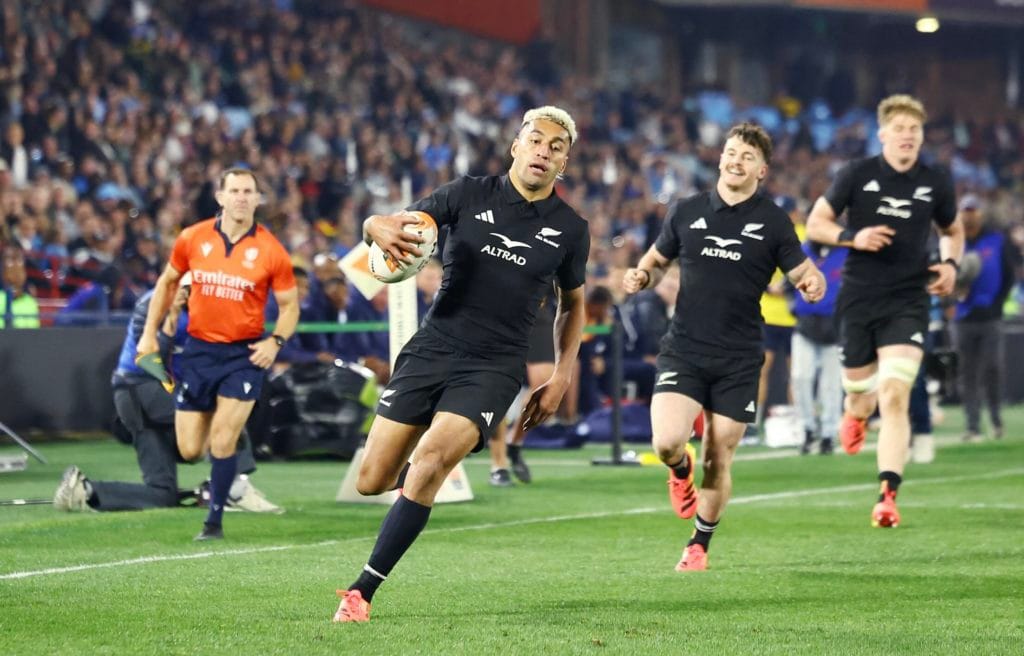
New Zealand ran in eight tries in Pretoria on Saturday, producing their most complete performance of the South African tour to date and finishing their provincial warm-ups unbeaten.

It was a statement built on scrum power, breakdown brutality and attacking freedom. Josh Moorby, Leroy Carter and captain Codie Taylor all crossed twice as the All Blacks raced into a 24-0 halftime lead.

The Bulls eventually found some life, scoring three tries, yet New Zealand kept the scoreboard ticking like a taxi meter on a busy Saturday night.

For Dave Rennie, the performance offered useful clues ahead of next Saturday’s first Test against the Springboks in Johannesburg.

“50 points against a very good Bulls side is a positive,” Rennie said.

“We played a team that was prepared to play and really took it to us. I thought our set piece was strong, especially the scrum.”

The All Blacks created 11 line breaks to the Bulls’ one and showed improved discipline, giving Rennie plenty of selection headaches with his Test squad now taking shape.

“That certainly wasn’t our Test side tonight, and so there will be a number of changes,” he said.

“There were some really good performances that will put pressure on us from a selection point of view.”

Rennie also knows the Bulls were not a Test-strength opponent. The Pretoria side had not played since June and had limited preparation following their URC final appearance.

That reality explains why Rennie was quick to sound the brakes on the victory parade.

“What we know is that the intensity levels and the quality we’re going to come up against next week are three, four, or fivefolds, but we’ve played reasonably well on tour, and we know we need to up the ante.”

The All Blacks could welcome back Will Jordan and Cam Roigard, who have progressed from their respective injuries. Damian McKenzie remains a concern with an ankle problem, while Rennie hopes he can train on Tuesday.

New Zealand captain Codie Taylor delivered his own warning.

“No disrespect to the Bulls but they [the Springboks] will lift the tempo and physicality. That’s what Test match footy is all about. It’s an exciting week ahead.”

Loftus was the dress rehearsal. Ellis Park is where the curtain rises.

And the Boks have heard the warning bell.

Bulls bolster pack and unleash overseas X-factor for All Blacks clash

By Adnaan Mohamed

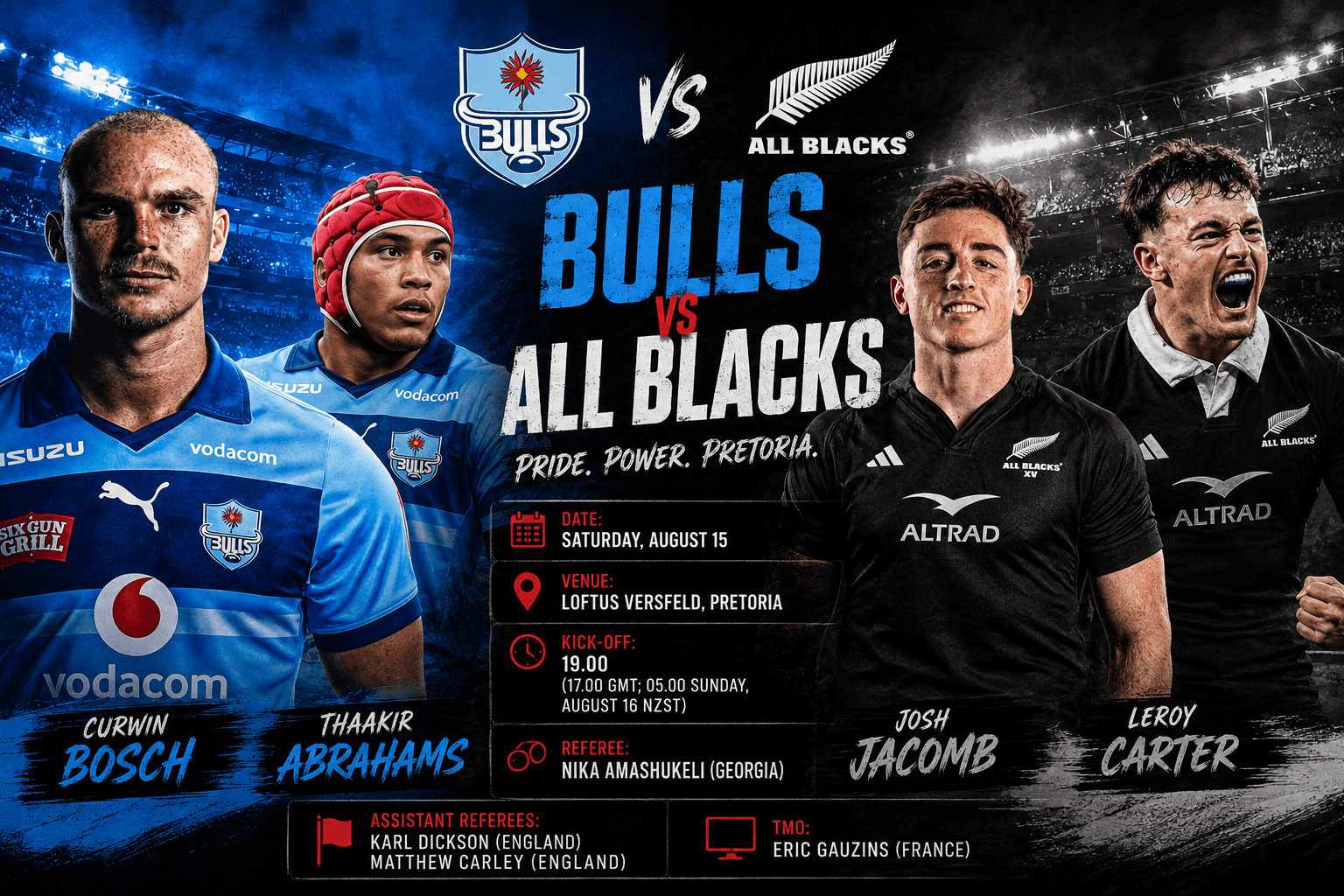
The Vodacom Bulls are loading up for an All Blacks ambush at Loftus Versfeld on Saturday, combining returning Springbok muscle with a pair of overseas-tested backs capable of injecting serious X-factor.

The recipe is clear: add international steel to the pack, then let Curwin Bosch and Thaakir Abrahams bring the fizz.

Bosch starts at flyhalf after two seasons with Brive in France, where the 29-year-old says he rediscovered the freedom that made him one of South Africa’s most naturally gifted attacking players.

“It’s amazing to be back in South Africa,” Bosch said. “The two seasons I spent in France were really good for me, but there’s no place like home.”

His French adventure was a mental reset.

“It was so good for me mentally to spend a bit of time in France and just get the shackles off and get back to doing what I do best, and that’s play rugby.”

Bosch believes the experience stripped away the noise and restored his instinctive game.

“There were no sideshows and no distractions. I could just focus on playing good rugby.”

“I just felt a lot more free. The last couple of seasons I spent in South Africa, I felt boxed a little bit.”

“That time in France freed me up. It took me back to how you play rugby at school. You see the space and you play the space. That’s when I’m at my best.”

Now the stage could hardly be bigger.

“It’s probably an opportunity of a lifetime to test yourself against the second-best team in the world,” Bosch said.

On the wing, Abrahams offers another attacking spark. The former Sharks and Munster winger returns to the Bulls with speed to burn and the ability to turn half-chances into highlight-reel material.

Together, Bosch and Abrahams give the Bulls a backline with genuine unpredictability.

Up front, the Bulls have reinforced the pack with Springbok quality. Hooker Johan Grobbelaar and loose forward Elrigh Louw have been released from the Springboks after their Argentina tour and will provide fresh international experience from the bench.

Both have had a single training session with the Bulls.

“It’s great to have them with us, and we’re looking forward to the challenge,” coach Johan Ackermann said.

Jaundre Schoeman and Mpilo Gumede make way in the match-day squad.

Captain Marcell Coetzee leads a pack containing plenty of experience, while Hanro Liebenberg returns to South Africa after his stint with Leicester Tigers.

Willie le Roux adds another Springbok presence at fullback, with Embrose Papier and Jeandré Rudolph providing tempo and thrust.

The numbers make for sobering reading. New Zealand have won three of the four meetings since 1949. The Bulls’ solitary victory came in 1976, when Northern Transvaal edged the All Blacks 29-27.

Almost 50 years later, Loftus gets another crack at rugby folklore.

The Bulls have brought the Boks for ballast and the overseas returnees for fireworks.

Now they need the whole package to explode.

Bulls: 15 Willie le Roux, 14 Thaakir Abrahams, 13 Stedman Gans, 12 Harold Vorster, 11 Stravino Jacobs, 10 Curwin Bosch, 9 Embrose Papier, 8 Jeandré Rudolph, 7 Hanro Liebenberg, 6 Marcell Coetzee (c), 5 JF van Heerden, 4 Ruan Vermaak, 3 Francois Klopper, 2 Juann Else, 1 Alu Tshakweni.
Bench: 16 Johan Grobbelaar, 17 Sti Sithole, 18 Khuta Mchunu, 19 Reinhardt Ludwig, 20 Elrigh Louw, 21 Paul de Wet, 22 Katlego Letebele, 23 Hakeem Kunene.

New Zealand: 15 Beauden Barrett, 14 Leroy Carter, 13 Rieko Ioane, 12 Anton Lienert-Brown, 11 Josh Moorby, 10 Josh Jacomb, 9 Cortez Ratima, 8 Peter Lakai, 7 Anton Segner, 6 Simon Parker, 5 Patrick Tuipulotu, 4 Fabian Holland, 3 Tyrel Lomax, 2 Codie Taylor (captain), 1 Xavier Numia
Bench: 16 Samisoni Taukei’aho, 17 George Bower, 18 Siale Lauaki, 19 Josh Lord, 20 Wallace Sititi, 21 Kyle Preston, 22 Timoci Tavatavanawai, 23 Emoni Narawa

Date: Saturday, August 15
Venue: Loftus Versfeld, Pretoria
Kick-off: 19.00 (17.00 GMT; 05.00 Sunday, August 16 NZST)
Referee: Nika Amashukeli (Georgia)
Assistant referees: Karl Dickson (England), Matthew Carley (England)
TMO: Eric Gauzins (France)

Stormers rue missed chances as All Blacks escape

By Adnaan Mohamed

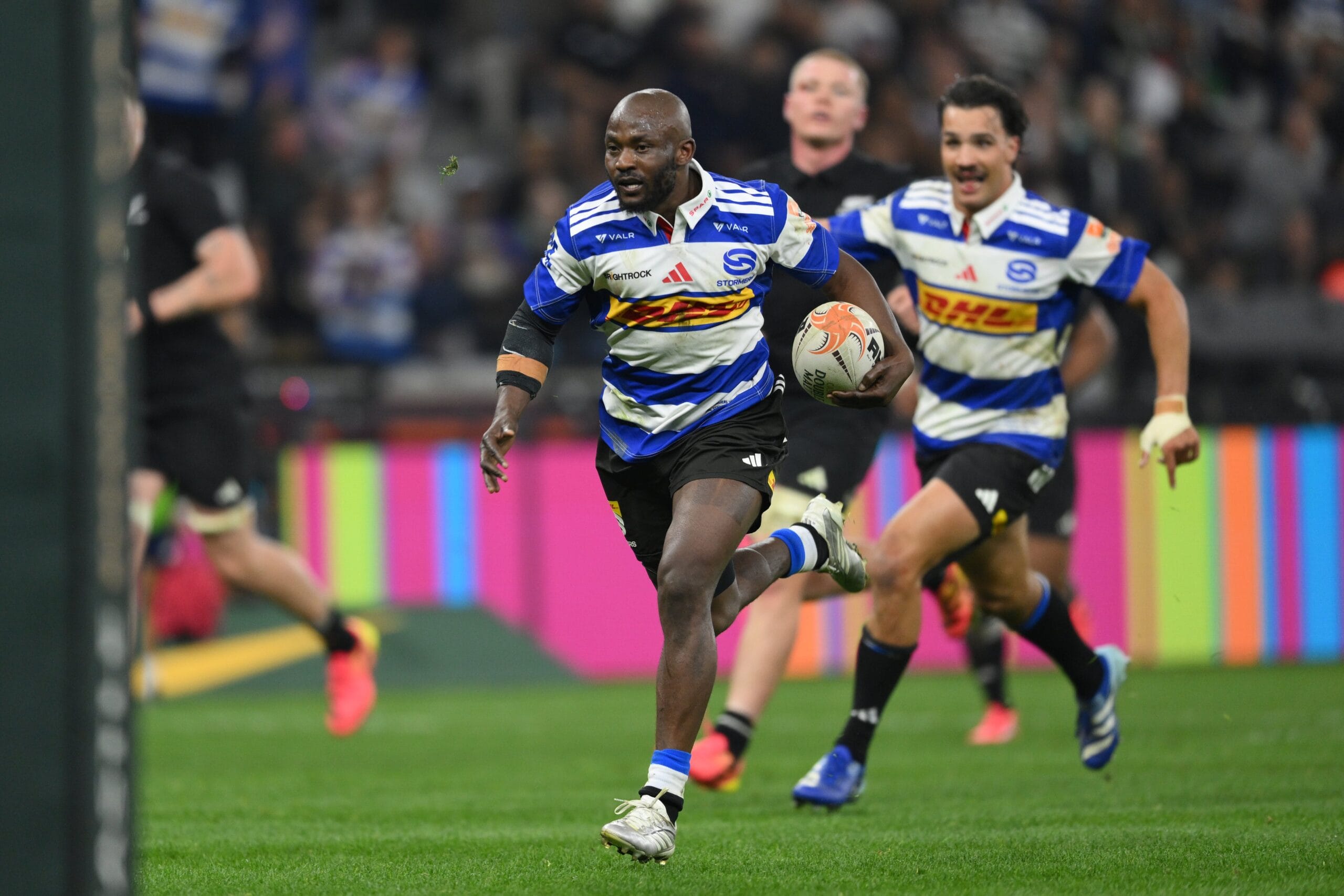
The Stormers came within touching distance of one of the biggest upsets in their history before a handful of crucial moments allowed the All Blacks to pull away at DHL Stadium on Friday night.

New Zealand eventually won 38-21 in the opening match of the Greatest Rivalry series, but the scoreline does not tell the full story.

At 14-14 after 65 minutes, the Stormers had genuine belief.

They had weathered a difficult opening, recovered from defensive lapses and gradually forced the All Blacks into a contest they were expected to dominate.

Then the game turned.

Rieko Ioane, Lee Roy Carter and Josh Moorby scored tries as New Zealand produced the clinical finishing expected from one of rugby’s most decorated teams.

For Stormers coach John Dobson, the frustration was knowing his side had created enough opportunities to make the result far more interesting.

“We dared to dream for a while, there were a couple of big moments,” Dobson said.

Those moments ultimately proved decisive.

Seabelo Senatla’s linebreak was one of them. The Stormers looked set to attack with real momentum before the opportunity ended in a penalty.

A promising maul on the far side also broke down when possession was lost.

Then came the pivotal passage at 14-all.

The Stormers were defending well and had the All Blacks under pressure, according to Dobson, before a scrum decision went against the hosts and New Zealand turned the resulting momentum into a try.

“They were shut down and boxed in, and that’s when I thought we really had a chance,” Dobson said.

Captain Ruhan Nel identified another critical moment.

The Stormers were in New Zealand territory with the scores level when a pick-and-go ended with the ball being lost forward.

Within moments, the Stormers were defending in their own 22.

New Zealand scored.

“If we converted that opportunity and go up 21-14, you’re feeling strong,” Nel said.

It was the sort of fine margin that separates a famous victory from a respectable defeat.

The Stormers had been written off before kick-off, with plenty of pre-match predictions suggesting the All Blacks would overwhelm them.

For long periods, the opposite was true.

New Zealand’s passing game eventually exposed the Stormers, but Dobson was full of praise for the skill level of the visitors.

“They pass so well. That style of rugby is magnificent,” he said.

Nel, meanwhile, was left with the unavoidable question of what might have been.

“I do feel there was an opportunity of two for us out there and if we handled it a little bit better we would’ve sung a different song,” he said.

The Stormers did not produce the historic result they dared to imagine.

They did, however, prove they belonged in the conversation.

Against the All Blacks, that is no small consolation.

The next step is turning those big moments from missed opportunities into match-winning ones.

The scorers:

Stormers:
Tries: Fourie, Senatla, penalty try
Cons: Ahmed 2

New Zealand:
Tries: Taukei’aho, Parker, Ioane, Carter, Moorby, Aumua
Cons: Barrett 3, Jacomb

DHL Stormers: 15 Warrick Gelant, 14 Seabelo Senatla, 13 Ruhan Nel (captain), 12 Jonathan Roche, 11 Leolin Zas, 10 Yaqeen Ahmed, 9 Imad Khan, 8 Evan Roos, 7 Hacjivah Dayimani, 6 Deon Fourie, 5 Connor Evans, 4 Adré Smith, 3 Neethling Fouché, 2 André-Hugo Venter, 1 Vernon Matongo.
Replacements: 16 JJ Kotzé, 17 Ntuthuko Mchunu, 18 Herman Lubbe, 19 Ruan Ackermann, 20 Keke Morabe, 21 Wandile Mlaba, 22 Dewaldt Duvenage, 23 Wandisile Simelane.

New Zealand: 15 Josh Moorby, 14 Leroy Carter, 13 Billy Proctor, 12 Anton Leinert-Brown, 11 Rieko Ioane, 10 Beauden Barrett, 9 Cortez Ratima, 8 Peter Lakai, 7 Anton Segner, 6 Simon Parker, 5 Patrick Tuipulotu, 4 Fabian Holland, 3 Pasilio Tosi, 2 Samisoni Taukei’aho, 1 George Bower.
Replacements: 16 Asafo Aumua, 17 Ollie Norris, 18 Siale Lauaki, 19 Sam Darry, 20 Ethan Blackadder, 21 Kyle Preston, 22 Josh Jacomb, 23 Caleb Clarke

Images: x.com/THESTORMERS

Deon Fourie comes full circle as Stormers hand ‘The Chef’ his chance

Adnaan Mohamed

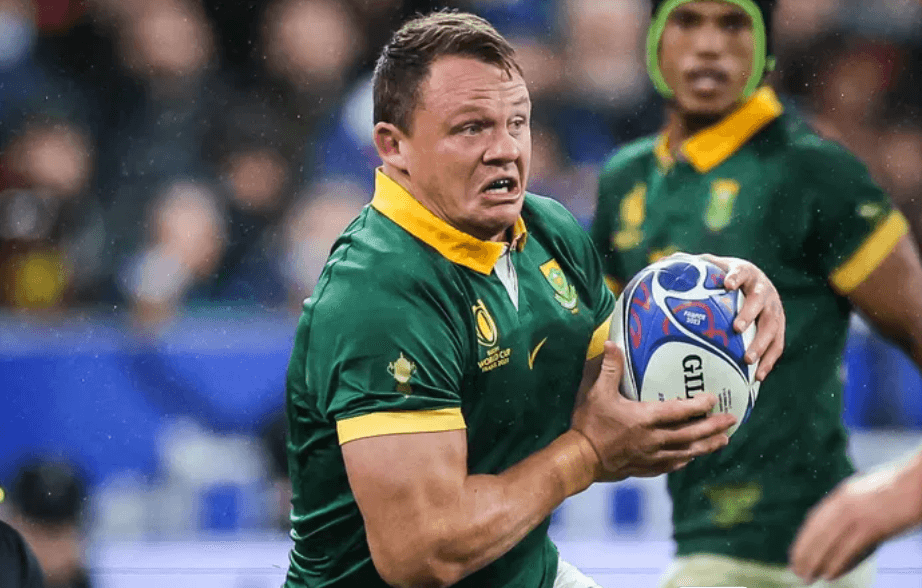
Deon Fourie’s return for the Stormers against the All Blacks on Friday carries a remarkable sense of rugby symmetry.

The veteran loose forward’s previous appearance against New Zealand came in the Springboks’ dramatic 12-11 Rugby World Cup final victory in Paris in 2023. His comeback now arrives as the Stormers prepare to face the All Blacks for the first time since Western Province’s famous 12-11 victory at Newlands in 1976.

The scoreline is impossible to ignore.

For Fourie, it is another meeting with rugby’s oldest measuring stick. For the Stormers, it is an opportunity to reconnect with one of the Cape’s great rugby memories.

The 39-year-old has been sidelined since May after suffering a knee injury from a croc-roll by Ulster lock Iain Henderson in a URC clash. More than 10 weeks after surgery, he says he is ready.

“It’s about 10 or 11 weeks after the operation. Fitness-wise, I’ll probably only be able to tell you on Friday,” Fourie said.

“I am definitely raring to go, and it’s a great opportunity. I was looking forward to this match since it was announced a year or two ago.”

Few players understand the occasion better.

Fourie spent 77 minutes at hooker after replacing the injured Bongi Mbonambi early in the 2023 World Cup final. Playing through a shoulder injury, he made 21 tackles, captained the Springboks during the closing stages after Siya Kolisi’s yellow card and helped preserve South Africa’s one-point victory.

He admits another chance to face the haka seemed unlikely.

“I didn’t know if I would still be able to play this year, but fortunately everything went well, and I will get an opportunity to face the haka again.”

The veteran has not given up on adding to his Springbok career either.

“You always want to wear the green and gold jersey. Hopefully, I can put in a good performance and put my hand up for one or two more Tests.”

While Fourie represents experience, the Stormers are also preparing to unveil one of South African rugby’s brightest young talents.

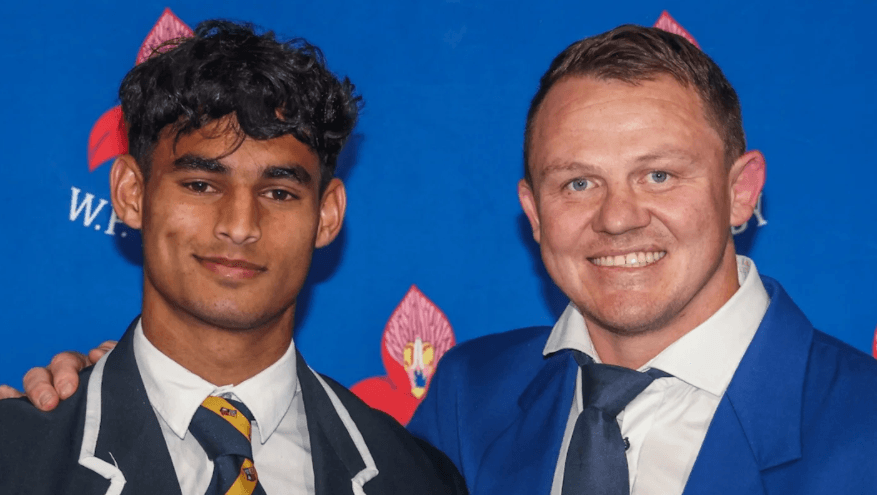
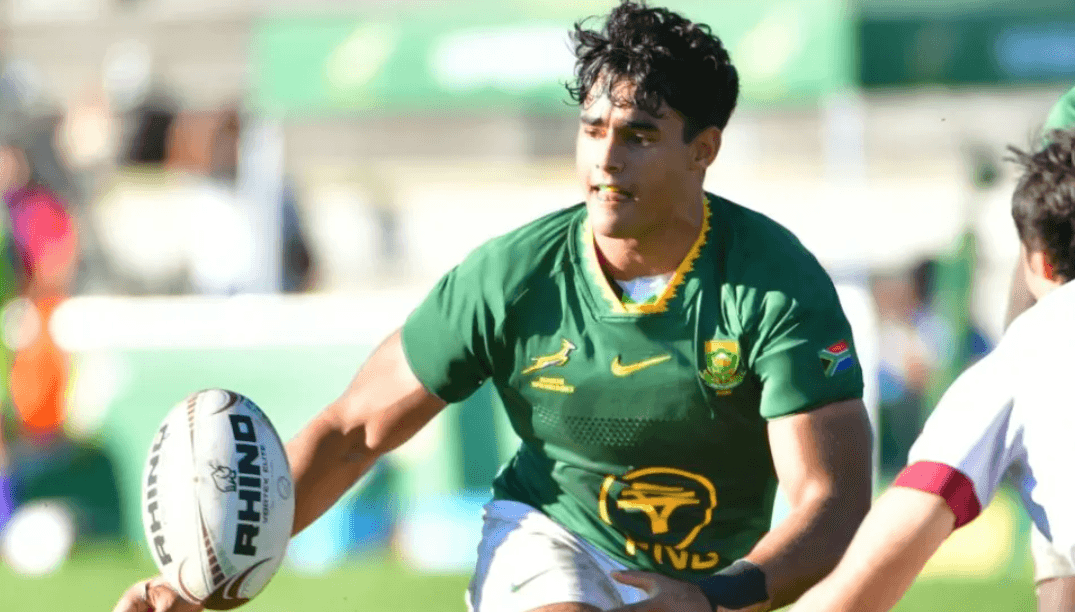
Highly rated 20-year-old Junior Springbok flyhalf Yaqeen Ahmed is expected to make his senior Stormers debut.

Nicknamed “The Chef” for his ability to cook up attacking opportunities, Ahmed has earned a reputation as one of the country’s most gifted young playmakers. He is expected to partner 22-year-old scrumhalf Imad Khan in a youthful halfback combination against the world’s second-ranked side.

The opportunity has come with several experienced playmakers unavailable.

Sacha Feinberg-Mngomezulu is expected to rejoin the Springboks for Saturday’s Rugby Championship Test against Argentina, while Jurie Matthee continues his recovery from injury.

It leaves Ahmed with one of the toughest introductions in world rugby.

Friday’s clash therefore becomes a meeting of generations.

One player is approaching his 40th birthday and chasing another opportunity in green and gold. The other is taking his first steps at senior provincial level.

One carries the scars of rugby’s biggest battles.

The other carries the promise of many still to come.

Against the All Blacks, there is rarely a gentle beginning or a sentimental ending. There is only the next chapter.

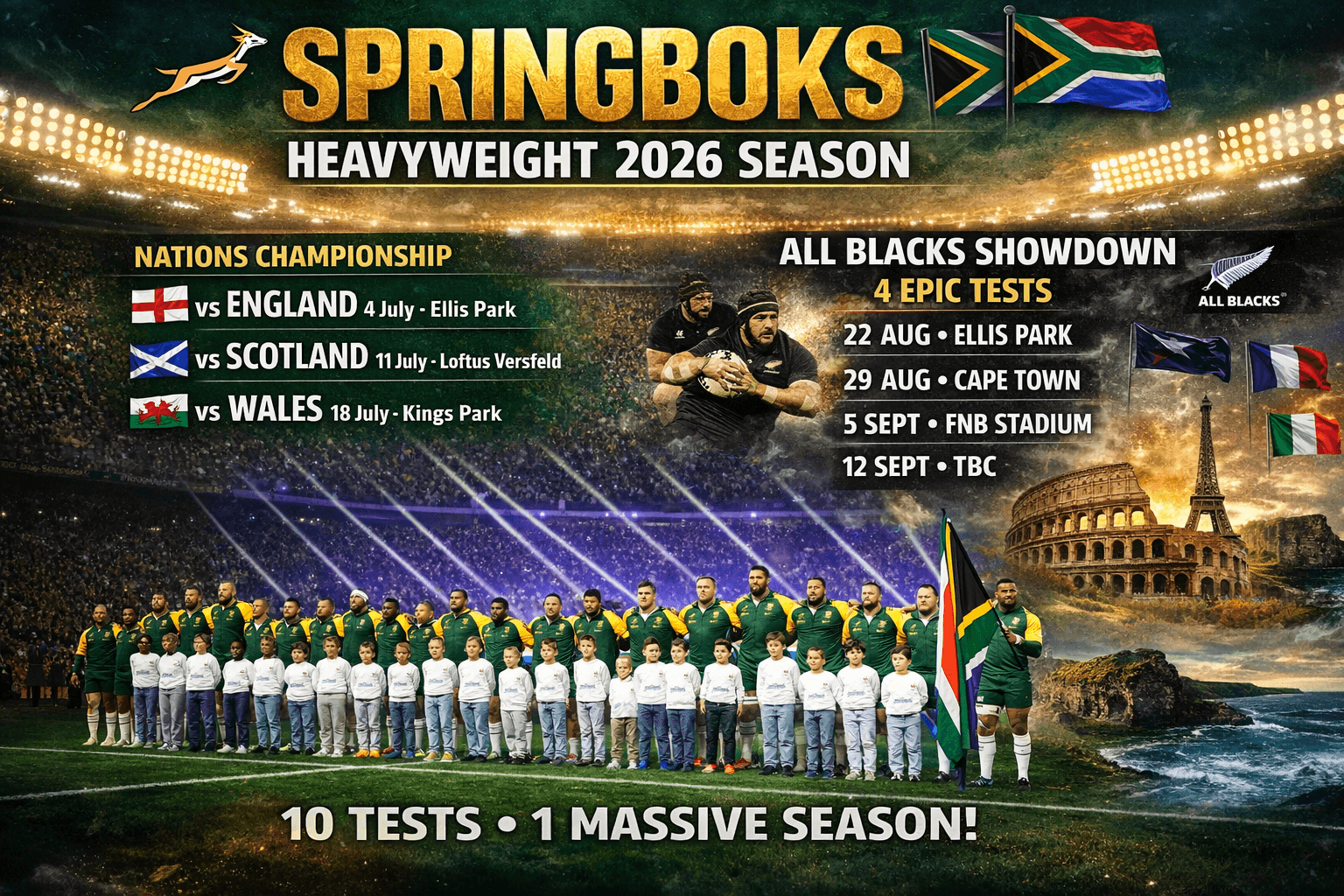
Springboks Brace for Heavyweight 2026 Rugby Season

Adnaan Mohamed

The Springboks’ 2026 Test calendar reads like a greatest-hits album pressed into green and gold vinyl. Ten fixtures. Eight heavyweight opponents. Iconic stadiums. Familiar foes. Old grudges. New chapters.

From the winter chill of Ellis Park in July to facing the All Blacks in Rugby’s Greatest Rivalry Four-Test Series, followed by the furnace of a late-season Nations Championship finale, South Africa’s world champions are primed for a campaign that promises collision, combustion and classic rugby theatre.

The season kicks off with a trio of home Tests against northern hemisphere visitors, as England, Scotland and Wales tour South Africa in July. England arrive at Ellis Park on 4 July still licking their wounds from a 29–20 defeat in 2024, while Scotland head to Loftus Versfeld a week later hoping to improve on a 32–15 loss. Wales complete the mid-year run at Kings Park on 18 July, returning to the scene of a humbling 73–0 defeat in 2025, a reminder of just how ruthless the Springbok machine can be when fully oiled.

August and September then ignite Rugby’s Greatest Rivalry Series as the All Blacks cross swords with the Boks in a four-Test epic that will stretch both squads to breaking point. Ellis Park (22 August), Cape Town Stadium (29 August) and FNB Stadium (5 September) host the opening three clashes, with a fourth Test scheduled for 12 September at a venue still to be confirmed. The last time the sides met in 2024, South Africa delivered a commanding 43–10 statement, but history teaches that past results mean little when black meets green.

The season’s final act unfolds on the road in November, with the Springboks entering the Nations Championship cauldron against Italy (6–8 November), France (13–15 November) and Ireland (21 November), all at venues yet to be confirmed. Italy will seek to overturn a 32–14 defeat from 2025, while France and Ireland, beaten 32–17 and 24–13 respectively, loom as familiar obstacles on the high-pressure European stage.

From altitude to ocean, from ferocious rivals to wounded challengers, the 2026 Springbok campaign is built like a forward pack: heavy, balanced and relentless. Every Test is a tackle waiting to happen. Every whistle, a fresh battle cry.

Springboks 2026 Fixtures

July – Home Tests (Nations Championship)

  • 4 July: vs England – Ellis Park, Johannesburg
  • 11 July: vs Scotland – Loftus Versfeld, Pretoria
  • 18 July: vs Wales – Kings Park, Durban

August–September – All Blacks Series

  • 22 August: vs New Zealand – Ellis Park, Johannesburg
  • 29 August: vs New Zealand – Cape Town Stadium
  • 5 September: vs New Zealand – FNB Stadium, Johannesburg
  • 12 September: vs New Zealand – Venue TBC

November – Nations Championship (Away)

  • 6–8 November: vs Italy – Venue TBC
  • 13–15 November: vs France – Venue TBC
  • 21 November: vs Ireland – Venue TBC

Boks brace for All Black war in Wellington

Adnaan Mohamed

Wellington has always been a theatre of drama for the Springboks. From that famous 36-34 ambush in 2018 to the nail-biting 16-16 draw a year later, the Cake Tin has witnessed South Africa’s grit under the fiercest spotlight.

On Saturday morning, Siya Kolisi and his men return to the capital with the Rugby Championship title race wide open, the Freedom Cup on the line, and pride at stake against their oldest foes.

Assistant coach Mzwandile Stick knows exactly what it will take.

“Last week we had two soft moments early in the game, and it cost us,” he reflected on the 24-17 defeat in Auckland.

“This time, we need to be at our best for the full 80 minutes. We must be clinical, execute with precision, and turn opportunities into points.”

It is a simple equation against the All Blacks: blink, and you bleed.

Kolisi, who will lead the Boks for his 96th Test, echoed Stick’s call for composure. The chatter around South Africa’s new-look backline being too young, too raw, too untested, doesn’t faze him.


“There’s a good mixture of players in this team,” he said.

“Some have been here before, some have lifted two World Cups. It’s not a completely new side. The new faces bring something different, and that excites me.”

For Kolisi, the challenge feels familiar yet fresh.

“It’s going to be intense, like a World Cup final in the way you need to stay calm and composed. But this is its own battle. There’s enough motivation to win this game and to make our country proud.”

The Freedom Cup adds its own layer of symbolism. South Africa claimed it last year for the first time since 2009, and defending it on New Zealand soil would be another statement of intent.

More importantly, a win would keep them in reach of both the Rugby Championship title and the No 1 world ranking.

The All Blacks will be ready, the crowd baying, the weather unpredictable. But as Kolisi leads his men out one truth remains: matches in Wellington are rarely forgotten.

Teams

New Zealand: 15 Damian McKenzie, 14 Will Jordan, 13 Billy Proctor, 12 Jordie Barrett, 11 Leroy Carter, 10 Beauden Barrett, 9 Noah Hotham, 8 Wallace Sititi, 7 Ardie Savea, 6 Simon Parker, 5 Tupou Vaa’i, 4 Scott Barrett (captain), 3 Tyrel Lomax, 2 Samisoni Taukei’aho, 1 Ethan de Groot.
Replacements: 16 Brodie McAlister, 17 Tamaiti Williams, 18 Fletcher Newell, 19 Fabian Holland, 20 Du’Plessis Kirifi, 21 Finlay Christie, 22 Quinn Tupaea, 23 Ruben Love.

South Africa: 15 Aphelele Fassi, 14 Cheslin Kolbe, 13 Canan Moodie, 12 Damian Willemse, 11 Ethan Hooker, 10 Sacha Feinberg-Mngomezulu, 9 Cobus Reinach, 8 Jasper Wiese, 7 Pieter-Steph du Toit, 6 Siya Kolisi (captain), 5 Ruan Nortje, 4 Lood de Jager, 3 Thomas du Toit, 2 Malcolm Marx, 1 Ox Nche.
Replacements: 16 Marnus van der Merwe, 17 Jan-Hendrik Wessels, 18 Wilco Louw, 19 RG Snyman, 20 Kwagga Smith, 21 Grant Williams, 22 Manie Libbok, 23 Andre Esterhuizen.

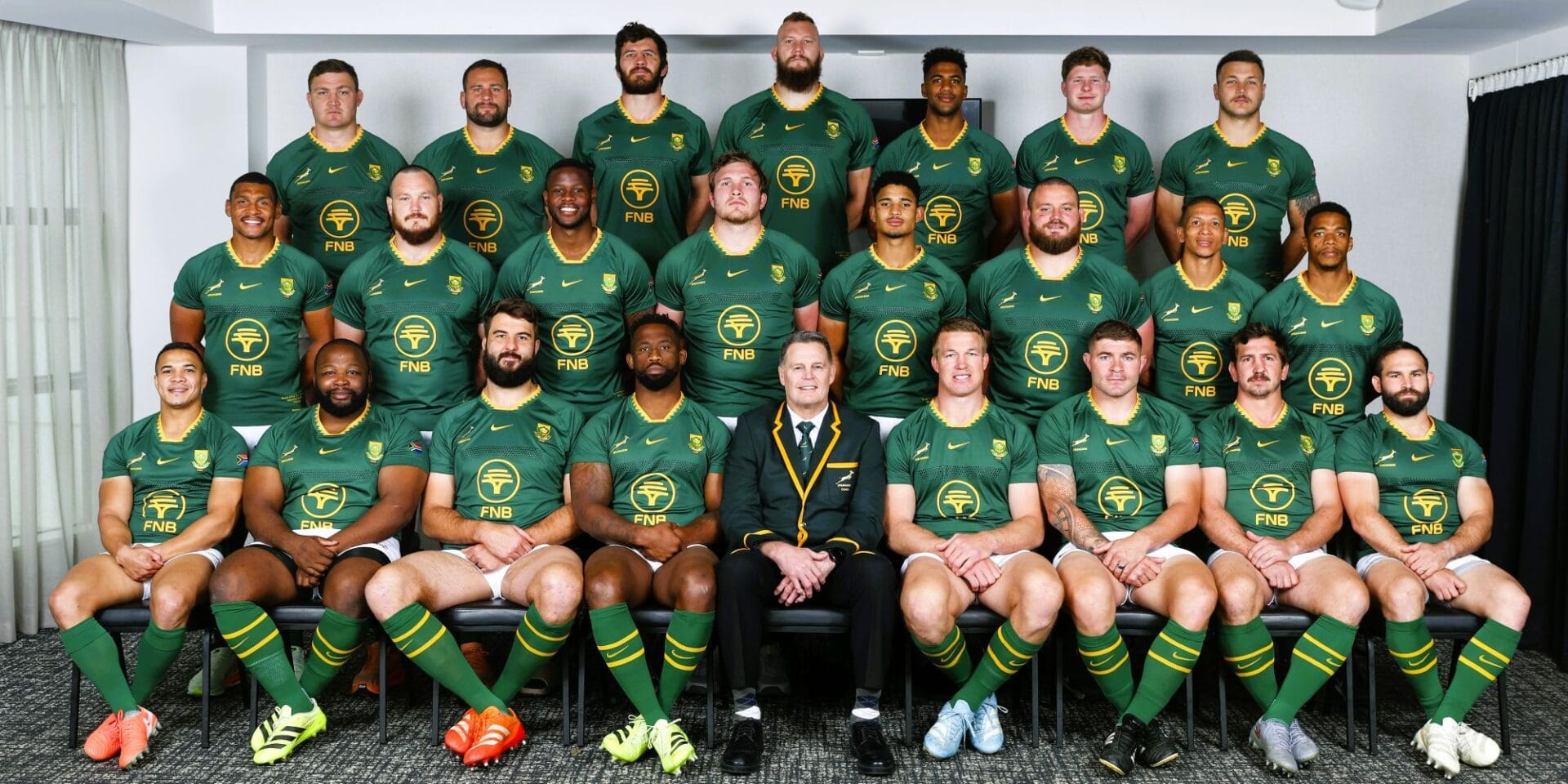
Springbok Team Photo in Wellington Credit: SA Rugby

Date: Saturday, September 8
Venue: Wellington Regional Stadium
Kick-off: 09.05 SA time
Referee: Nika Amashukeli (Georgia)
Assistant referees: Angus Gardner (Australia), Jordan Way (Australia)
TMO: Eric Gauzins (France)