


Proteas v Black Caps: Redemption, Rivalry and T20 World Cup Stakes

By Adnaan Mohamed

At the ICC Men’s T20 World Cup, co-hosted by India and Sri Lanka, the Proteas arrive at Saturday’s showdown against New Zealand still catching their breath after a double Super Over escape against Afghanistan.

It was chaos dressed as control. It was a match South Africa should have closed, but instead allowed to smoulder before stamping it out with singed fingers.

Now comes a sterner examination in the form of a Black Caps side clinical in temperament and tactically astute. And hovering above it all are two men in contrasting spotlights: Kagiso Rabada and Rachin Ravindra.

In the Spotlight: Rabada’s Redemption, Ravindra’s Reinvention

Rabada remains one of South Africa’s premier fast-bowlers with thunderbolt pace, big-match pedigree, and the ability to bend a contest to his will. Yet numbers whisper unease.

Since 2025, he averages 34.55 in T20Is with an economy of 9.82. Injury breaks and workload management have limited him to nine games in that stretch, but rhythm in T20 cricket is like swing under lights it vanishes quickly.

Against Afghanistan, two no-balls in the final over cracked open the door to disaster. That chaotic 20th over nearly cost the Proteas the match. But dropping Rabada now would be reactive rather than rational. Strike bowlers are not porcelain; they are forged in pressure. Back him, simplify his brief, and trust the muscle memory.

If Rabada channels control instead of emotion, he becomes South Africa’s edge against New Zealand’s deep batting line-up.
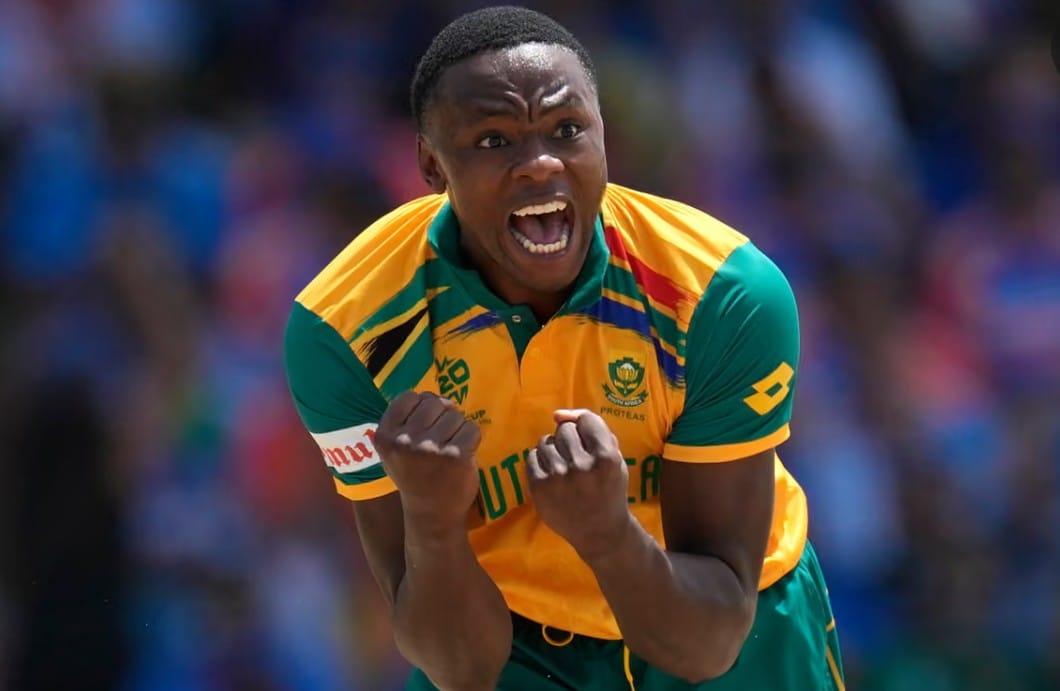
Kagiso Rabada Photo: CSA

Across the aisle stands Ravindra with potential personified.

His international T20 numbers are modest: strike rate 135.19, average 19.09, three half-centuries in 40 innings. Yet statistics sometimes trail evolution. Recent cameos against India revealed a more assertive No. 3, one capable of manipulating spin and accelerating against pace.

Against South Africa, Ravindra’s left-handedness could become tactical gold. If he and New Zealand’s cluster of left-handers target Keshav Maharaj early, the middle overs could tilt black.

Saturday clash will be more about trajectory.

South Africa: The Four Pillars So Far

1. Ryan Rickelton – Composed at the crease, assertive in tempo. He has been South Africa’s glue at the top, blending patience with acceleration. His reading of spin on tricky surfaces has stood out.

2. Quinton de Kock – Two runs shy of 3000 T20I runs, he remains the Proteas’ ignition switch. When he fires in the powerplay, South Africa dictate terms.

3. Keshav Maharaj – On surfaces offering grip, Shamsi has threaded spells like a seamstress in a storm — calm, clever, disruptive. His middle-overs control has repeatedly applied brakes to opposition surges

4. Lungi Ngidi – Man of the Match in both matches, been the Proteas paceman has been South Africa’s most effective bowler with 7 wickets in two matches 

Rabada may command headlines, but these four have quietly shaped South Africa’s campaign.

New Zealand: The Black Caps’ Key Cogs

1. Devon Conway – He absorbs pressure and resets innings without fuss. His ability to bat deep gives New Zealand structural integrity.

2. Glenn Phillips – The detonator. Few in world cricket clear ropes with such ease in the death overs. If Phillips is set at 15 balls to go, the scoreboard can warp quickly.

3. Mitchell Santner – Captain and control merchant. Just 30 runs short of 1000 T20I runs, Santner’s value lies in balance with is left-arm spin strangulation and ice-cool leadership.

Ravindra may be the wildcard, but these three are the pillars.

Selection Chess: Bosch or Balance

South Africa’s selection dilemma mirrors tactical nuance.

They replaced seam-bowling allrounder Corbin Bosch with left-arm spinner George Linde against Afghanistan. But playing two left-arm finger spinners, Linde and Maharaj, against a New Zealand top eight potentially stacked with four left-handers may feel like feeding symmetry to the opposition.

Bosch’s return would restore seam variety and late-order hitting. On the red-soil surface used in the Afghanistan thriller, flat but honest, seamers who vary pace could prosper under lights.

New Zealand is unlikely to tinker unless the pitch wears dramatically, in which case Ish Sodhi becomes a spin option.

Conditions & Tactical Undercurrents

The same red-soil strip that produced the Super Over epic will host this clash. Expect pace early, grip later, and dew as a complicating actor in the second innings.

Toss may matter more under lights. Discipline will matter most.

As Aiden Markram admitted, 22 extras across two matches is a bleeding wound. In T20 cricket, 11 free runs per game is not generosity, it’s negligence.

History vs Momentum

South Africa have won all four of their previous T20 World Cup meetings with New Zealand. Yet in this decade, the Black Caps have taken the last three bilateral T20I encounters.

The past whispers. The present shouts louder.

What Decides Saturday?

  • Powerplay Duel: Boult versus De Kock. Swing versus swagger.
  • Spin Manipulation: Can Ravindra counter Maharaj?
  • Death Discipline: Rabada under pressure, Phillips in pursuit.

This rivalry, sharpened by rugby fields and cricket squares alike, rarely disappoints.

New Zealand are methodical surgeons. South Africa are emotional sculptors. One chisels; the other carves.

If the Proteas learned from Ahmedabad’s firestorm, they will arrive tempered. If not, the Black Caps will not require a second invitation.

Proteas begin West Indies T20 series as World Cup preparation intensifies

By Adnaan Mohamed

The streamers has barely settled on the pitch, yet the cricketing carousel is already spinning at full tilt. Less than 48 hours after the SA20 final, seven players are back in harness, this time in national colours as South Africa and the West Indies begin a trimmed three-match T20 series, a final nets session before the T20 World Cup spotlight switches on.

Originally slated for five games, the series was shortened to avoid colliding with the World Cup support window. Make no mistake, though this is no gentle loosener. Both teams are still bruised from the last global showpiece. South Africa reached the final and had one hand on the trophy before India snatched it away by seven runs. West Indies fell at the Super Eights hurdle, undone by the Proteas. The hunger to go one better burns like a fresh new ball on a green pitch.

For South Africa, the backdrop is complicated. Results in 2025 were uneven – 12 losses in 18 matches and no series wins – often due to injuries and players juggling formats.

All-format coach Shukri Conrad will still want a series victory inked next to his name, even if this contest is labelled “preparatory”.

Management, however, have opted for rotation. Quinton de Kock, Marco Jansen and Tristan Stubbs—fresh from lifting the SA20 trophy with Sunrisers Eastern Cape against Pretoria Capitals—have been rested for Tuesday’s first T20 in Paarl. Lhuan-dre Pretorius and Eathan Bosch step in as short-term replacements.

The series is a dress rehearsal for the T20 World Cup starting next week in India, where rhythm matters as much as results.

Markram’s joy for Stubbs and empathy for Maharaj

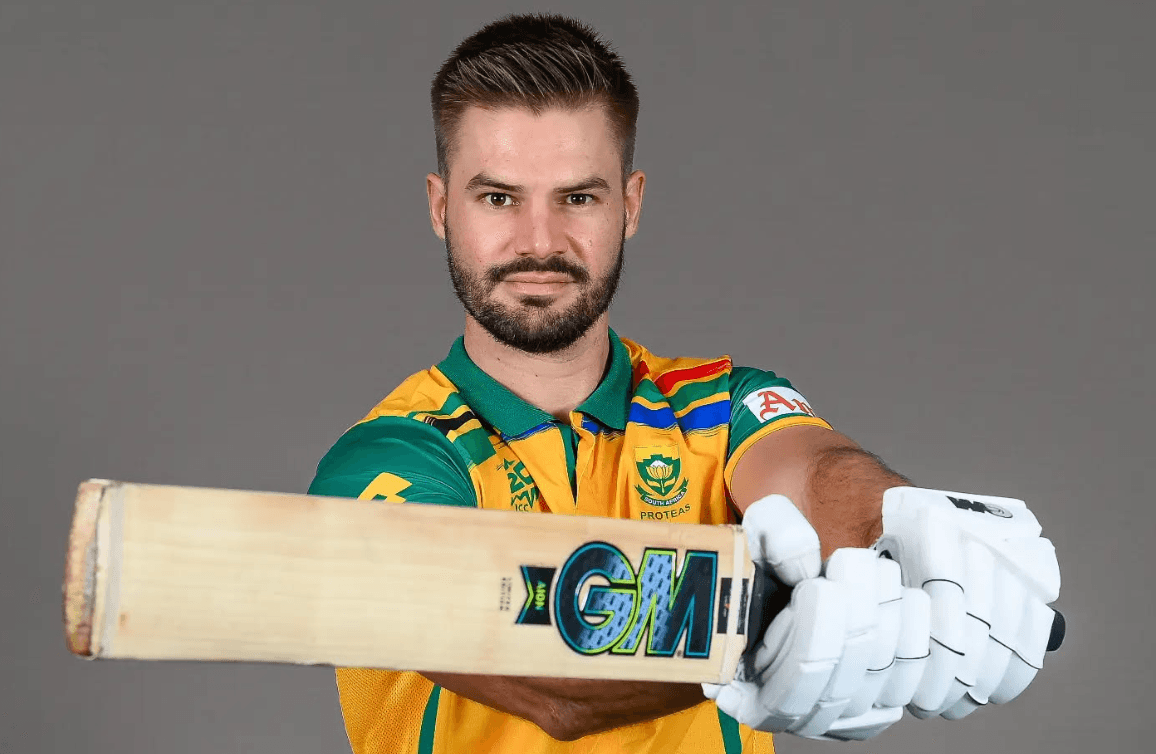
Aiden Markram Photo: CSA

Proteas T20 captain Aiden Markram, who knows the Sunrisers’ dressing room intimately, was glowing about Stubbs’ match-defining final.

“He’s one of the guys in the team everyone wants to see do well. He’s that sort of person, and he grafts hard, he’s the ultimate pro.

And when you put the hard work in and don’t get the results you can get quite down on yourself, even your peers feel sorry for you. Then to come out and play a knock like that last night [Sunday], you can only be happy for him. It’s great to do it in final.

And when you do well in big games you take that confidence to the next one.”

Stubbs’ unbeaten 63 off 41 balls, alongside Matthew Breetzke’s 68 off 49, powered the Sunrisers’ chase of 159 with balls to spare – an innings stitched together like a perfectly timed partnership.

On the losing side stood Keshav Maharaj, Capitals skipper and Proteas stalwart. Markram understood the sting.

“As a person he’s an all-in type of guy, and it would have hurt him. He’s not an emotional kind of guy.

It’s just that he cares and puts a lot of love into it, then you come up just short, and the way the game unfolded as well, I understand why he’s hurting.

When I see him I’ll put an arm around him, get him riled up. I chatted to him a bit last night and said the trophy you want to win is the one in a few weeks time and that’s what we’ll go for now, and he’s all in for that.

We’ll try get him over last night as quick as we can and get him looking forward to the world cup as quick as we can.”

Now the whites are folded away, the national caps pulled on, and the scoreboard reset to zero. The real exam looms, but first, three high-tempo auditions under Paarl’s lights.

South Africa squad vs West Indies (T20s)

Aiden Markram (capt), Corbin Bosch, Dewald Brevis, Lhuan-dre Pretorius, Rubin Hermann, George Linde, Keshav Maharaj, Kwena Maphaka, Lungi Ngidi, Anrich Nortje, Kagiso Rabada, Ryan Rickelton, Jason Smith, Eathan Bosch

Proteas Rise in India: Shukri and Temba leads a masterclass in resilience

By Adnaan Mohamed

For years, touring India has felt like stepping into cricket’s equivalent of the “Death Zone” in brutal conditions, deafening crowds, and a cauldron of pressure where even great teams lose their bearings. South Africa has known that pain too well. Heavy defeats. Broken confidence. Tours remembered for their scars rather than their strides forward.

But this time, something powerful shifted.

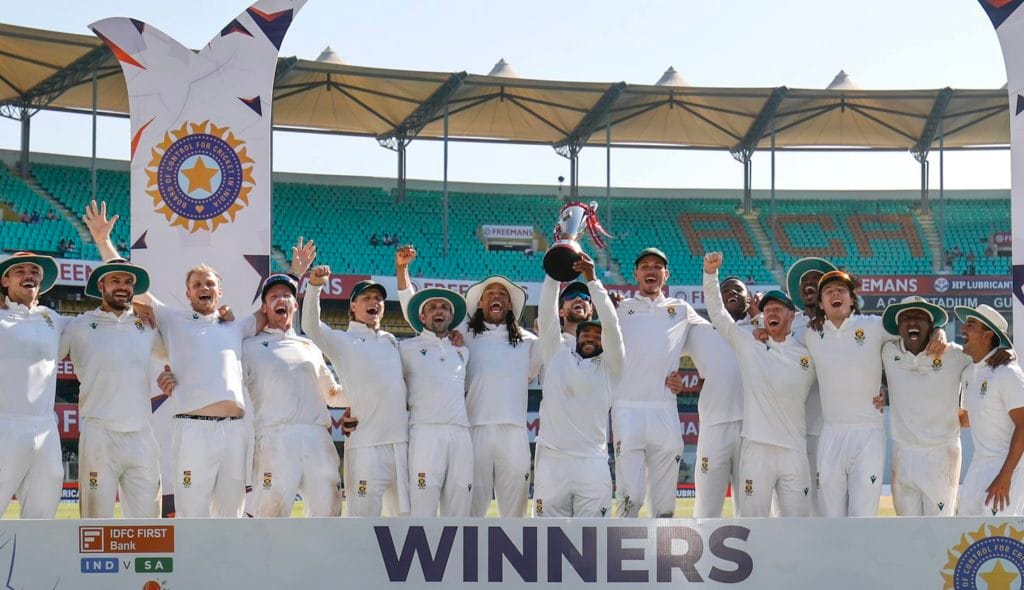
In a story worthy of every athlete who has ever been told they’re not enough, the Proteas walked back into the lion’s den, and roared back even louder, sealing a historic 2–0 Test series win, their first in India in 25 years.

The victory was a reset, a reclaiming of identity, and a reminder of what’s possible when belief becomes bigger than fear.

A Captain Who Carries More Than the Badge

Temba Bavuma’s journey mirrors the heartbeat of modern sport in South Africa: resilience, self-discovery, and the courage to keep standing up when the world expects you to stay down.

Twice before he had toured India. Twice he came home with the kind of numbers and memories most athletes try to forget. Thrown into unfamiliar roles, navigating team turmoil, and battling his own form demons, Bavuma could easily have let those failures define him.

But the man who walked out in Guwahati was not the same athlete.

He was calmer. Clearer. Centered. A captain who had found his voice. A leader whose strength lay not in shouting orders, but in empowering others.

“Coming here, I would never have thought 2–0 would be the result,” Bavuma admitted.

“We know how dark it can be, so getting 2–0 here is an incredible achievement. We’ve painted ourselves into history.”

This is the language of someone who understands the trenches and knows what it means to climb out of them.

A Team Built on Trust, Not Ego

Under coach Shukri Conrad, the Proteas have become more than just a squad. They’re a collective built on shared ownership. Conversations are open. Roles are clear. Leadership is distributed like responsibility in a relay race, everyone carries the baton at some point.

“I’m a lot more assured as a person and as a captain,” Bavuma said.

“We have a lot of leaders in the team. Guys who add value in their own space. Guys I bounce ideas off. And I’ve learned to separate Temba the batter from Temba the captain.”

For athletes, this is gold: Identity is not a single performance. Leadership is not a solo act.

Champions Step Up When It Matters

Great teams need great moments. And South Africa found them everywhere.

  • Simon Harmer, returning to the very country where his career once stalled, produced the greatest bowling series by any visiting spinner in India: 17 wickets at 8.94. A statistic and a story built on grit.
  • Marco Jansen was a walking highlights reel: destructive bouncers, crucial runs, and a catch so athletic it bordered on impossible.
  • Aiden Markram reinvented himself as South Africa’s safest pair of hands, plucking a world record nine catches and steadying the mood whenever needed.

This wasn’t a win built on stars. It was built on synergy and those subtle connections athletes feel when the entire team is in rhythm.

Rising Above the Weight of History

India had lost just one series at home in 12 years. Their fans are famously unyielding. Their conditions notoriously unforgiving. And yet, the Proteas showed that history, no matter how intimidating, is only a backdrop, not a destiny.

Their 408-run win in the second Test wasn’t just dominance; it was a message:

This team is evolving. Growing. Believing.

For South African cricket, often weighed down by near misses and what-ifs, this was an emphatic reminder that the future can be bold, bright, and beautifully unpredictable.

What This Means for the Athlete in All of Us

Every athlete, whether you run trails, swim laps, hit gym reps, or chase PBs knows what it feels like to revisit a place of past disappointment. The doubt. The fear. The ghosts.

What the Proteas did in India is what everyone strives for:

  • To return to a place of pain, and rewrite the story.
  • To trust the process even when your stats say you shouldn’t.
  • To lead with humility, not ego.
  • To push through dark moments because the light ahead is worth it.
  • To discover that your greatest breakthroughs often hide behind your greatest failures.

Bavuma and his team won a cricket series and delivered a universal message of courage:

Your past is not a prophecy. Your setbacks are not your ceiling. Your biggest victories often arrive exactly where you once struggled most.

And sometimes, after 25 long years, everything aligns, and you finally conquer your Everest.

Tumi Sekhukhune Ready To Rise Again At The Icc Women’s T20 World Cup 2024

As the Proteas Women gear up for the ICC Women’s T20 World Cup 2024 in the United Arab Emirates (UAE), Tumi Sekhukhune finds herself at a defining moment in her career. After battling through injuries and missing the 2023 home World Cup, the seasoned seam bowler is ready to prove her worth and represent her community of Daveyton, Johannesburg, with pride.

Overcoming Setbacks

For Sekhukhune, missing last year’s T20 World Cup was a significant setback. “It wasn’t a nice experience for me, especially because it was at home. Playing on a global stage in front of my family would have been very special,” she shares. However, this disappointment spurred her to work even harder.

“I had to sharpen my skills and reflect on what I could offer to the team,” she says. The aftermath of her recurring groin injury in 2022 and her exclusion from the World Cup squad led to both mental and physical challenges. “I had a mental breakdown. Sometimes you feel like you’re not enough, or that your skills aren’t enough.”

Motivated by her teammates and provincial coaches, including former DP World Lions coach and new Proteas Women fielding lead Bongani ‘Coach Fantastic’ Ndaba, Sekhukhune found a way forward. “I had coaches who helped me improve in specific areas, and taking small steps helped me stay motivated,” she adds.

Despite the challenges of regaining fitness, she maintained her focus. “Some days, I didn’t feel like doing anything, but I told myself to take it one day at a time.”

Pride in Representing Daveyton

Daveyton, her hometown, has always played a significant role in Sekhukhune’s journey. “Growing up in Daveyton shaped the person I am today,” she reflects. A multi-talented athlete who participated in handball, volleyball, and netball in her youth, Sekhukhune’s transition to cricket allowed her to showcase her skills on an international stage when she made her debut in September 2018.

Representing her community in the World Cup fills her with pride. “It’s special to see people from Daveyton supporting me, posting messages on social media, and knowing they’re 100% behind me. That connection really means a lot to me.”

Preparing for the World Cup

Securing her spot in the 2024 T20 World Cup squad is a milestone for Sekhukhune. “One of my main goals was to get selected for the World Cup. Now that I have, my focus is on staying consistent, ensuring I’m prepared, and being ready to seize opportunities when they come.”

Sekhukhune has also tailored her training to adapt to the challenging conditions in the UAE. “I spent more time in the sun, trying to get used to the conditions. Our tour of Pakistan before heading to the UAE helped me adjust to the heat.” As a senior player, she knows her role goes beyond just bowling. “It’s important for me to contribute as much off the field as on it. My bowling style suits these conditions, and with the team’s success last year, there’s pressure, but I’m ready for it.”

Personal Growth and Reflection

The past few years have provided Sekhukhune with opportunities for personal growth. “I had to unlearn certain habits and adopt new ones. It wasn’t easy, but it helped me improve both as a cricketer and as a person.” Her time away from the game allowed her to reconnect with family and friends. “I spent more time with family, friends, and my dog, which helped me stay grounded.”

She also pursued her studies during recovery. “My injury gave me time to focus on finishing my degree in Supply Chain Management in Logistics, and my family motivated me to continue my education.”

Advice to Future Proteas

Sekhukhune has learned the value of patience and discipline in overcoming setbacks. “Sports come with challenges and injuries, but it’s important to stay grounded. Do your gym work, train hard, and fuel your body with the right nutrients. When setbacks come, be disciplined and trust the process.”

For young girls dreaming of playing for the Proteas, her message is clear: “Cricket is a rewarding game, filled with ups and downs. Keep working on your craft, stay patient, and even if you fall down, you’ll rise again. Believe in yourself, and know that you are going places.”

Ready to Shine Again

Sekhukhune’s journey back to fitness and form is a testament to her strength and determination. As she prepares for the ICC Women’s T20 World Cup 2024, she stands as a proud representative of her community, ready to make her mark once again. With the support of Daveyton and the lessons she’s learned along the way, Tumi Sekhukhune is poised to rise, carrying the heart of South Africa with her on the global stage.