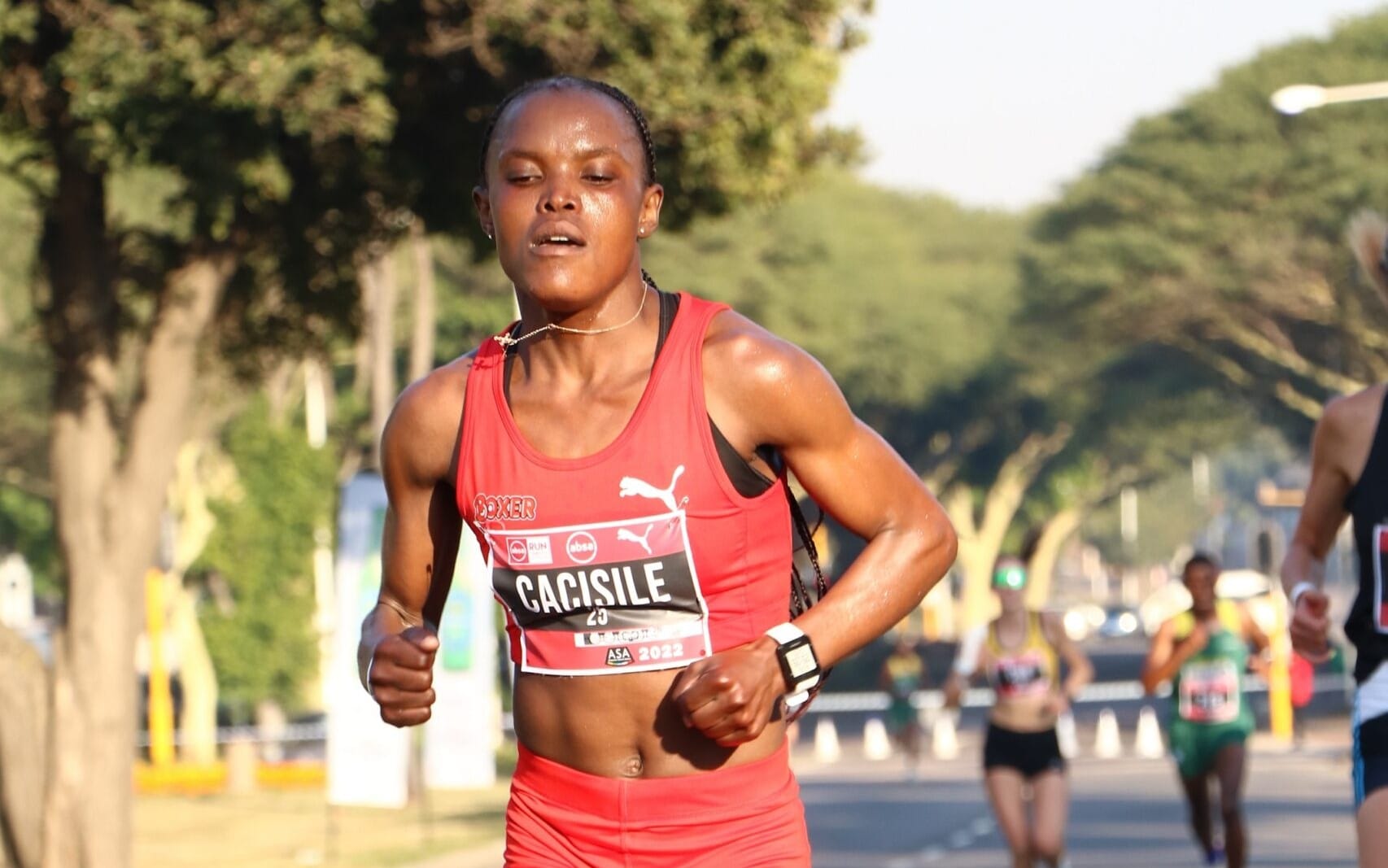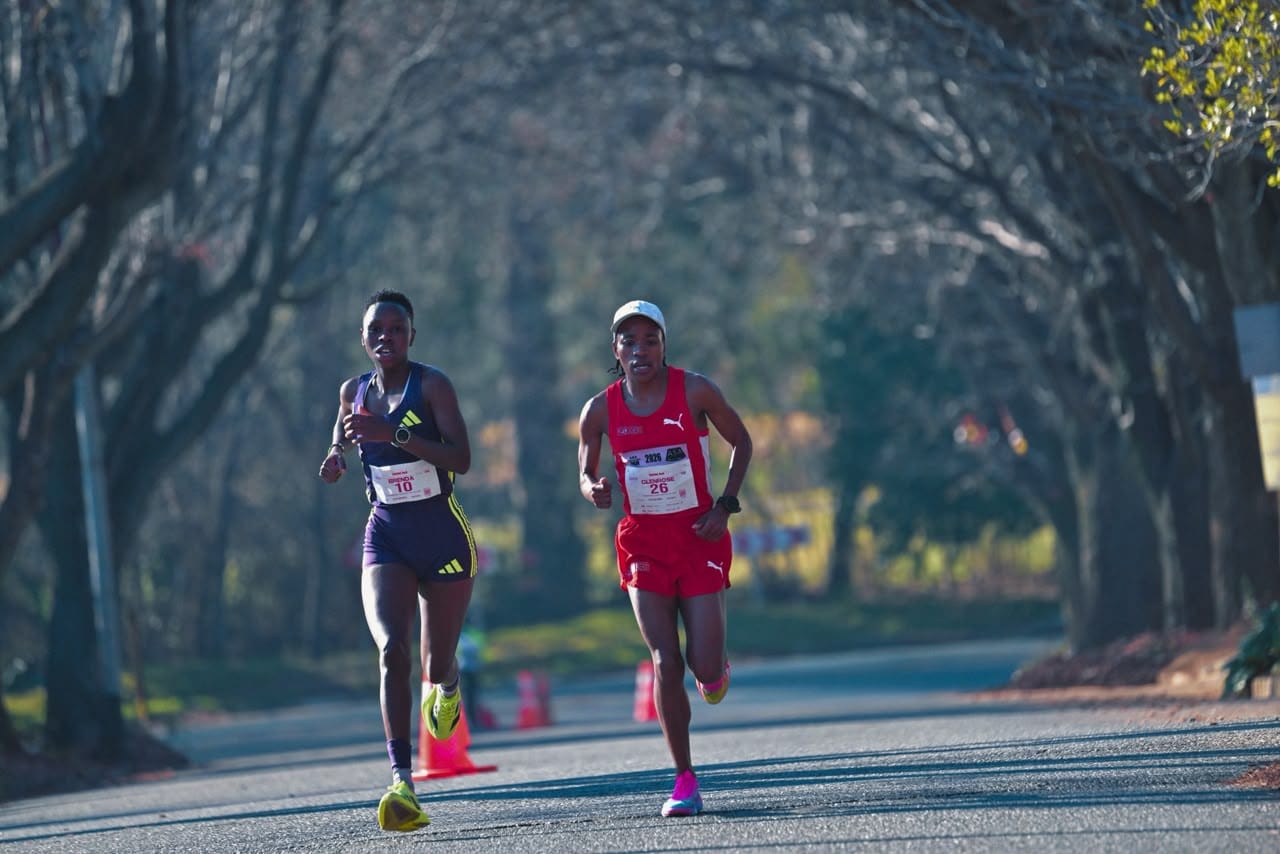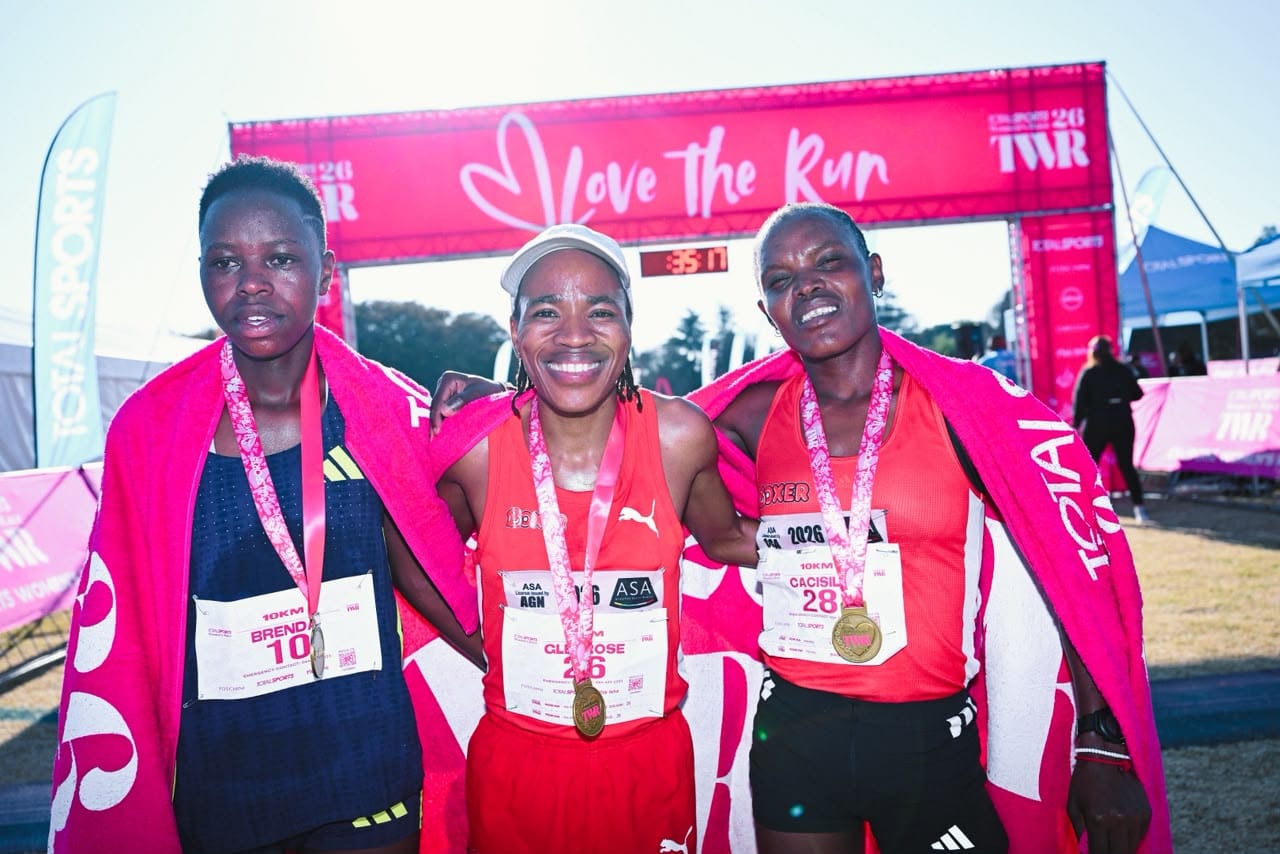



Kavanagh arrives buoyed by a standout 2025 season in which she became the fourth-fastest South African women’s 10km runner of all time. The Hollywood Athletics Club athlete has shifted her focus back to the track this year, aiming to sharpen speed before transferring it to the road.
“This year, I will be focusing quite a lot on the track. Track is something I need to work on as it doesn’t come naturally to me,” said Kavanagh. “I want to challenge myself in order to develop as an athlete… I’m hoping to get some speed and translate that speed to the road.”
She opened her season by winning the 3 000m at the first KZNA League Meeting in a career-best 9:00.21, and says Gqeberha is about setting the tone.
“The goal for the first race of the season is to lay down a good solid foundation,” she said. “I get the best results when I just run. If I’m calm and relaxed, I run at my best.”
Eastern Cape favourite Cwenga Nose, the 2025 SA 10 000m silver medallist, will be equally motivated on home roads. The Phantane AC runner opened his season with a 28:45 win at the Colchester 10km and is eyeing an improvement on his 28:41 personal best.
“I’m in very good shape because I spent the whole December training hard to have a good season,” said Nose. “The plan is to stick to the race plan and run my own race.”
According to Series Founder Michael Meyer, the stage is set.
“Gqeberha consistently produces world-class performances, and we are confident it will provide the perfect platform for Tayla and Cwenga to test themselves against the very best.”
Matthew Caldwell and Callan Lötter claimed their maidenaQuellé Midmar Miletitles in 2026 through two contrasting but equally decisive performances, showcasing tactical intelligence, fearless execution and open-water mastery.
In the elite men’s contest, Caldwell didn’t just swim the mile, he drew his own map across it. While the front pack surged ahead like a tightly packed shoal, the Johannesburg swimmer peeled off to the right, choosing solitude over the slipstream. It looked risky, even reckless. In reality, it was calculated calm.
Caldwell had boldly predicted before the start that the podium would feature himself, Henré Louw and French Olympian Damien Joly. True to script, the trio, joined early by Connor Albertyn, took control. But as confusion crept into Joly’s navigation around the hotspot markers, Caldwell stayed committed to his wide, lonely arc.
Matthew Caldwell wins 2026 Midmar Mile Photo: Midmar Mile
“I just needed to be as wide as possible, not close to anyone. I just didn’t want to be in sight. I wanted to be like an invisible person swimming there,” Caldwell said. “So the plan was just swim my own race in clean water.”
That invisible line carried him home first in 18:32, with Louw second in 18:42 and Albertyn third in 18:44. Joly faded to fourth in 18:51.
“It’s lovely. I’ve been wanting this for a few years now,” Caldwell added. “Henré, myself and Connor on the podium, that’s perfect, that’s how it should be with South Africa on top.”
If Caldwell’s race was about subtlety, Lötter’s was pure authority. Battling rough conditions, the 19-year-old attacked early in the elite women’s race, stretching the field like elastic snapping under pressure. By 400m she was clear; by halfway she led by 12 seconds; by the final marker the gap had ballooned to 19.
She touched the finish in 19:51, while the duel behind her simmered. Former champion Stephanie Houtman claimed second in 20:02, with Carli Antonopoulos third in 20:07. The trio was more than a minute ahead of the rest.
“My plan was to go out comfortable and see where the rest of the people were,” Lötter explained. “And then my plan was only to start building from 400m onwards.”
“It feels really good. It just shows that my training has been working and I’m really happy with how I performed today,” she added, crediting her coach. “Troy has helped me a lot and given me the confidence and made me enjoy the sport again.”
Callan Lotter wins Photo: Midmar Mile
Beyond the elite battles, Midmar’s deeper currents told stories of endurance and legacy. Reino von Wielligh and Gary Albertyn completed the formidable challenge of swimming 32 miles over four days, each marking their 30th Midmar Mile with age-group victories from Von Wielligh in 20:58 (31–40) and Albertyn in 21:18 (51–60).
“It’s something I wanted to do because of my age, 32, 32 miles, raise R32,000,” said Von Wielligh. “I think it was very symbolic.”
The finish line also welcomed legends: seven-time champion and record holder Chad Ho, and 1997 winner Robyn Bradley (now Minogue), who returned after 30 years abroad to finish fourth in her age group.
“It’s a phenomenal swim,” Bradley said. “Just the organisation and how it’s put together. It’s just incredible.”
At Midmar, some swimmers win by disappearing, others by breaking away, but all leave ripples that last long after the water settles.
The aQuellé Midmar Mile will celebrate two extraordinary feats of endurance in 2026 when Jill “Quix” Quicke and George Watson line up for their 50th swim at the world’s largest open-water event.
Quicke’s association with the iconic KwaZulu-Natal race stretches back to 1975, when she became one of the first women to compete officially. Just nine years old at the time, the Pietermaritzburg swimmer was already part of a changing chapter in Midmar Mile history.
“My parents said they thought I was good enough to swim the Midmar Mile. My dad took me up to the dam, as my mom was too nervous, in case I never came out the other side,” Quicke recalled. “The entire girls’ race was about 150 people. We all started together and you had as long as you liked to get across. I think I took 47 minutes.”
Growing up in Pietermaritzburg meant Midmar became a constant on her sporting calendar. She swam every year from primary school through to matric, achieving a best finish of 14th in a competitive field with a time of 21 minutes.
Although university commitments and provincial indoor hockey caused her to miss a handful of editions, Quicke returned to the dam with renewed resolve, often pushing through significant physical setbacks.
“Since completing my degree, I have done the swim consistently just to keep my total ticking over,” she said. “In 2016 and 2017 I did the 8 Mile Challenge for the Save the Rhino fund. I swam one year after being in hospital the day before with a kidney stone and one year where I was on crutches following a big knee operation.”
In recent seasons, the Midmar Mile has become a family affair.
“In 2019, I swam with my nine-year-old niece, Derryn Millward, for her first time. Since 2019 my niece, my sister, Mary Millward and I have swum together most years, and we are going to try and keep together for the big one this year.”
Now based in Johannesburg, Quicke says the significance of reaching 50 swims has taken time to register.
“I am finding it hard to believe it is my 50th swim as I don’t feel that old, but I am aware that nowadays I have to put in a bit of training to ensure that I can get across,” she said. “I think other people are more impressed with the milestone than I am, but it is a good feeling to think about the achievement.”
Watson’s Midmar Mile journey began in 1976, a year he describes as pivotal.
George Watson Photo Credit: Action Photo
“A special year for three reasons,” he said. “Firstly, it’s the year I got married, started a new job in finance and swam my first Midmar.”
Now 77, Watson says consistency rather than times was always the objective.
“My goal was not to miss Midmar for as long as I was able.”
Despite that mindset, he recalls one standout performance.
“The year I did my best time, I started late and still managed a 22-minute swim. It was somewhere around 1982/3.”
He has also experienced the race in extreme conditions.
“There was a huge storm in 1978 and waves of at least 2ft. A water polo friend gave up after swallowing half the dam,” Watson recalled.
For Watson, Midmar remains as much about community as competition.
“I made a lot of friends through swimming and water polo, and Midmar was the one place I was sure to connect with them.”
As he approaches his 50th swim, he has no plans to stop.
“I have no particular goal but will swim for as long as I can manage.”
South African middle-distance star Tshepo Tshite launched his 2026 campaign like a runner hitting the bell lap with fresh legs, slicing through history with a new South African national short track 3000m record at the Czech Indoor Gala in Ostrava on Tuesday night.
The 29-year-old stormed to second place in a blistering 7:38.17, shaving more than a second off the previous South African record of 7:39.55 set by Elroy Gelant in Belgium in February 2014. Tshite crossed the finish line a heartbeat behind Portuguese winner Isaac Nader, who claimed victory in 7:38.05, in a race that unfolded like a tactical chess match played at full sprint.
Tshite’s performance adds another glittering medal to his growing collection of national milestones. The versatile speed merchant already owns South African records in the indoor 1500m (3:35.06), outdoor 1500m (3:31.35) and indoor mile (3:54.10), further cementing his reputation as one of the country’s most dynamic distance talents.
Running with the poise of a seasoned campaigner and the hunger of an athlete still chasing new horizons, Tshite stayed tucked into the lead pack before producing a measured surge in the closing stages. His rhythm never faltered, gliding around the indoor toward history.
Athletics South Africa acting president John Mathane praised the performance, recognising both its timing and significance for the season ahead.
“Congratulations to Tshepo, his coaches and support team! It’s a great start for him so early in the season,” said Mathane.
Gelant, whose long-standing mark finally fell, welcomed Tshite’s breakthrough, acknowledging the evolving strength of South African distance running.
“Records are there to be broken, and I’m proud to see Tshepo raising the bar for South African athletics,” said Gelant. “It shows the depth and growth of our distance running, and I’m excited to see how far he can take it this season.”
Tshite’s record-setting run signals a statement of intent for the year ahead, positioning him as a serious contender on the global indoor circuit. His ability to balance raw speed with endurance makes him a rare hybrid. He is equally comfortable navigating the tactical surges of championship racing and the relentless pace of record attempts.
Meanwhile, world indoor 800m champion Prudence Sekgodiso also lined up in Ostrava, finishing seventh in the women’s two-lap contest in 2:04.26. Ethiopia’s Nigist Getachew dominated the race, breaking the tape in a world-class 1:59.98.
While Sekgodiso’s outing served as an early-season gauge, Tshite’s performance rang out like the crack of a starter’s pistol for South Africa’s 2026 athletics ambitions. If this opening stride is anything to go by, the road ahead could see Tshite shifting gears into even faster territory as the season unfolds.
Kenya’s Brenda Jepchirchir, the 20-year-old world No.1 will toe the line at the Absa RUN YOUR CITY GQEBERHA 10Kon Sunday, 1 March 2026, chasing history and dragging the pace of women’s road running on the continent into uncharted territory.
Fresh from her electrifying victory at the Valencia 10K in January, where she scorched the streets in 29:25, Jepchirchir has already torn through one of distance running’s most stubborn psychological barriers. Now she’s eyeing something even bigger: becoming the first woman to run a sub-30-minute 10km road race on African soil.
Jepchirchir’s rise has been built on patience and precision. Her Valencia performance launched her to the top of the 2026 world rankings and cemented her status as one of the sport’s most feared road racers. But rather than staying on Europe’s lucrative circuit, she’s followed the fast lane south. It’s a path previously carved by icons such as Genzebe Dibaba and Yelamzerf Yehualu.
The draw is simple: the Absa RUN YOUR CITY Series has become a speed laboratory where elite athletes don’t just chase times, they manufacture them.
“I’ve heard great things about the Absa RUN YOUR CITY Series and the Gqeberha 10K. The course is known for being fast, the organisation is excellent, and the competition is strong. I’m excited to experience racing in South Africa and to be part of such a high-energy event,” Jepchirchir said.
Her presence transforms the race into a high-octane proving ground for South Africa’s leading women’s 10km specialists, particularly Glenrose Xaba and Tayla Kavanagh amongst others. Both runners have steadily tightened their grip on the domestic road scene, and lining up beside the world’s fastest woman is the equivalent of stepping onto a treadmill that keeps accelerating.
For Xaba, a proven championship racer with tactical steel, Jepchirchir’s relentless tempo could serve as the perfect pacing carrot, or a punishing reality check. Meanwhile, Kavanagh’s fearless front-running style could thrive in a race that promises to unfold at record-threatening speed. The clash offers South African athletes a rare opportunity to test themselves against global gold standard pacing without leaving home soil.
Jepchirchir’s breakthrough wasn’t accidental. It was the product of months spent stacking disciplined mileage like bricks in a foundation built for speed.
“It was an amazing feeling and a very special moment for me. Valencia is such a competitive race, so winning there and breaking 30 minutes for the first time meant a lot,” she explained.
“The biggest factor has been consistency. Over the last six months I’ve been able to train well, stay healthy, and really build momentum. On 1 March, the goal is to put together a strong race, compete well, and see what time is possible on the day. If conditions are right, I’d love to run fast again, but the focus must also be on execution and racing smart.”
Race organisers believe Jepchirchir’s debut injects jet fuel into an already electric event.
“To have the current world No.1, fresh off a sensational win in Valencia, choose to make her South African debut at our event speaks volumes about the stature of the Absa RUN YOUR CITY Series,” said Michael Meyer, Managing Director of Stillwater Sports and Series Founder.
“Brenda’s presence raises the bar once again and guarantees an exciting, world-class race for both elite and recreational runners on the streets of Nelson Mandela Bay.”
With a combined prize purse of R1.686 million across the 2026 series, alongside performance incentives designed to reward South African athletes, the Gqeberha leg promises fireworks.
Absa RUN YOUR CITY GQEBERHA 10K START by Anthony Grote
When the starter’s gun cracks, the race could unfold like a perfectly executed negative split: smooth, controlled, and devastatingly fast when it matters most.
Every racing season needs a clean start. A place where legs feel fresh, goals feel possible and the road seems to pull you forward. For the fourth straight year, that place is Gqeberha.
On Sunday, 1 March 2026, theAbsa RUN YOUR CITY GQEBERHA 10K returns as the opening stride of South Africa’s premier road-running series. By now, it knows exactly what runners want. Speed. Rhythm. Atmosphere. And just enough magic to carry you through the tough kilometres.
The route is the headline act. Fast, flat and honest, it rewards controlled pacing and a strong final push. Early kilometres invite restraint, the middle settles into flow, and the closing stretch offers the kind of terrain where PBs are either confirmed or heartbreakingly missed by seconds. Add coastal air, wide roads and landmark scenery, and it’s easy to see why elites and everyday runners keep coming back.
Absa RUN YOUR CITY Gqeberha 10K by Anthony Grote
But this race isn’t just about what’s underfoot, it’s about what’s around you.
From the first kilometre, the course hums with energy. Music zones, performers and brand activations break the run into manageable segments, turning the 10K into a sequence of small victories rather than a single long grind.
“We’re excited to kick off the 2026 series in style with the Absa RUN YOUR CITY GQEBERHA 10K in ‘The Friendly City’,” says Michael Meyer, Managing Director of Stillwater Sports.
“Not only will runners and supporters witness world-class racing on home soil, but they’ll also experience 10km running at its finest, complete with unforgettable on-route entertainment brought to life by our sponsors and local performing arts groups. We can’t wait to start the season with a bang – come join us and #RunYourCity!”
That balance, elite performance paired with inclusive experience, is what has defined the RUN YOUR CITY Series. Major partners including Absa, PUMA, Powerade, AVIS and Heineken line the route with activations that feel purposeful rather than distracting, offering both visual lift and psychological relief when the legs start asking questions.
For Absa, the race is about more than kilometres logged.
“At Absa, we are passionate about creating memorable experiences that bring communities together,” says Jabulile Nsibanyoni, Absa Group Head of Sponsorship.
“The entertainment along the route is thoughtfully curated to celebrate the city’s rich heritage and cultural traditions, turning the race into a vibrant tribute to the spirit of the Eastern Cape coastline. Both participants and spectators can look forward to a dynamic showcase of performances that reflect the warmth, diversity, and energy that Gqeberha is known for.”
PUMA, meanwhile, continues to lean into the runner experience itself.
Absa RUN YOUR CITY Gqeberha 10K by Anthony Grote
“We love supporting, motivating, and inspiring runners of all levels,” says Rae Trew-Browne, PUMA Run Train Marketing Manager.
“In 2026, we’re excited to introduce a brand-new campaign. We’re not letting the cat out of the bag just yet, but one thing is certain: every runner who passes through the PUMA Zone on race day will be treated to a fun, energising, and memorable experience that celebrates the joy of running and the spirit of the series.”
With five races across five cities, Gqeberha doesn’t just open the series, it sets the tone. Smooth roads. Big noise. And a reminder of why we race in the first place.
Formula One might be measured in tenths of a second, but championships are won the way marathons are run: through preparation, resilience and relentless attention to detail.
Unveiled on 2 February 2026, the new drop marks year two of adidas’ partnership with Mercedes-AMG PETRONAS F1, and like a second-season athlete, it’s leaner, smarter and more confident.
Maintaining the visual identity of its debut range, the collection evolves with sharper design codes inspired by Mercedes’ iconic colours, shapes and values.
This isn’t merch. It’s kit.
Built with the same mindset that shapes elite running apparel and high-performance motorsport engineering, the collection spans apparel, footwear and accessories tailored for every member of the team. That includes drivers, engineers, and mechanics while offering fans gear worthy of race day.
Designed like race equipment, worn like training gear
Every piece prioritises comfort, airflow and freedom of movement without sacrificing paddock-ready polish. Think of it as a perfectly balanced race car: stripped back, functional, yet unmistakably premium.
Driver wear takes centre stage. The authentic jerseys feature an all-over engineered shiny print inspired by unity and cohesion.
It’s a visual reminder that no championship is won alone. Subtle PETRONAS teal accents cut through the design, while adidas’ CLIMACOOL technology helps regulate temperature, keeping drivers cool and dry during long days off track.
Mechanics’ gear mirrors the efficiency of a pit stop. Modern silhouettes are paired with curved teal graphics that suggest motion and speed — fast, technical and purpose-built, like a runner’s lightweight race top engineered for peak output.
For engineers, the shift from white to black establishes a unified team identity. Logos and detailing illuminate against darker base tones, while advanced fabrics deliver a refined balance of elegance and comfort with precision design for precision thinkers.
Footwear that goes the distance
No performance system is complete without the right shoes. The collection is anchored by a reimagined Ultraboost 5, featuring a teal heel that fades into a black mid and forefoot, finished with glossy silver Three Stripes. Built with the cushioning and responsiveness runners trust, it’s equally at home logging steps in the paddock or navigating race-day intensity.
Caps and accessories in Mercedes-AMG PETRONAS colourways round out a range that looks as sharp trackside as it feels in motion.
Michael Batz, Motorsport Category GM at adidas, said:
“As we gear up for the second year of our partnership, we have continued to pour a lot of thought and craft into designing pieces that meet the demands of every single member of the team… We can’t wait to see it being worn by all during the upcoming season!”
Mercedes-AMG PETRONAS F1 Chief Commercial Officer Richard Sanders added:
“Our second teamwear collection reflects those values perfectly yet again while delivering apparel that not only meets the technical demands of F1 but also embodies the identity of our team.”
Drivers feel the difference.
George Russell said:“For us, every detail matters… This kit allows me to stay sharp, focused, and perform at my peak.”
Kimi Antonelli added:“Their commitment to optimising fit and function means I can step out onto the track feeling confident and ready.”
Because whether you’re chasing lap times or kilometre splits, performance always starts with what you wear.
The adidas x Mercedes-AMG PETRONAS F1 Team new collection is available to purchase from adidas.co.za/motorsport, and a worldwide selection of adidas wholesale accounts.
See It Againcantered straight into racing folklore, completing a redemption arc as dramatic as a last-furlong swoop from the clouds when he won the World Sports Betting Cape Town Met (Gr 1) over 2000m on Saturday, 31 January 2026.
The 6-year-old, sent off a confident 5/2, travelled like a horse rediscovering his old rhythm. When jockey Andrew Fortune angled him into daylight in the straight, See It Again lengthened stride with the smooth authority of a champion finally back in tune. He held the relentless late surge of 33/1 outsider Legal Counsel by three-quarters of a length, with The Real Prince flashing briefly from the rear before flattening out into third. Okavango, who had dictated a muddling tempo, boxed on gamely for fourth.
It was a training masterclass from Justin Snaith, who saddled the first, second and fourth, underlining his dominance on a day when his yard fired like a well-oiled starting gate. The runner-up was ridden by Aldo Domeyer, Fortune’s son. It was a poignant subplot in a race rich with narrative.
Veteran jockey Andrew Fortune on See It Again celebrates his remarkable victory at World Sports Betting Cape Town Met in Kenilworth on Saturday Photo’s: Supplied
For See It Again, this victory snapped a 454-day win drought. Once brilliant at three and four, the son of Twice Over had been written off after behavioural issues at the gates blunted his spark. Critics had labelled him “past it”. Snaith disagreed.
The trainer credited the calmer environment at his Philippi base and the work of behaviourist Malan du Toit for helping reset the horse’s mindset. The signs were already there: gritty third-place finishes in the Green Point Stakes (Gr 2) and L’Ormarins King’s Plate hinted that the engine was humming again.
Fortune, who nicknamed him “Champy”, had been feeling it too. Working the horse daily, he forged a bond built on trust and patience, virtues Fortune himself had to relearn. The veteran jockey’s comeback is as remarkable as the horse’s. After battling addiction, weight issues, suspensions and rejection, he once admitted at his lowest ebb that “no one wanted me.”
Now re-admitted in his late 50s, Fortune is riding like a man reborn. His handling of See It Again was cool, balanced and perfectly judged from the hands of a jockey who knows both the cost of mistakes and the value of second chances.
Owner Mr N Jonsson added another chapter to his own fairytale, landing a fourth consecutive Cape Town Met with four different horses, Jet Dark (2023), Double Superlative (2024), Eight on Eighteen (2025) and now See It Again. He called it “an impossible dream.”
Fortune doubled up earlier when steering Double Grand Slam to victory in the Majorca Stakes (Gr 1) over 1600m. From a wide draw, he read the lack of pace, slid into a stalking role and struck early up the stand-side rail. The mare, a ten-time winner, held off Rainbow Lorikeet by a neck, once again edging out son Aldo in a family photo finish.
Elsewhere on the card, Star Major sprang a 33/1 surprise in the Politician Stakes (Gr 3), patiently ridden by Luyulo Mxothwa to deny Fortune and favourite Happy Verse. Ahead of the Facts crushed the Western Cape Stayers (Gr 3) by three lengths despite a hefty weight turnaround, while Time for Love rediscovered her best to win the Summer Fling Stakes (Gr 3) at 25/1.
A Symphony of Style
High fashion, elite racing and social culture converged in spectacular harmony under the 2026 theme Symphony of Style. Off the track, fashionistas and celebrities enjoyed unrivalled views of the day’s thrills, including the Best Dressed competition and a performance by the Amaballet’s Amavengers, a high-energy dance troupe whose choreography blended classical ballet, Amapiano rhythms, and street dance elements, centring on visual spectacle and musical synergy.
A Symphony of Style – Winners of the Best Dressed Competition
Nina van Dina took first place in the Best Interpretation of the Theme Symphony of Style, Beaia Kgokong from Johannesburg was awarded the Style Icon award, while Sheara Murphy won the Designers’ Choice award, and Best Dressed Crew award went to Kevin Ellis and Tracey Maltman who interpreted the theme to perfection. Ellis and Maltman previously won the Best Dressed Crew award in 2007. All winners walked away with bumper prizes, including a Fieldbar Mini Bar, bottle of Johnnie Walker, R3,000 in sports betting vouchers and more.
But the day belonged to See It Again, a horse once off the bridle of belief, now back in full gallop, reminding the racing world that champions, like jockeys, sometimes just need the reins loosened to fly again.
For more information on the line-up of upcoming events, visit www.racecoast.co.za.
John Dobson didn’t duck the tackle or hide behind the referee’s whistle after theStormers’ second straight derby defeat to the Sharks. Instead, the Stormers coach fronted up and admitted that while the game plan was drawn up neatly, the behaviours at the collision points never shifted.
The Stormers were whistled for 16 penalties and shown two yellow cards in their38–24 United Rugby Championship (URC) loss in Durban on Saturday, and for Dobson, the most worrying part wasn’t the scoreboard, it was the lack of growth between the two derby encounters.
“We talked about it this week to start the halves well. We probably got both right, but the rest wasn’t a behaviour change from last week. I think the two games were very similar,” said Dobson.
While the Stormers repeatedly knocked on at key moments, the Sharks played with the composure of a side winning the arm-wrestle inch by inch, completing a rare back-to-back Cape Town double.
“Credit to the Sharks, they beat us properly over the past two weeks. Our discipline was poor and our set-piece definitely let us down. I thought their aerial game was really good and they played with a really clear plan that worked for them.”
Good morning Warrior Nation! 🦈 💪 Don’t forget to chase your wins this coming week like Jaco Williams chases an overcooked kick! 🏃 🏆 pic.twitter.com/DkyWG0t5WB
Instead of tightening their grip at the breakdown, the Stormers loosened it. Seventeen penalties conceded, two more than the previous week, told the story of a side stuck in the same defensive patterns, conceding ground without resistance.
“The most destroying part of last week is that the same things that went wrong last week, went wrong this week. Five-metre lineouts not converted, giving penalties away at mauls which led to some of the discipline stuff. So for the stuff to fix, there needs to be a change in behaviour. It was really poor from us and I feel bad for our supporters.”
What gnawed at Dobson was the sense of déjà vu, the same soft underbelly exposed, the same pressure points targeted.
“The most frustrating thing about tonight [Saturday] is that everything that went wrong last week went wrong this week. There has to be a behaviour change; it is really poor from us and bad for our supporters.”
Once again, the Stormers’ defensive work inside their own five-metre zone cracked under pressure, turning promising stands into penalty concessions and scoreboard damage.
“Five-metre lineouts not converted, giving penalties away at mauls, which led to some of the discipline stuff. So, to fix the stuff, there needs to be a change in behaviour. It was really poor from us, and I feel bad for our supporters.”
Dobson was quick to salute Sharks coach JP Pietersen, whose side dominated the key exchanges and imposed themselves when it mattered most.
“I give them enormous credit. They’ve come, and they beat us twice. He is obviously doing something right within the organisation. They played with real purpose, a clear plan, so yes, he has done well.”
The aerial contest and the penalty count proved decisive battlegrounds. While the Sharks ruled the skies, the Stormers spent long stretches retreating under pressure and playing a man short.
“We didn’t win the contestable game as much as we would have liked to. They were really good in the air. If you are going to be on 11 penalties in 20 minutes, that’s going to include a card.
“If you are going to play 40 minutes in a South African derby with seven forwards, with Damian Willemse scrumming on the flank a lot of the time, it’s not good enough.”
Stormers captain Sacha Feinberg-Mngomezulu echoed his coach’s assessment, admitting discipline knocked the stuffing out of a side that briefly had the upper hand.
“The lack of discipline cost us. When we played our game, we were on top of them. Going into halftime, we were up 24-14, and we just let it slip.
“Within ten minutes, we went from an upbeat team scoring tries. That’s just the reality. We were being reckless, careless and irresponsible. Our discipline is costing us.”
For the Stormers, the message is blunt: unless the habits at the breakdown, maul and aerial contest change, they’ll keep losing the same battles, and bleeding the same points.
Ellis Park will once again rumble like a restless scrum on Saturday afternoon as the Lions and Bulls lock horns in a Jukskei Derbythat promises sparks, sweat and shifting momentum on the URC log.
TheLions, settled and confident, return home looking to turn continuity into currency. Their memories of last November’s 43–33 win over the Bulls still echo, but head coach Ivan van Rooyen knows this weekend’s contest will be a far sterner examination.
“Obviously, they’ll be hurting from the result at Loftus,” Van Rooyen said.
“But they’ve got some superstars returning in Kurt-Lee Arendse, Canan Moodie, and Marcell Coetzee, and mentally they’ll be a very different team after the two results they got overseas. We’ll have to rise to that emotional level and physical level.”
For Van Rooyen, the derby won’t be decided on reputation but on precision when lungs burn and legs feel heavy.
“Of course, we’ve got plans, they’ve got plans – but I think the team that can execute under pressure on Saturday, and enforce their strengths more often during the 80 minutes will emerge successful.”
The Lions’ unchanged 23 is a statement of trust. Chris Smith, facing his former employers, will be the conductor of tempo at flyhalf, while skipper Francke Horn leads a familiar loose trio into what is expected to be a collision-heavy battle for breakdown supremacy.
Out wide, Springbok fullback Quan Horn provides composure at the back, with Richard Kriel and Angelo Davids offering strike power on the wings.
Across the tunnel, Bulls coach Johan Ackermann has reloaded his side with intent. The return of Elrigh Louw at openside flank sharpens the Bulls’ breakdown blade, while Devon Williams replaces veteran Willie le Roux at fullback, injecting pace and aerial contestability for what is expected to be a tactical kicking duel.
YOUR team to face the Lions tomorrow at Ellis park 🥶
🏆Vodacom Bulls vs Lions | ⏰KICK-OFF: 14:30 | 📍Ellis Park | 🗓️31 January
In midfield, Harold Vorster and Stedman Gans form a more direct, defence-first pairing, signalling a Bulls side built for impact rather than finesse. Kurt-Lee Arendse’s return on the wing adds lightning to the Bulls’ backline, while Handré Pollard resumes his role as the general steering the attacking ship.
The Bulls’ engine room has also been reshuffled, with Reinhardt Ludwig starting at lock and Cobus Wiese primed off the bench to bring brute force in the closing exchanges.
With both sides chasing log momentum, this derby shapes as less chess match and more street fight — a high-tempo contest where accuracy will be the sharpest weapon and composure the ultimate decider.
Teams
Lions: 15 Quan Horn, 14 Angelo Davids, 13 Henco van Wyk, 12 Bronson Mills, 11 Richard Kriel, 10 Chris Smith, 9 Morne van den Berg, 8 Francke Horn (capt), 7 Batho Hlekani, 6 Jarod Cairns, 5 Reinhard Nothnagel, 4 Ruben Schoeman, 3 Asenathi Ntlabakanye, 2 PJ Botha, 1 SJ Kotze Replacements: Morne Brandon, RF Schoeman, Conraad van Vuuren, Etienne Oosthuizen, Darrien Landsberg, Renzo du Plessis, Haashim Pead, Erich Cronje