Irvette van Zylreturns to the OUTsurance Gun Run this weekend after a seven-year absence, with the four-time Olympian targeting another fast performance on the Cape Town course where she produced one of the event’s most notable runs.
Van Zyl will contest Sunday’s 21.1km Half Marathon, while fellow Hollywood Athletics Clubathlete Stephen Mokoka lines up in Saturday’s 10km, where the 41-year-old veteran enters as one of the leading contenders.
Van Zyl’s last appearance at the Gun Run came in 2019, when she won the women’s half-marathon in 1:12:11.
The performance was particularly impressive given that Van Zyl had undergone significant surgery earlier that year before returning to top form.
Seven years later, she is looking forward to tackling the course again.
“I’m quite excited,” Van Zyl said.
“This is the first time I will be back running it since 2019. I knew I wanted to go back but never had the chance. So yeah, just excited everything worked out this year that I can go and run it.”
The 30-year-old knows the course well and remains fond of its combination of challenge and scenery.
“I like the route. It has a bit of a tough hill in it and yeah, it’s just nice views running it and it’s almost a great atmosphere running in Cape Town and going through C point at the finish.”
Van Zyl has set herself a realistic target rather than chasing her 2019 performance at all costs.
“I’m hoping for close to that time that I did run in 2019. So anything under 73 I’ll be very happy with, but the weather also has to play with. So we’ll see.”
For the South African marathoner, the significance of her return extends beyond the stopwatch.
“But yeah, I’m just excited to be healthy and be running and just be back after seven years of absence and really looking forward to it.”
While Van Zyl will be chasing another strong performance over 21.1km, Mokoka will be aiming to make an immediate impact on his Gun Run debut.
The former South African 10km record holder boasts a 27:38 personal best, recorded in Manchester in 2015, as well as a 59:36 half-marathon best and a 2:06 marathon personal best.
His longevity remains one of the defining features of his career. Mokoka is a four-time Olympian and has represented South Africa at five World Championships.
His 2026 season has also demonstrated that his speed remains intact, including a sub-29-minute performance at the Hollywoodbets Durban 10km.
Last year’s Gun Run 10km winner, Adam Lipschitz, has moved up to the half-marathon this year, where he will target the course record.
That leaves Mokoka as the leading name in the 10km field, although several Cape Town-based athletes will be hoping to disrupt his winning plans.
The weekend therefore offers Hollywood Athletics Club two experienced international performers with very different objectives.
For Van Zyl, it is a long-awaited return to a course where she has already left her mark.
For Mokoka, it is an opportunity to add a Gun Run victory to an already decorated distance-running career.
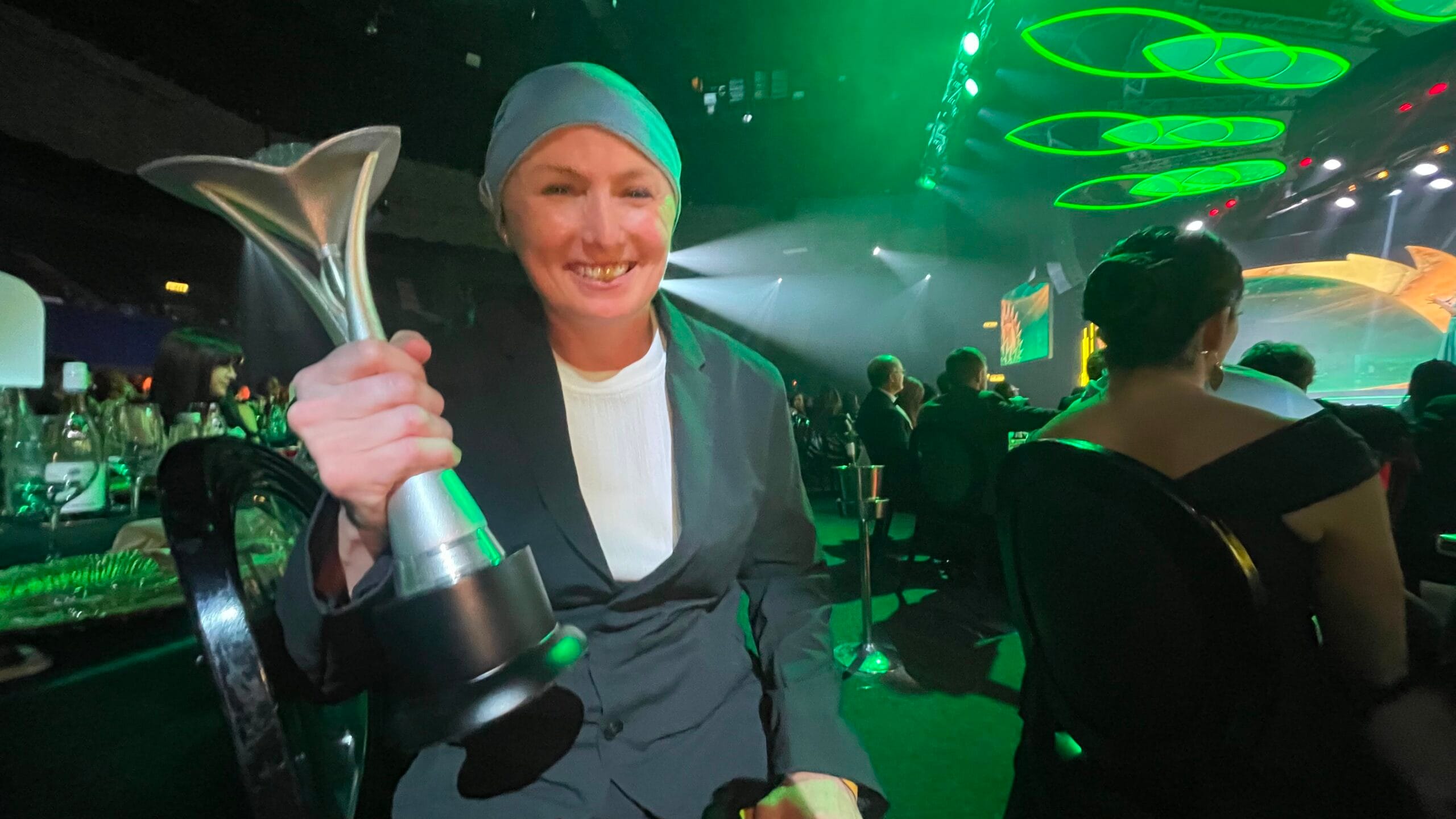
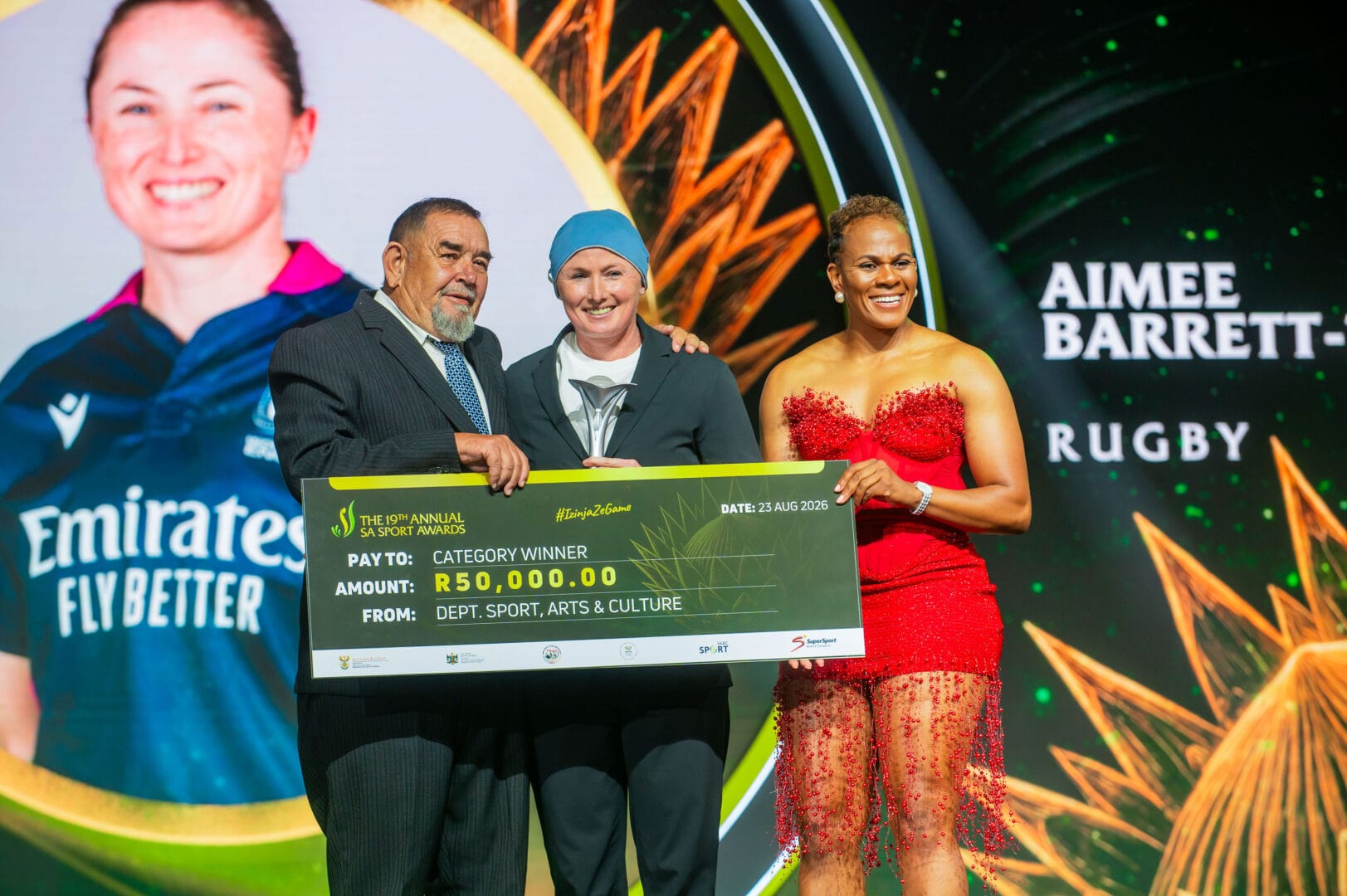
SUN CITY, NORTH WEST: From breaking barriers on the rugby field to facing breast cancer with extraordinary courage, Aimee Barrett-Theron continues to inspire. The most-capped female international referee in rugby history was named Technical Official of the Year at the South African Sport Awards. Her message to the Springboks ahead of their Cape Town clash with the All Blacks? “Sterkte.”
By Adnaan Mohamed
Aimee Barrett-Theronhas spent years policing rugby’s most ferocious frontiers with a whistle, a stopwatch and nerves forged in the furnace of elite sport.
On Sunday night, 23 August, the trailblazing referee received another trophy for her extraordinary contribution, being named Technical Official of the Year at the 19th South African Sport Awards at Sun City Superbowl.
Her latest accolade came with an unmistakably human soundtrack. Barrett-Theron is halfway through treatment for breast cancer, temporarily away from the international rugby battlefield and drawing strength from the same discipline that carried her through some of the sport’s biggest arenas.
“The treatment’s going well. I’m about halfway through at the moment so it’s been quite a challenge not being on the field, but I’m still very much involved for coaching because I’m still very much involved here so it’s a tough time to be out there, but I’m still as supportive as I can,” she said.
The road back remains a marathon measured in courage rather than kilometres.
“Yeah, yeah, so a couple of tests and a lot of my friends out there referring I’d love to be supportive there but it’s 20% for the year,” Barrett-Theron said in the interview, reflecting on her curtailed involvement in officiating.
Her career has already smashed through several glass ceilings.
A former Springbok Women’s XVs and Sevens player, she swapped playing boots for the referee’s whistle and became the first woman to referee a men’s professional match in South Africa.
She has since taken charge of 52 international Tests, making her the most-capped female international referee in rugby history. Earlier in 2026, she became only the second woman ever to referee 50 Test matches.
Her CV reads like a roll of honour: the 2017 and 2025 Women’s Rugby World Cups, the Tokyo Olympics, the United Rugby Championship and the Women’s Six Nations.
Then came the diagnosis.
In July, Barrett-Theron announced her temporary departure from officiating after being diagnosed with breast cancer. She has confirmed the condition is treatable and is concentrating on treatment and recovery, with specialists guiding her through the process.
Rugby’s family responded with the force of a defensive line. World Rugby and SA Rugby leaders joined players, officials and supporters in sending messages of encouragement.
Her Sport Awards triumph added another medal to a career already heavy with milestones.
“It’s special to be able to get the trophy,” she said. “At the end of the day and to be recognised for the hard work that we put in”
Then came the question every South African wanted answered: could the Springboks beat the All Blacks at DHL Stadium on Saturday in the second Test of Rugby’s Greatest Rivalry?
For a moment, the referee’s hat came off.
“Yeah, when it comes to Springboks, I can take my referee hat off and I’d love the boys to have any positive results on the weekend.”
Her message to the Boks carried the warmth of a teammate standing beside the tunnel before kick-off.
“Yeah, just stack them on and good luck boys. Represents us the best you can. We know you’ve got it in you.”
And there was one final word, simple enough to fit on a dressing-room wall and strong enough to carry across the Cape Town wind:
“Sterkte.”
For Barrett-Theron, the whistle may be silent for now. Her voice remains firmly in the game.
South African sport has crowned her greatness. Rugby knows her resilience will be worth another standing ovation when she returns.
Under the glittering banner of “Crowned in Greatness”, the 19th South African Sport Awards delivered a night where champions, trailblazers and behind-the-scenes heroes took their bows.
Simbine claimed Sport Star of the Year, adding another gleaming medal to an already formidable athletics legacy. The sprint king has spent years living on the razor’s edge of hundredths of a second, and this time the stopwatch gave way to the applause of a nation.
The Protea Men’s Test Cricket team pocketed Sport Team of the Year, another feather in Cricket South Africa’s cap after a campaign that demanded patience, character and plenty of backbone.
Prudence Sekgodiso was crowned Sportswoman of the Year, while swimmer Pieter Coetze took Sportsman of the Year. Athletics also supplied Coach of the Year Thabo Matebedi, ensuring the track-and-field brigade left Sun City with pockets bulging with silverware.
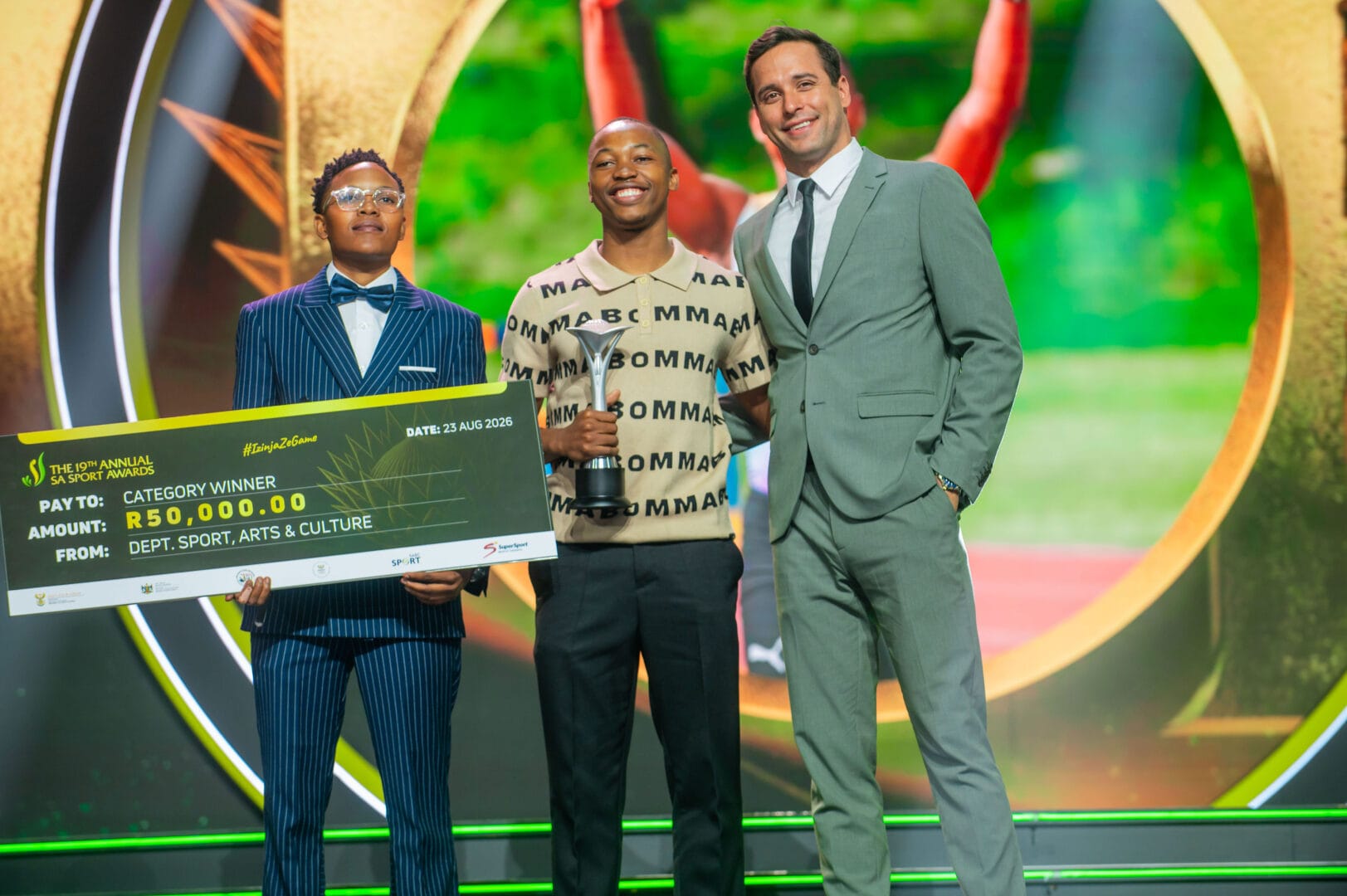
Bayanda Walaza, the Youth/Junior Sport Star of the Year with SA swim legend Chad le Clos
Simoné Kruger won Sportswoman of the Year with a Disability, while Puseletso Michael Mabote claimed Sportsman of the Year with a Disability for para athletics.
The evening’s unsung heroes received their own standing ovation. Anthony Moruthanewas named Sport Administrator of the Year, Nqobile Kunene Sport Volunteer of the Year, and Khokho Association South Africa Recreation Body of the Year.
Cricket South Africa collected National Federation of the Year, while Rachel Makhura took Sports Media Journalist of the Year, with photographer Skhu Nkomphela winning Sport Visual Journalist of the Year.
And then came the lifetime tributes, a reminder that sporting greatness is built over generations. Siya Vabaza-Booi, Selwyn Nathan and Veli Nhlapo received the Steve Tshwete Lifetime Achievement honour.
The Andrew Mlangeni Green Jacket went to William Mtolo, Teenage Dladla, Prof. Mlungisi Ngubane and Patson Banda, while Rayno Nel, Tasneem Solomons and Temba Bavuma were recognised for Excellence.
It was a night when South African sport looked in the mirror and saw its past, present and future staring back.
The crown fitted. The champions roared. And the sporting heartbeat kept thumping.
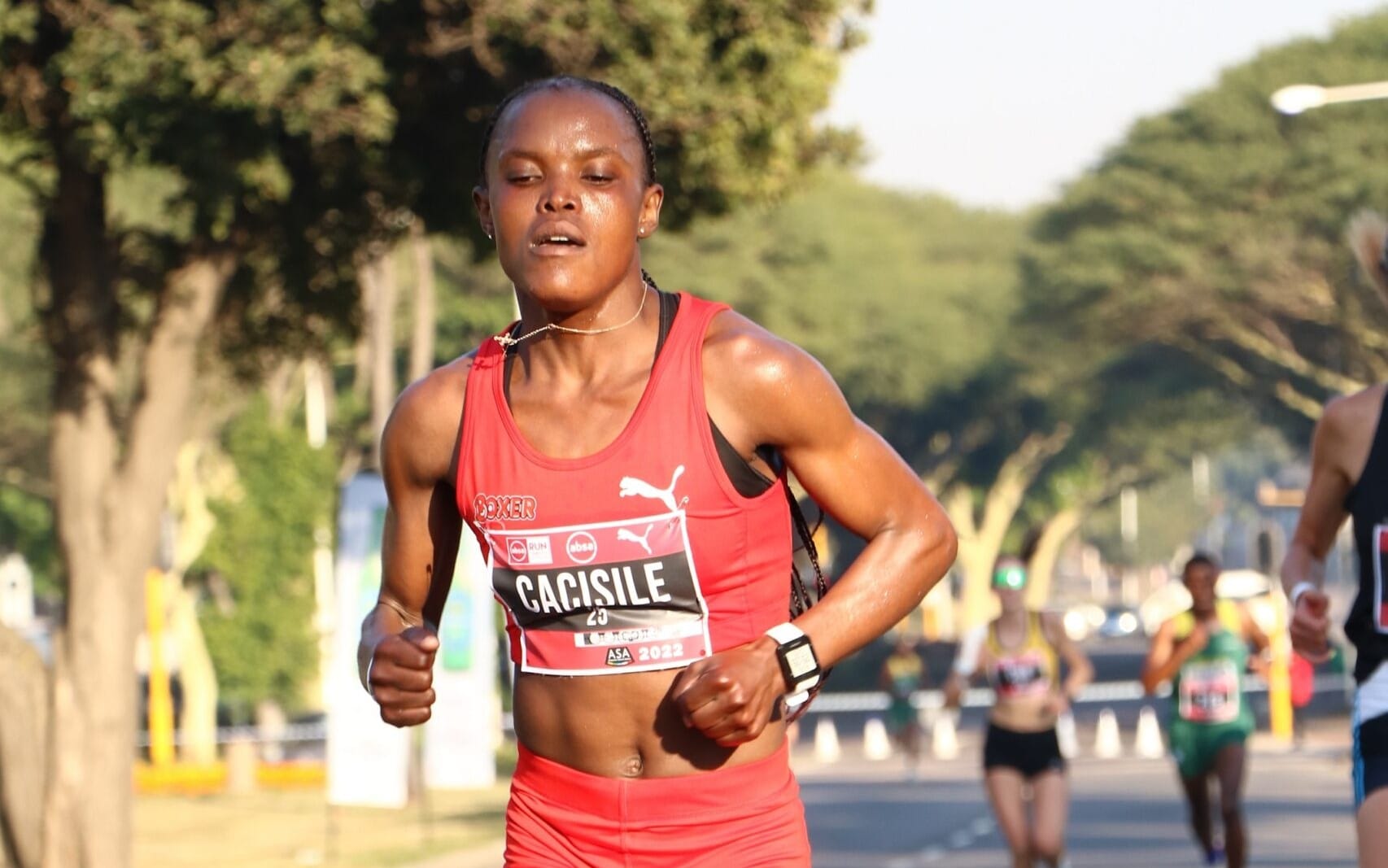
Sosibo has enjoyed a sizzling 2026 campaign, lowering her 10km personal best to 32:16 at the SPAR Women’s Grand Prix Durban leg in June and dipping under 32:45 three times this season.
Then came Durban.
She clocked 32:36 to finish sixth in a quality international field at the Absa RUN YOUR CITY DURBAN 10K, a performance that gave her belief and plenty of bite.
“Durban was amazing for me this year. I ran a PB at SPAR and got a top-six finish at the Absa RUN YOUR CITY DURBAN 10K, which gave me a big confidence boost,” said the KwaZulu-Natal-born runner, now based in Soweto.
Her legs have been talking loudly ever since.
On Sunday, she ran 34:01 for third at the Totalsports Women’s Race Joburg, less than 24 hours after winning the senior women’s 10km title at the Central Gauteng Cross Country Championships.
That is some serious mileage in the bank.
Sosibo knows what it feels like to mix it with the best. At the 2023 World Road Running Championships in Riga, Latvia, she finished 10th in the half marathon in a personal best 1:09:31.
Now, under the watchful eye of legendary coach Michael ‘Sponge’ Seme, who has also guided four-time Olympian Stephen Mokoka, she believes the old magic is returning.
“Things have been going well for me this year. I feel like the Cacisile who was competing back in 2023. I’m coming back slowly but surely.”
Tshwane, however, is ready to collect its toll.
The hilly, high-altitude route can chew up ambitious runners like a hungry school of piranhas. Sosibo knows a personal best may be asking for too much.
“Tshwane is a tougher course with hills at altitude, so I’m not expecting a PB. My target is to race smart and run with the lead pack for as long as possible.”
Michael Meyer, Managing Director of Stillwater Sports, believes her Durban performance has changed the conversation.
“Cacisile’s 2026 season has been hugely encouraging, and her sixth-place finish in Durban showed that she can compete with a strong international field,” Meyer said. “We’re looking forward to seeing her build on that performance in Tshwane.”
The race is sold out, with the gun going at 08:00 from Stanza Bopape Street in Arcadia.
For Sosibo, the mission is clear: climb with courage, conserve the fuel and unleash the finishing kick when the road finally points home.
Her comeback may be labelled “slowly but surely”.
On Sunday, she will be hoping it looks anything but slow.
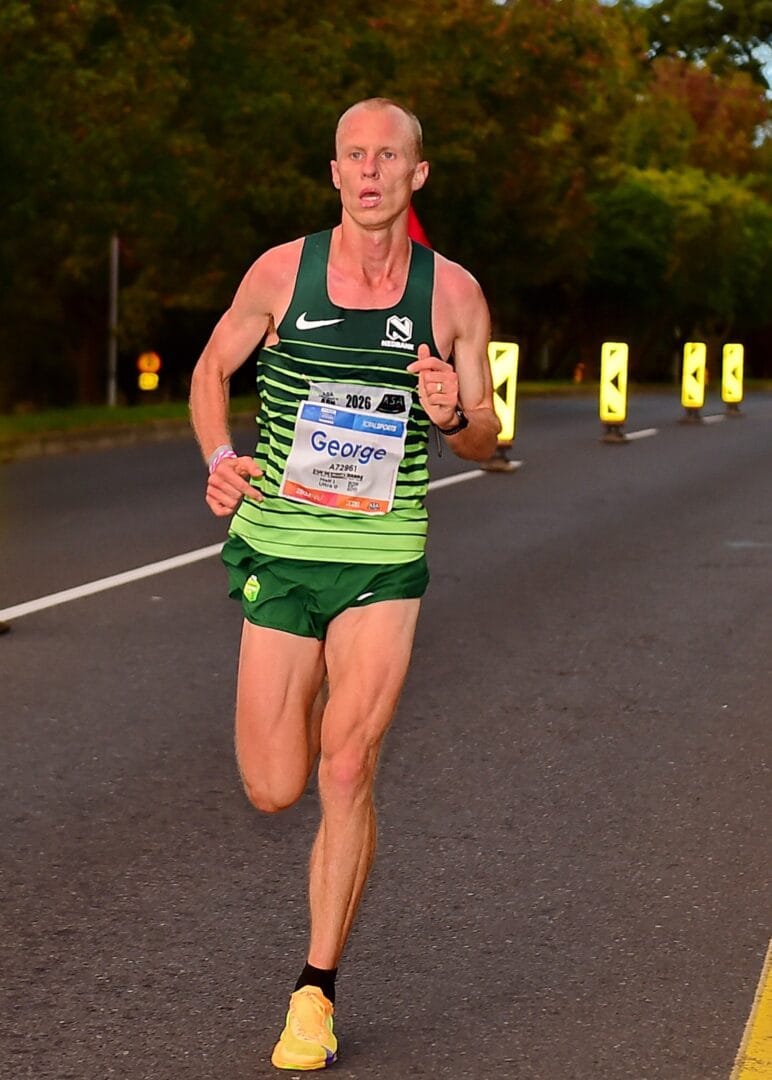
George Kusche has conquered the Comrades Marathon. Now the reigning champion wants to find out whether his legs still have enough sting to mix it with the 10km specialists.
Kusche will line up at the sold-out Absa RUN YOUR CITY TSHWANE 10K on 23 August, with Kenya’s Salem Kibet arriving with victory firmly in his sights.
The 28-year-old Kusche has never been a one-distance pony. A sub-four-minute mile and 13:28.95 5000m personal best from his US NCAA days provided the speed foundation for his road-running career.
A 28:56 10km in Gqeberha in 2024 was followed by a 2:20:12 marathon debut in Cape Town and fourth place at last year’s Soweto Marathon.
Then came his Comrades masterpiece.
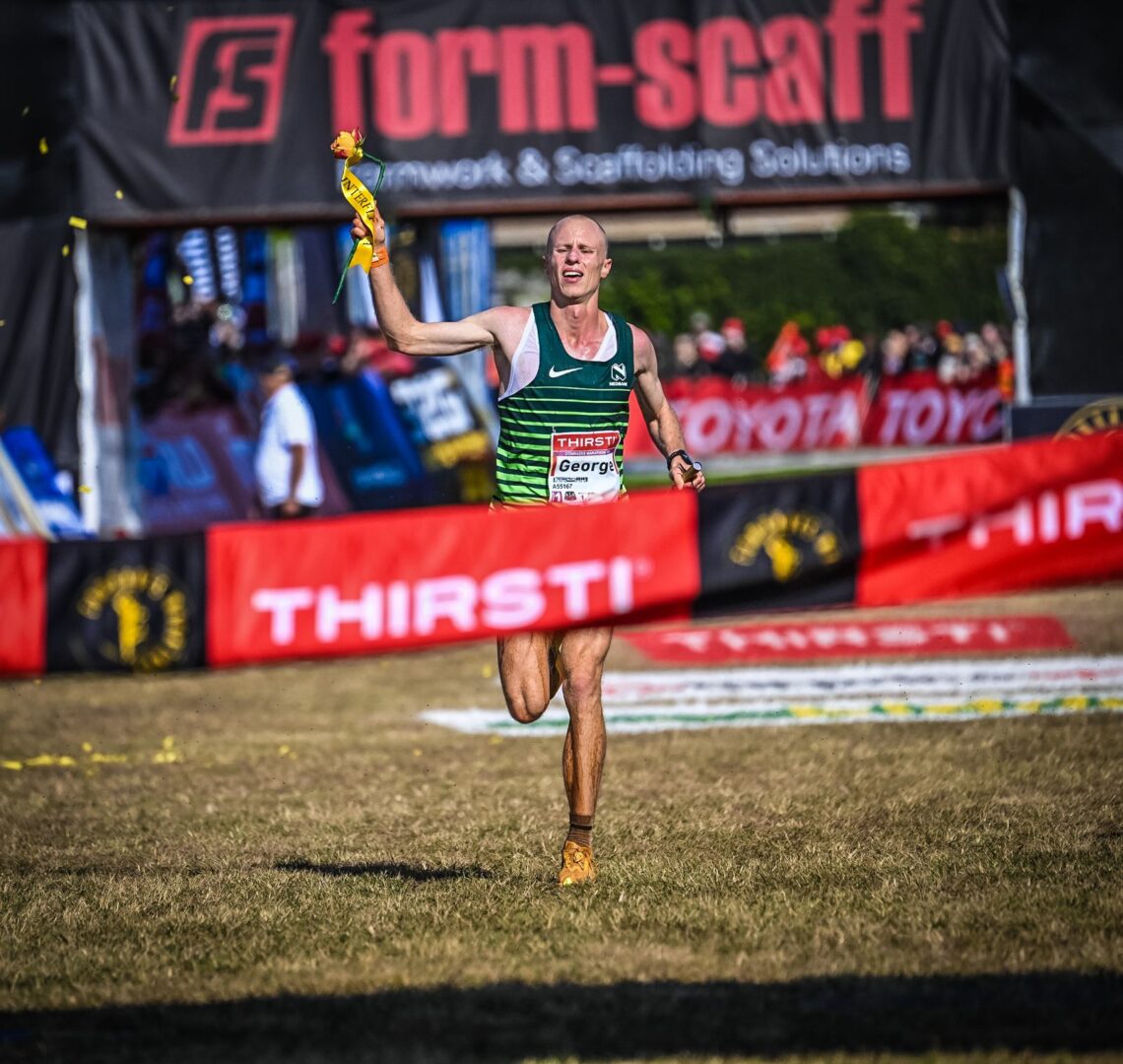
George Kusche is set to tackle the Tshwane 10k in his home town Pretoria. PHOTO CREDIT: Action Photo
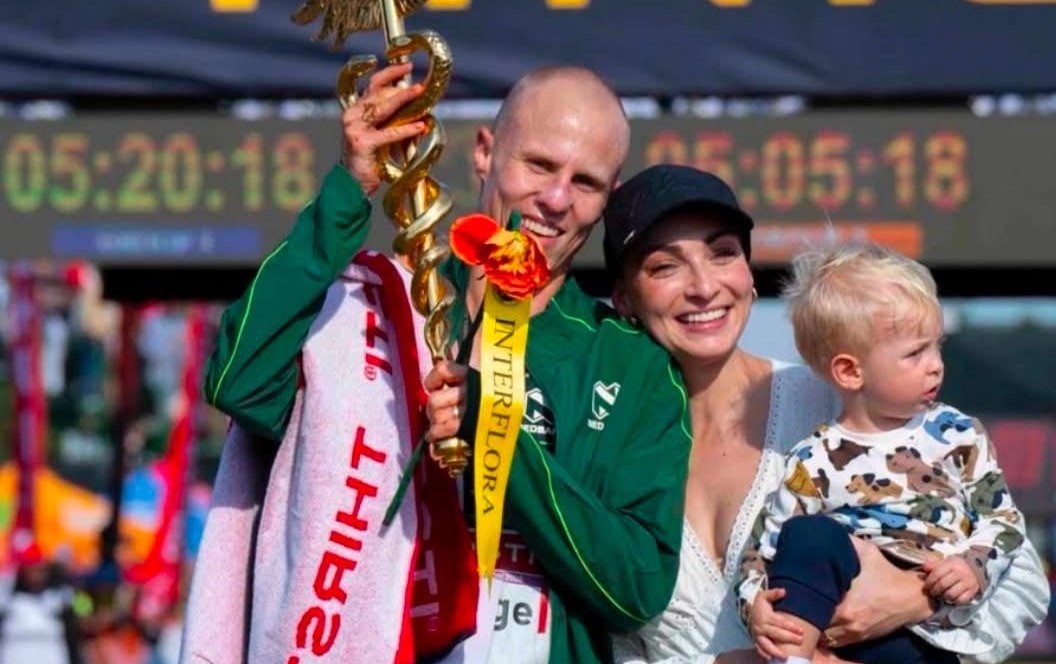
Kusche clocked 5:15:56 on 14 June to obliterate the Up Run record by more than eight minutes. It was an ultra-marathon performance with a sprinter’s heartbeat underneath it.
Now he wants to put that speed back under the microscope.
“It’s very important for me to run a fast 10km because I train as a marathon athlete year-round and then I switch to Comrades-specific training in March,” Kusche said.
“And if you want to be a good marathoner, you must be able to run a good 10km. So I’m hoping to be able to run a good race at the Absa RUN YOUR CITY TSHWANE 10K. I’d love to see if I can run sub-30 minutes, which should be a good time at altitude. I’m curious to see how well I can do. I’m in decent shape and I’m really looking forward to this.”
A sub-30-minute run could put Kusche in the thick of the action, although Tshwane’s hills have a habit of turning confident runners into humble pedestrians. Only 10 men broke 30 minutes in last year’s race.
Kibet knows the terrain and the pace required.
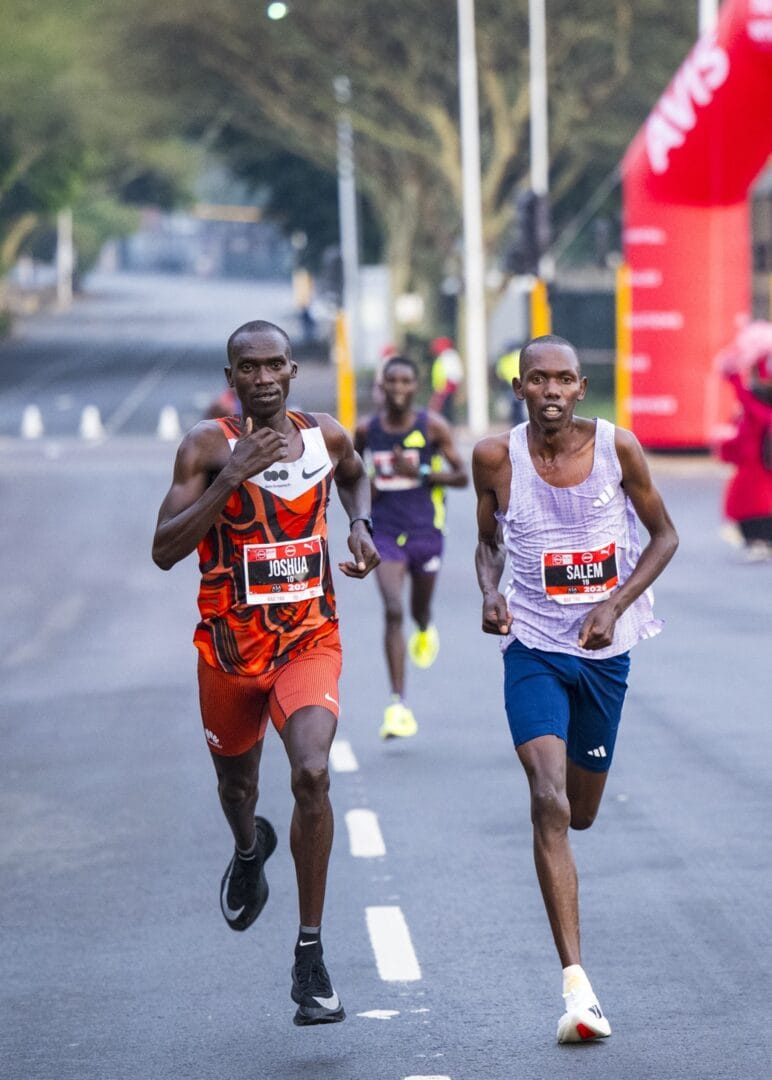
Joshua Cheptegei and Salem Kibet in action at the Absa RUN YOUR CITY DURBAN 10K in July this year. PHOTO CREDIT: Anthony Grote
The Kenyan arrives after running a lifetime-best 27:29 for second behind Uganda’s Joshua Cheptegei in Durban last month. He now wants to move one place higher.
“My target is to improve on my performance from Durban and compete for the win,” Kibet said.
“Finishing second in Durban was not easy, especially running alongside a great athlete like Joshua Cheptegei. That experience taught me a lot. I thank God for the opportunity, and I am looking forward to giving my best in Tshwane.”
Stillwater Sports managing director Michael Meyer believes the meeting of Kusche’s endurance and Kibet’s speed could add serious spice to the Pretoria showdown.
“George Kusche’s decision to test himself over 10km against a field of established specialists adds another fascinating dimension to what is shaping up to be a highly competitive Absa RUN YOUR CITY TSHWANE 10K,” Meyer said.
“He has already shown that he has the speed and endurance to compete at the highest level, and it will be exciting to see what he can produce over 10km after his record-breaking Comrades victory.”
Kusche brings the endurance. Kibet brings the velocity. Tshwane supplies the hills.
For years, the Free State has produced world-class runners, yet many of its brightest stars have had to leave home to chase the country’s biggest road races. Now the road is coming to them. In a major boost for athletics in the province, the Absa RUN YOUR CITY Series will expand from five to six events with the inauguralAbsa RUN YOUR CITY MANGAUNG 10Kon October 25, handing Mangaung a seat at South Africa’s top table of road running.
The announcement has been welcomed as a game-changing victory by some of the province’s biggest athletics names, who believe the race could unlock opportunities for thousands of aspiring runners.
Former Olympian and South African 1500m record holder Johan Cronje believes the city has waited long enough.
“Mangaung has always needed a world-class road race. There are no more excuses now. Local runners can compete against some of the best athletes in the world on their own doorstep.”
Cronje expects around 5,000 runners at the inaugural event and believes it has the potential to grow into a race attracting between 10,000 and 15,000 participants.
Three-time Olympian LJ van Zyl described the arrival of the race as a watershed moment for athletics in the province.
“Young athletes no longer have to leave home to experience a race of this calibre. It’s a real game-changer.”
“I’ve been excited because Free State has been overlooked for quite a while,” she said.
Swarts revealed that around 700 youngsters compete every Friday in the province’s cross-country league, with nearly 1,800 expected at next month’s provincial championships.
“This motivates our youngsters. Development starts with cross country, and now they’ll see the country’s biggest names competing alongside them. Does that not give hope? This is a story of hope.”
She believes the event will inspire children from townships and rural communities to dream bigger.
“Anyone can enter. Whether you’re from a township or a rural area, you can dream. Every day I work to help young people achieve the dreams they set for themselves. This race gives them that opportunity.”
Even Swarts has been bitten by the running bug again.
“I’ve started training because I had to be part of this. I’m competitive, so I’m hoping to break one hour. Since training for distance running, I’ve gained enormous respect for middle and long-distance athletes.”
The race is the result of a partnership between Stillwater Sports, the Mangaung Metropolitan Municipality and the Free State Department of Economic Development and Tourism.
Since Absa became title sponsor in 2021, more than 200,000 runners have taken part in the series, which now stretches across Gqeberha, Cape Town, Durban, Tshwane, Johannesburg and Mangaung.
Stillwater Sports Managing Director Michael Meyer said the expansion was another important step in growing the series while creating tourism and economic opportunities for host cities.
Absa Group Chief Marketing and Corporate Affairs Officer Sydney Mbhele said runners had been calling for Mangaung to be included for years.
“We are proud to have listened because at Absa, we believe every story matters.”
Mbhele added that the bank’s R1 Campaign has already raised almost R10 million through Team Absa’s Strava activities to support school vegetable gardens across South Africa, with Free State communities set to benefit.
Mangaung Executive Mayor Gregory Nthatisi said the race would showcase the city’s heritage and hospitality while creating opportunities for local businesses.
Free State MEC for Economic Development and Tourism Ketso Makume believes the event will strengthen the province’s growing reputation as a sport tourism destination.
For a province that has spent years watching South Africa’s biggest road races from the sidelines, the starter’s gun in Mangaung will signal far more than the beginning of another 10km. It will announce that the Free State has finally arrived.
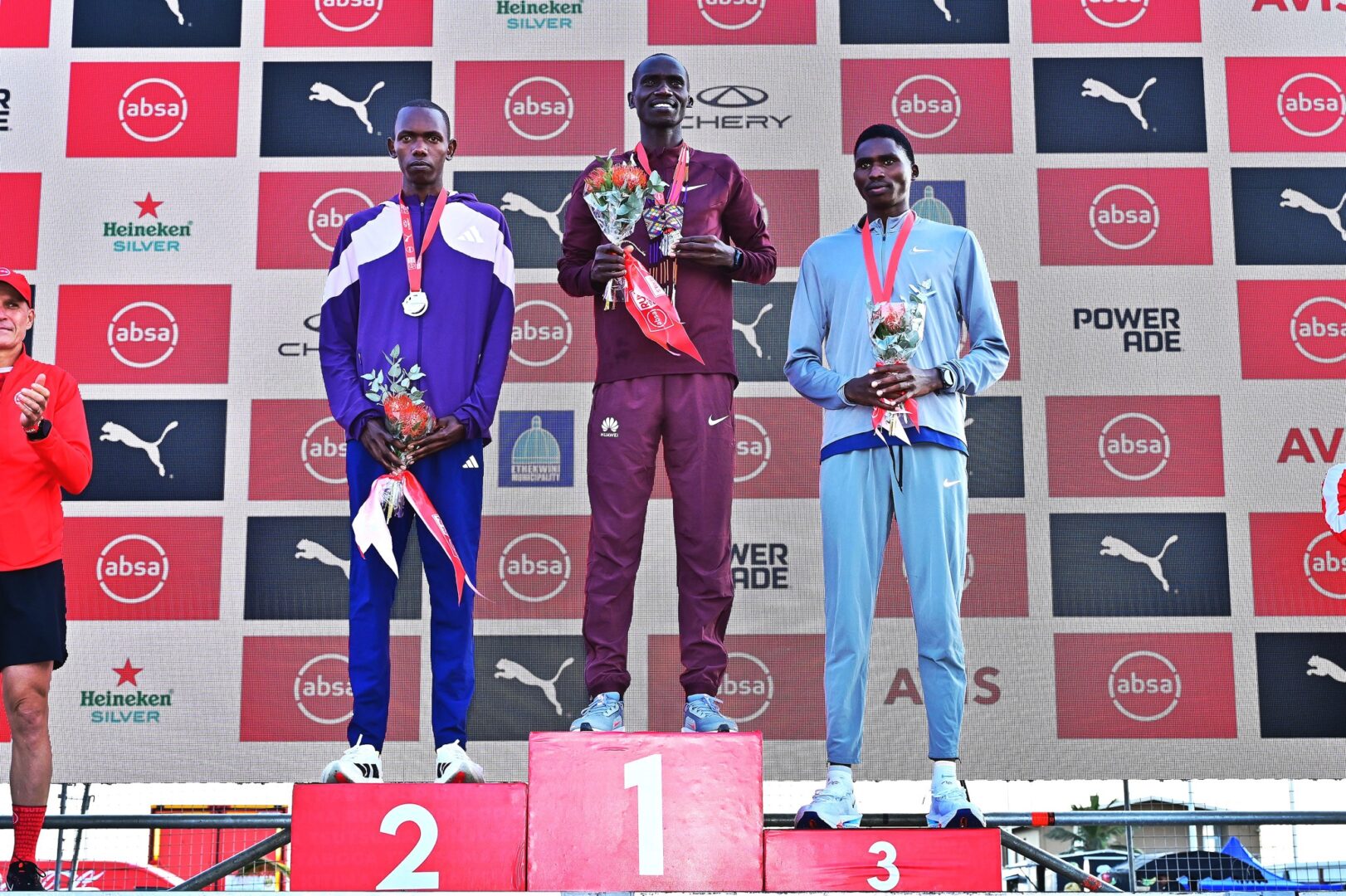
The Ugandan Olympic champion stopped the clock in 27:19, the second fastest 10km ever run on African soil, after averaging 2:44 per kilometre on Durban’s fast course.
Top three men’s finishers at the Durban 10K by Action Photo
Kenya’s Salem Kibet finished second in 27:29, while Uganda’s Emmanuel Kibet completed the podium in 27:32.
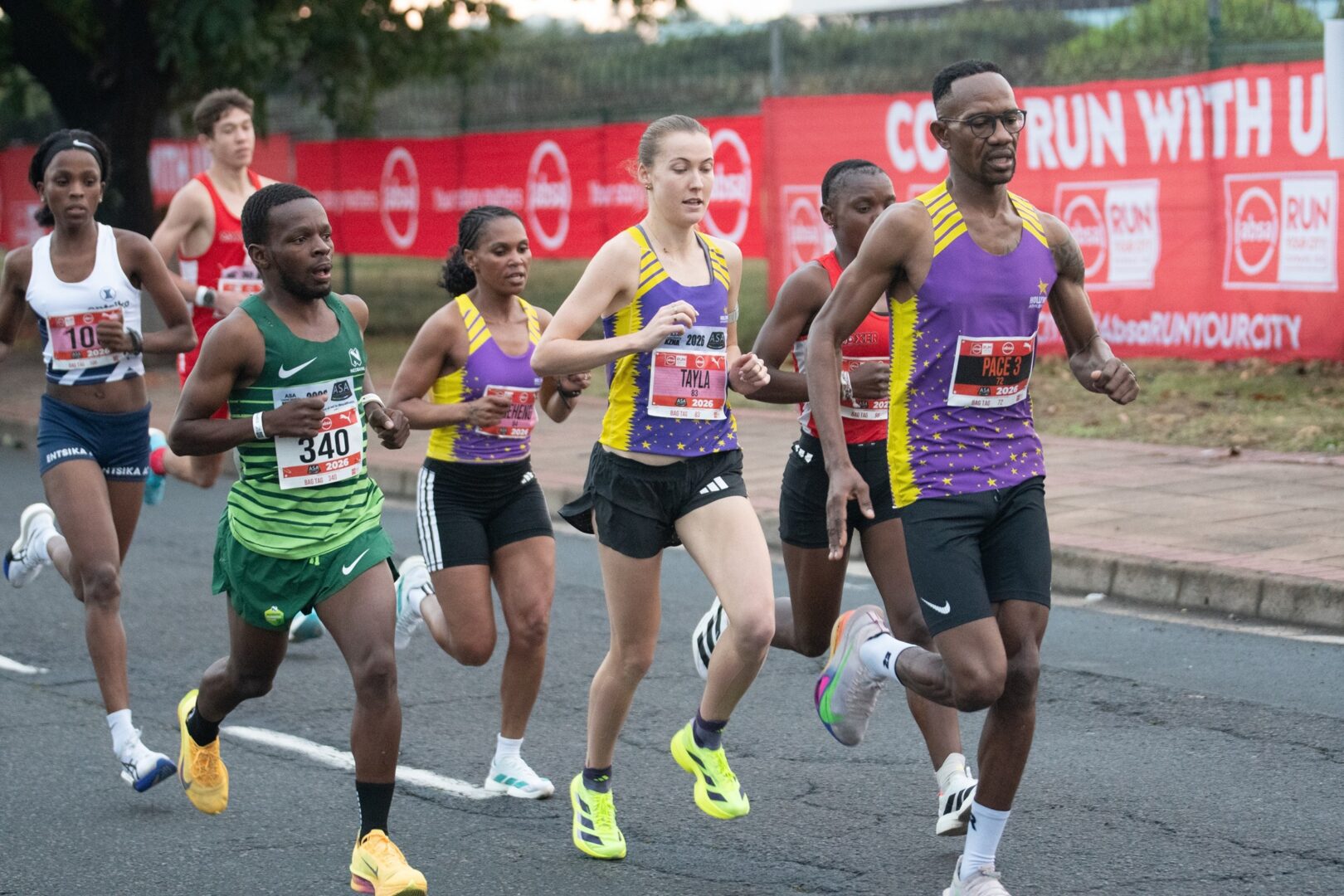
The strength of the elite field was reflected by the performances of the leading South Africans. Defending champion Kabelo Mulaudzi was the first local athlete home in sixth place in 28:06, while Durban favourite Tayla Kavanagh equalled her personal best of 31:28 to finish fourth in the women’s race. Hollywood Athletics Club teammate Neheng Khatala of Lesotho crossed the line fifth in 32:04.
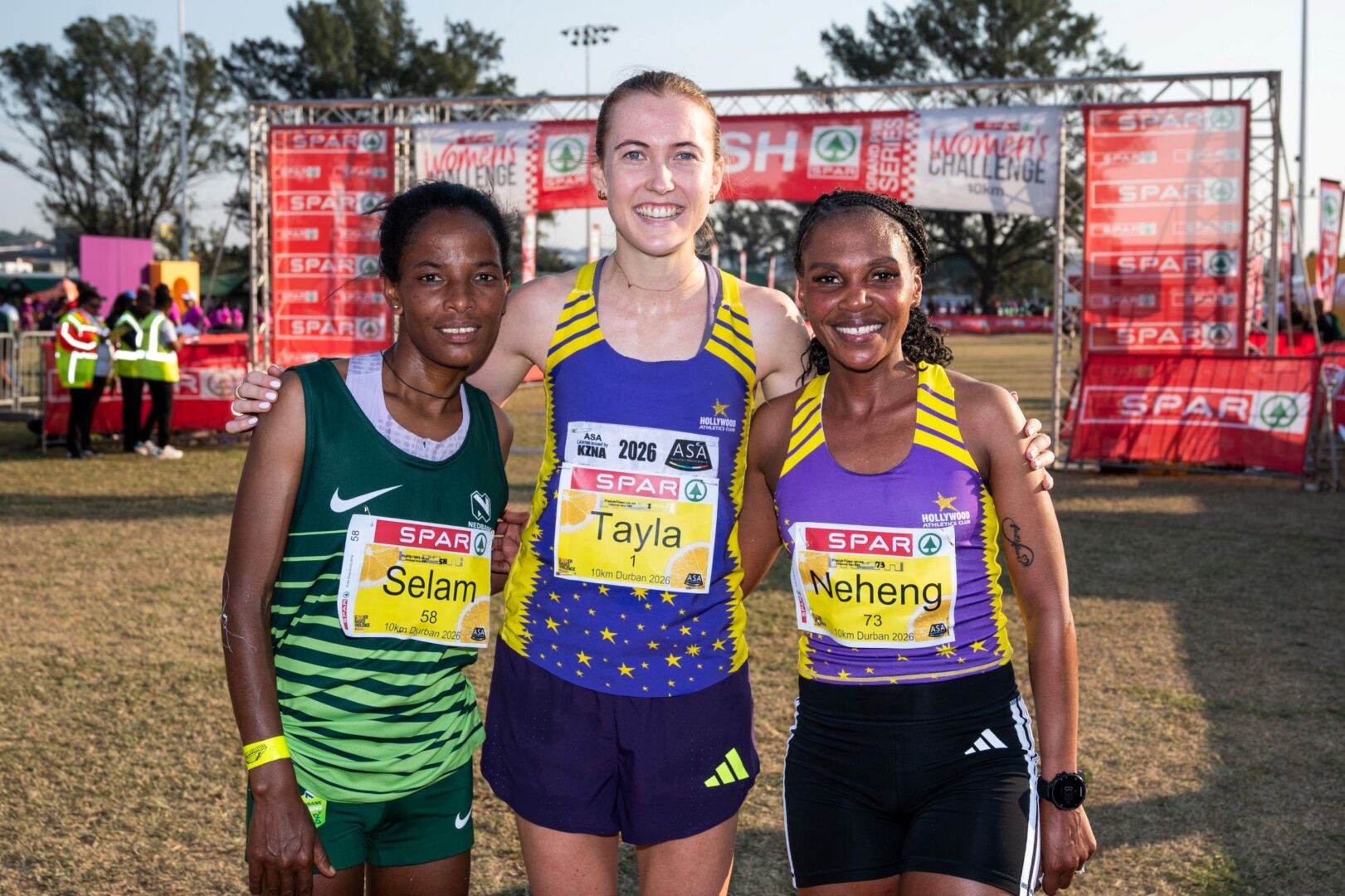
Hollywood AC stars Tayla Kavanagh and Neheng Khatala were the first SA women across the finish line Photo: Gavin Ryan
Cheptegei, who won the Durban race in 2017 before setting a South African All-Comers record of 27:16 a year later, said the elusive barrier remains achievable with stronger pacing support.
“I’m so happy to be here again. Running in the streets of Durban with such an incredible field was spectacular. My goal was to run sub-27, but it wasn’t possible today,” said Cheptegei.
“Maybe we needed a pacemaker to take us through 5km and then speed up again later. To win again and set a new course record makes me happy and gives me motivation moving forward.”
The 29-year-old, regarded as one of the greatest distance runners of his generation, felt the pace eased too early.
“Sometimes you plan to run faster and you need help from different athletes. I realised it wasn’t going to be possible because the tempo wasn’t fast enough and I had to push by myself.”
Cheptegei remains convinced the landmark performance will happen on African roads.
“I believe it’s very possible. We need more support with the pacemaking duties and then we can see a sub-27 here. The course is spectacular, the conditions were perfect and the level of competition was really good.”
He also praised the organisers for assembling one of the strongest international fields seen in South Africa.
“These events give athletes opportunities to showcase their talent and become sporting heroes. Such incentives help develop the sport and South Africa is headed in the right direction.”
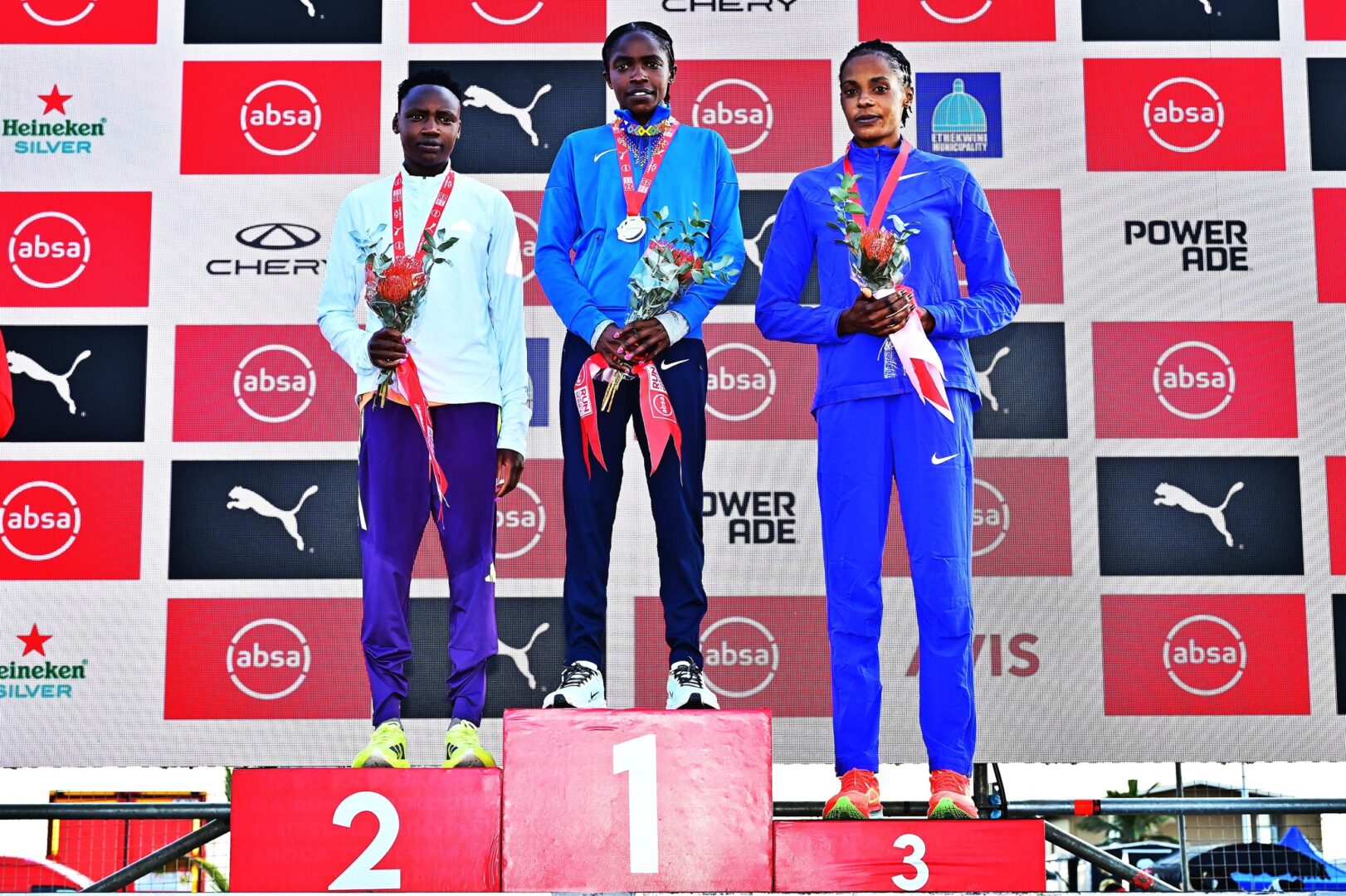
The women’s race produced a Kenyan clean sweep as Doreen Cherop claimed the biggest victory of her career in 30:43, finishing ahead of Brenda Jepchirchir (30:52) and Beatrice Chepkoech (31:25).
Top three women finishers at the Durban 10K by Action Photo
“My target was to finish on the podium. I’m so happy to become the winner today. I didn’t expect it,” said Cherop.
“We reached 5km in about 15:04, which was fast for me. When I got close to Brenda, I found extra energy and kicked all the way to the finish.”
Cherop said she hopes to return to Durban after exceeding her own expectations.
“I expected to run 31 minutes, but I ran 30. I’ll be back because the weather is good and the race is good.”
Although the historic time barriers remained intact, Sunday’s performances reinforced the Absa RUN YOUR CITY DURBAN 10K’s reputation as one of Africa’s premier road races and showed that the continent is edging ever closer to another landmark moment.
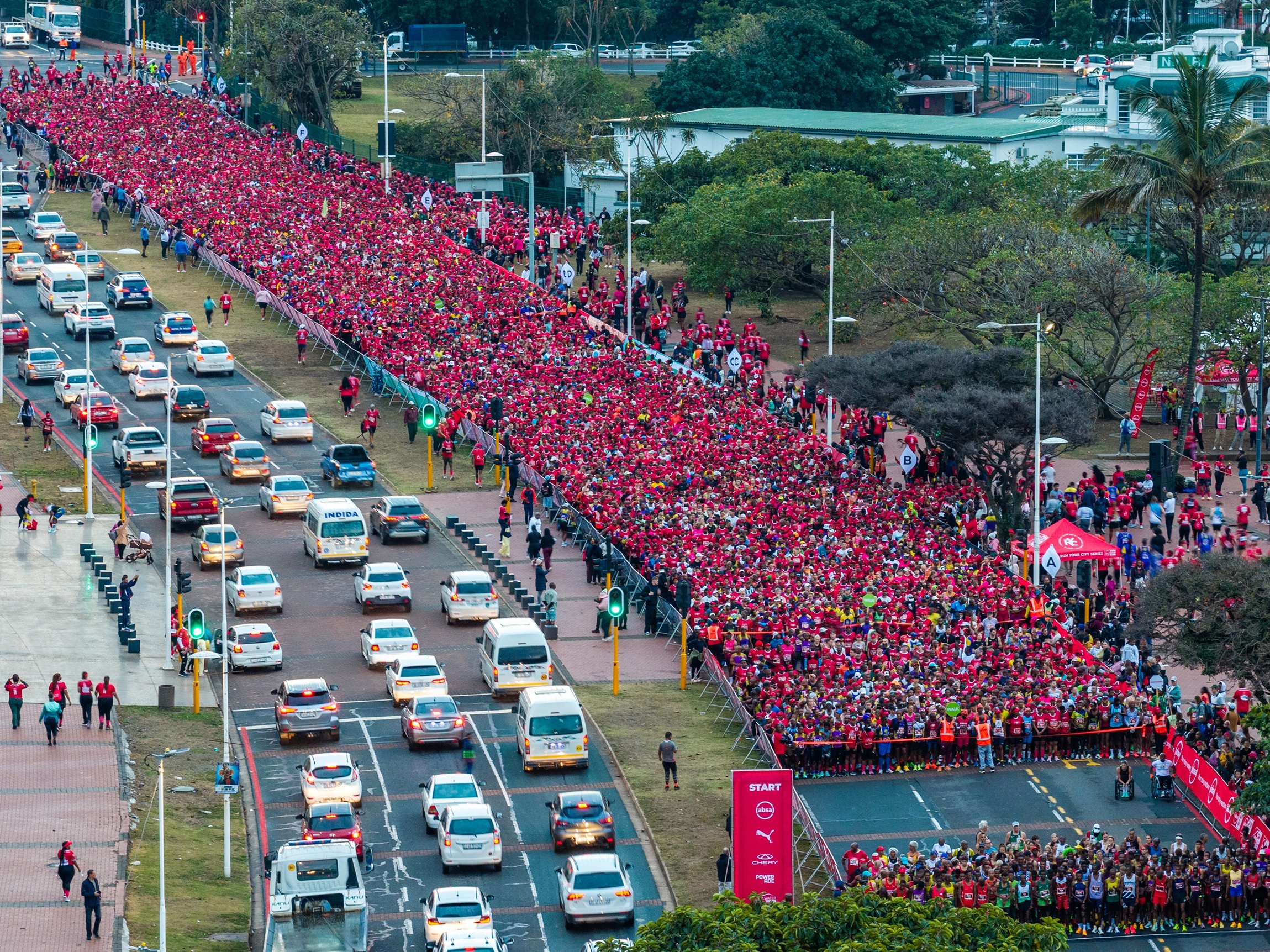
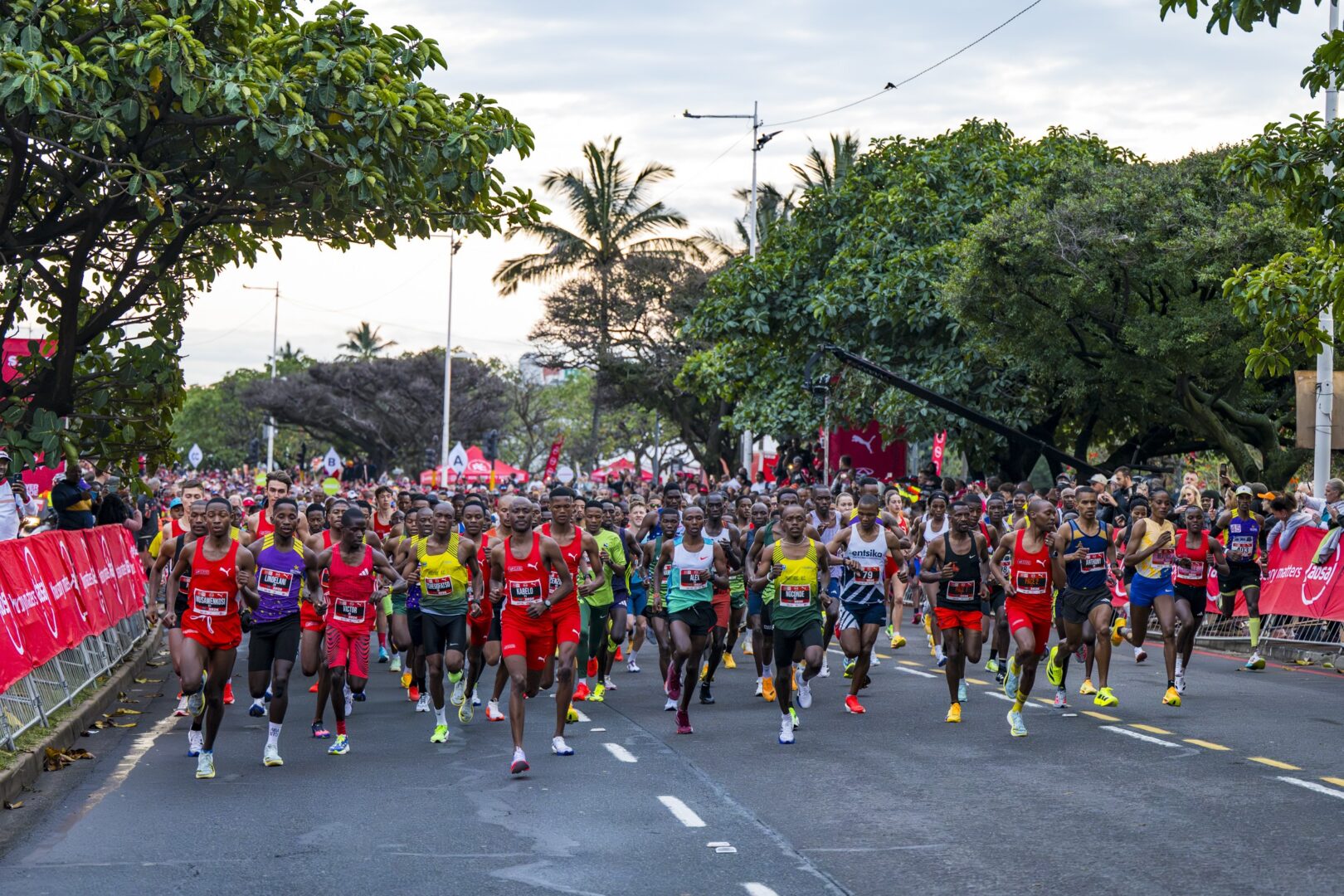
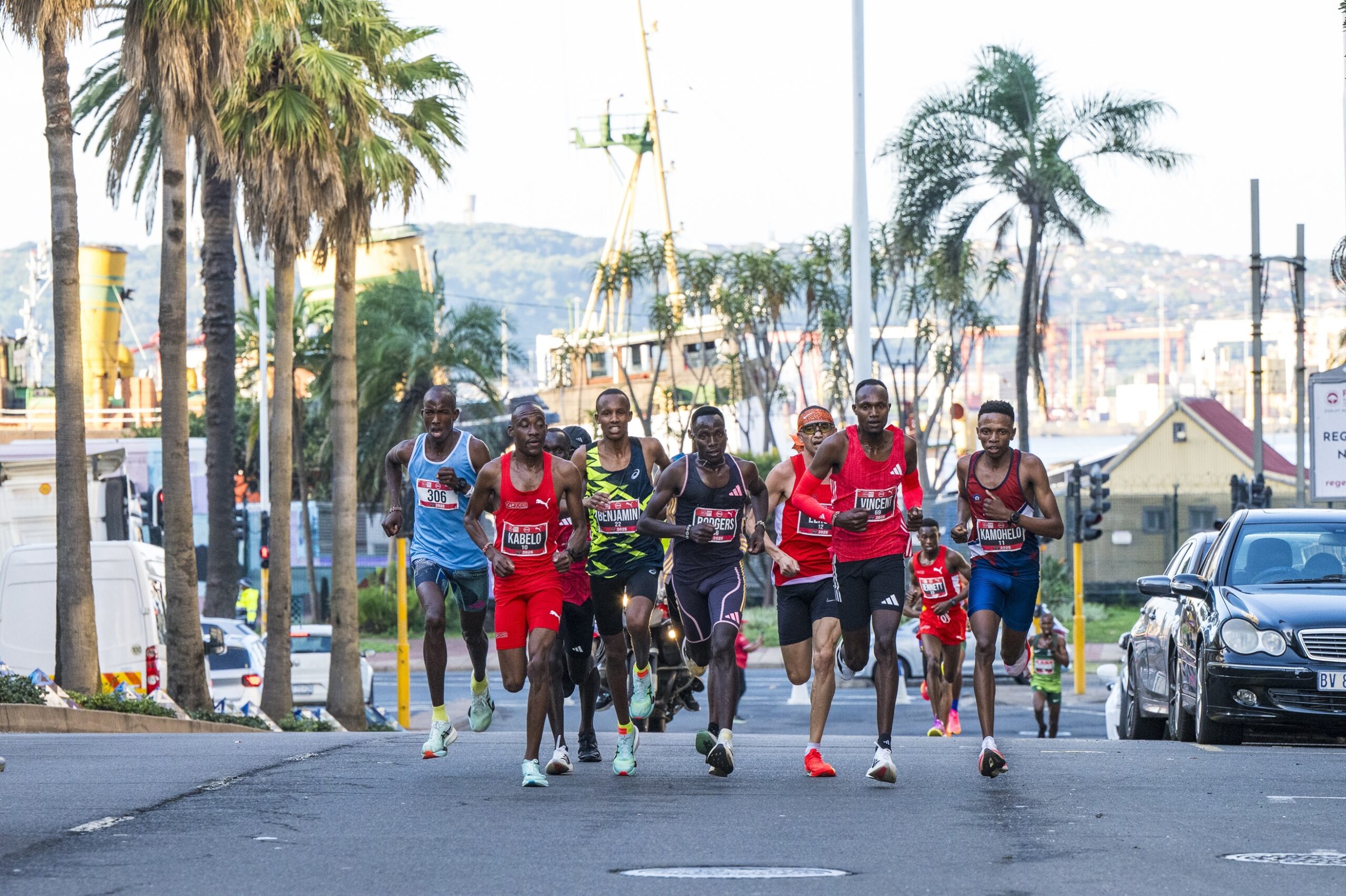
Elite start of the Durban 10K PHOTO CREDIT: Anthony Grote
The Hollywood Athletics Club star is enjoying the richest vein of form of her career, but Sunday’s commanding victory in Durban merely confirmed where her attention lies. The Commonwealth Games 5 000m in Glasgow is the next target. After that, Glenrose Xaba’s South African 10km road record moves firmly into view.
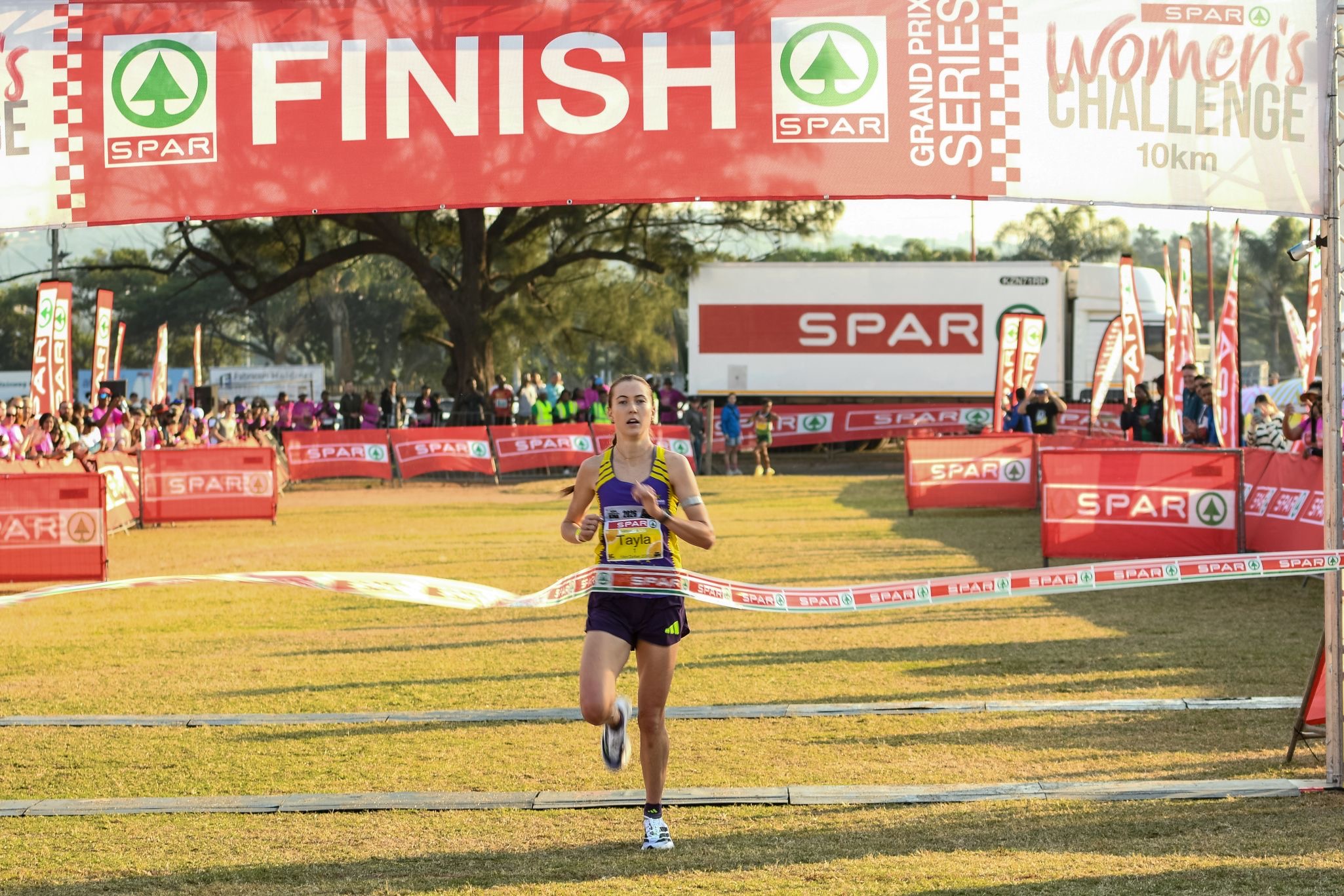
Kavanagh underlined her credentials with another front-running display in the second leg of the SPAR Grand Prix series, clocking 31:32 after leading from gun to tape. The performance trimmed one second off the 31:33 she recorded while winning the opening race in Cape Town in March.
Ethiopia’s Selam Gebre stayed within striking distance before finishing second in 31:45, while Kavanagh’s Hollywood teammate Neheng Khatala completed the podium in 32:08.
The victory added another chapter to a remarkable season. The 25-year-old lowered her personal best to 31:26 at the Sanlam Cape Town 10km Peace Run in May, secured a third successive title in that race and swept to national crowns over 5 000m and 10 000m at the South African Championships in Stellenbosch.
Despite opening a healthy advantage in the SPAR standings, Kavanagh says the series title is not driving her schedule.
“My focus is on the Commonwealth Games. I have one more 10K and then all eyes are on the Commonwealth Games,” she said.
“I haven’t committed to any other SPAR races yet, so I can’t tell you if I’ll be trying to win the whole series. I’m trying to participate in the ones that I can.”
Durban presented a different challenge to Cape Town, where Kavanagh spent much of the race chasing Glenrose Xaba. This time she dictated the pace from the front and trusted her instincts.
“I was quite proud of how I managed to relax within the race, constantly checking in with myself and how my body was reacting.”
“Selam and I had a really good race. At the 9km mark I still felt I had something left in the legs, so I tried to open up. I was really happy with how it played out.”
While Glasgow has become her immediate destination, the national record remains the long-term prize.
Xaba’s South African 10km road record of 31:12, set in Durban in 2024 when she erased Elana Meyer’s 23-year-old mark, has become the benchmark Kavanagh wants to reach.
“I’d love to get there this season. Hopefully by the end of 2026 I can reach that goal or see how close we can get,” she said.
“I know on a good day, if everything comes together, I have a good chance. It’s a matter of time. It’s in God’s hands when it happens, but it’s something I do want to chase.”
The stopwatch has become Kavanagh’s toughest opponent.
If her current trajectory continues, Glasgow could provide another springboard before she takes aim at one of South African road running’s most treasured records.
SPAR GRAND PRIX 10KM RESULTS – DURBAN
Results of the Durban leg of the SPAR Grand Prix Series on Sunday, 28 June 2026.
Sinesipho Dambile arrived in Doha chasing another strong performance. He left with a Diamond League trophy, a personal best and a place in South African athletics history.
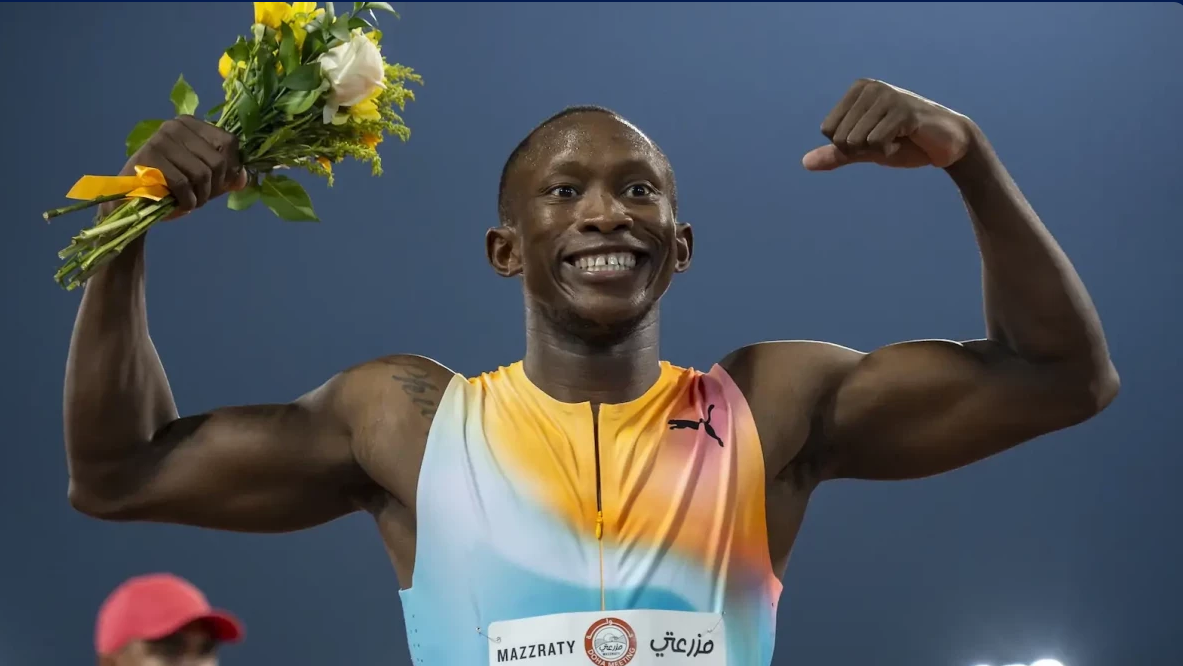
The 24-year-old stormed to victory in the men’s 200m over the weekend night, clocking a career-best 19.74 seconds to claim his maiden Diamond League title.
In the furnace-like conditions of the Qatari capital, with temperatures hovering around 37°C and a legal tailwind of 1.8 m/s, Dambile produced a race that was equal parts power and precision.
Running in lane five, he exited the blocks cleanly and attacked the bend with purpose. By the time the field straightened up for the home run, the South African had already edged ahead.
Zimbabwe’s Makanakaishe Charamba and Dominican Republic’s Alexander Ogando mounted a late challenge, but Dambile never looked troubled. His stride remained smooth and controlled as he powered clear over the closing metres.
The clock stopped at 19.74 seconds, trimming 0.03 seconds off his previous best and confirming the rich vein of form he has carried throughout the season.
“This is my fourth Diamond League event. I am having the best season of my life thus far. I am still building and can get even better,” Dambile said afterwards.
The result is another significant step for an athlete whose ambitions stretch well beyond Doha.
“I want to get gold at the Commonwealth Games and then go to the Ultimate Championships. I’ve never been to the Commonwealth Games before and would like to experience it. I’m also looking forward to the final Diamond League in Brussels.“
His triumph completed an unprecedented South African sprint clean sweep across the Diamond League circuit this season.
Gift Leotlelaopened the account in the 100m in Shanghai. Zakithi Nene followed in the 400m in Stockholm. Dambile’s Doha victory ensured South Africa has now produced Diamond League winners across all three major sprint distances in the same season for the first time.
The country’s sprint programme has often promised much. In 2026, it is cashing in those promises.
An Athletics South Africa spokesperson hailed the achievement.
“Sinesipho’s performance is a testament to the talent, commitment and growing strength of South African sprinting. His success reflects the progress being made across the sprint events and serves as inspiration for aspiring athletes across the country.”
With Glasgow’s Commonwealth Games and September’s Ultimate Championships looming, Dambile’s season is gathering momentum.
For now, the fastest thing in Doha was not the tailwind. It was a South African sprinter finding another gear.
With two kilometres remaining, George Kusche glanced at the race clock for the first time all day.
The display showed roughly 5:08.
His body felt like a battered vehicle limping home after a cross-country expedition. His left calf had been threatening mutiny for more than 30 kilometres. Every stride sent warning signals through weary muscles. The road tilted and twisted ahead like a mischievous serpent refusing to surrender its final secrets.
Yet something curious happened.
The mathematics suddenly made sense.
“I remember thinking, if I run 10 minutes in these last two kilometres, I’m still going to run 5:18.”
For most runners, that would be astonishing pace after nearly 86 kilometres.
For Kusche, it was a moment of realisation.
History was waiting at the finish line.
The remarkable part is that he still wasn’t thinking about winning.
“I thought to myself, I can’t think about anything else now. I need to focus on putting my foot in front of the other and running as fast as I can.”
That fear may have been his greatest ally.
Because while many runners arrive at Comrades armed with bravado and bold predictions, Kusche approached the race like a scientist approaching an unsolved equation.
Carefully.
Methodically.
Relentlessly.
And in doing so, he produced one of the greatest performances the race has ever witnessed.
THE UNDERDOG WHO WAS NEVER CHASING A TROPHY
When Kusche crossed the finish line at Hollywoodbets Scottsville Racecourse in Pietermaritzburg, the clock stopped at 5:15:56.
The time demolished Russian Leonid Shvetsov’s 18-year-old Up Run record of 5:24:49 by almost nine minutes.
It also delivered the fastest average pace ever recorded in the history of the Comrades Marathon.
Yet the journey began not with victory but with disappointment disguised as success.
A year earlier, the former NCAA athlete had finished 12th in his Comrades debut.
Many runners would have celebrated.
Kusche analysed.
“On the day I knew that was the absolute best I could have done,” he said.
“But I know I made a lot of mistakes preparing for that Comrades because it was my first one. I was naive about what it takes to run Comrades.”
The race became a classroom.
The student paid attention.
PROJECT 2026
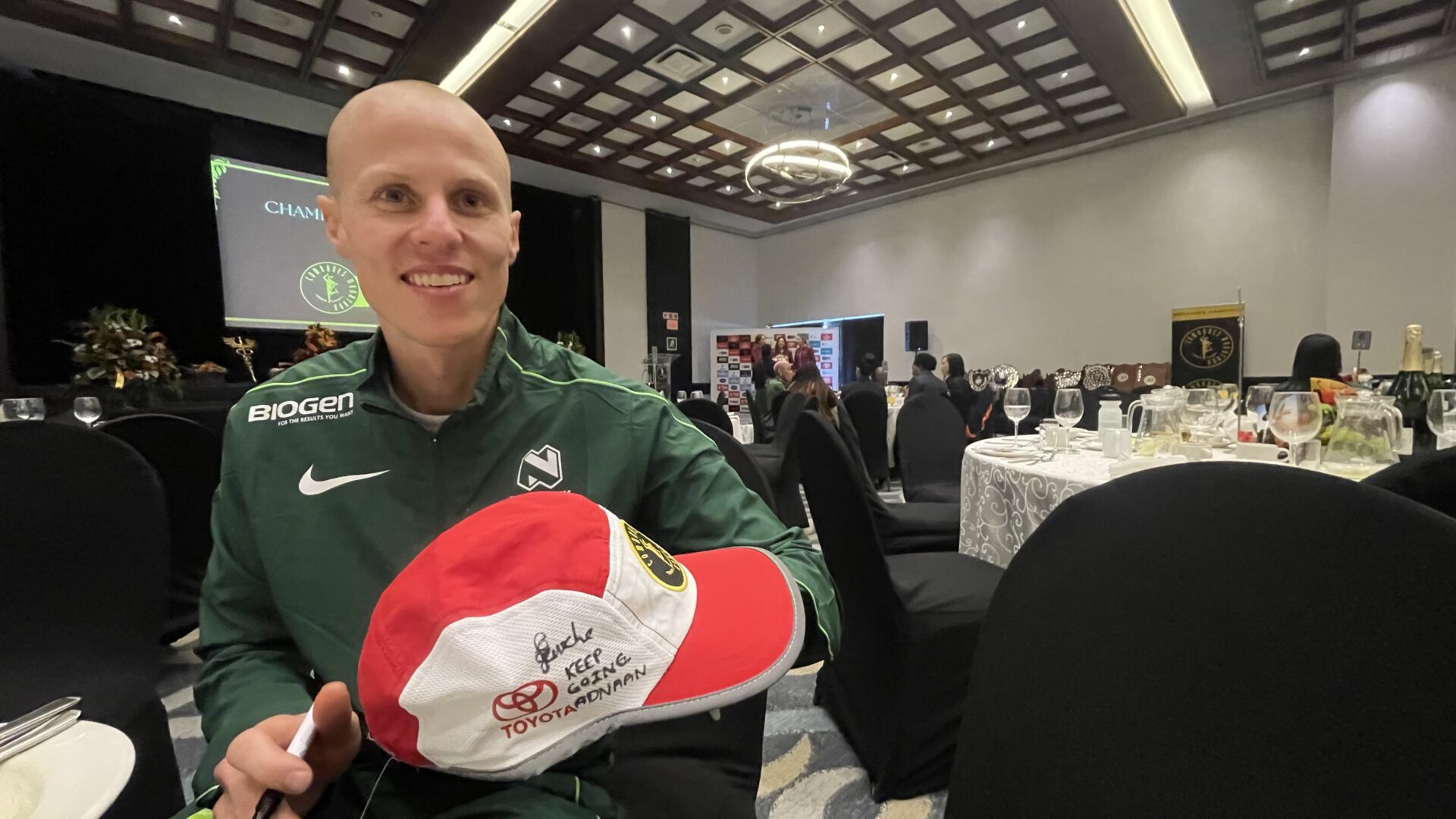
George Kusche at the 2026 Comrades Winners Breakfast Photo: Adnaan Mohamed
Most athletes emerging from a strong debut create a target.
Kusche created a process.
“It was Project 2026, but not to win.”
That statement sounds almost absurd after what followed.
“It was Project 2026 to focus on the process as much as I can and make sure that on June 14, 2026, I show up as the absolute best version that I could be.”
“If that means a win, then I’m happy.”
The distinction matters.
The goal was not a trophy.
The goal was optimisation.
Every kilometre became a data point.
Every session became an experiment.
Every mistake became valuable information.
THE SCIENTIST IN THE RUNNING SHOES
Away from racing, Kusche works full-time as a Data Scientist at Pepkor Lifestyle.
The numbers are woven into his DNA.
Born in Malalane in Mpumalanga, educated at Laerskool Malelane and Affies in Pretoria, he earned a Master’s degree in Statistics and passed eight Actuarial Society of South Africa examinations on his first attempt.
He coaches himself.
That revelation surprised Fordyce.
In an era overflowing with coaches, consultants and performance gurus, Kusche remains his own architect.
“I coach myself.”
His approach combines science and instinct.
“I accumulated a lot of volume, but that came over a period of a year.”
“It’s a gradual increase in both volume and intensity and elevation gain.”
“I meticulously tracked various metrics over time and ensured that they increased and peaked at the right time.“
The scientist measured everything.
The athlete listened to his body.
The combination proved potent.
THE HILL THAT BUILT A CHAMPION
Every Tuesday, a hill in Pretoria became his laboratory.
He repeatedly climbed and descended Platheus Hill.
No dramatic sprinting.
No social media heroics.
No chest-thumping workouts.
“I simply jogged up and jogged down.”
“And I just let the elevation gain do the damage it had to do.”
Slowly, the hill surrendered.
“Without increasing my effort, I could see my pace increasing and my heart rate decreasing.”
Like water carving a canyon, the work accumulated quietly until the results became impossible to ignore.
THE OVERTRAINING MYTH
As race day approached, whispers began circulating.
Some observers believed Kusche was training too much.
Even Fordyce and former champion Nick Bester had concerns.
“We said George is terribly overtrained.”
Kusche knew the rumours.
“I know about the overtraining allegations.”
His answer reflected the analytical mindset that defines him.
“You can’t look at one number and say someone’s overtraining.”
“My workouts kept improving.”
His peak week reached an eye-watering 259 kilometres.
Yet he remembers feeling restrained.
“I felt like I could have done 300.”
“I felt guilty not running more.”
The engine was humming.
The data agreed.
THE SURGES THAT BROKE THE RACE
The winning move arrived long before he took the lead.
Running within a pack, Kusche sensed comfort spreading among his rivals.
Comfort is dangerous in championship racing.
So he attacked it.
“I didn’t want the pack to be comfortable.”
Climbing Inchanga, he repeatedly surged.
Not wildly.
Not recklessly.
Simply enough to raise the temperature.
“I felt really strong.”
“I just decided to go in front of the pack and gradually increase the pace.”
The surges acted like tiny cracks in a dam wall.
Invisible at first.
Devastating later.
“After about four of those surges, I decided it’s now time to go for gold.”
The race had changed.
The field simply had not realised it yet.
FEAR ON POLLY SHORTTS
For television viewers, Kusche looked magnificent.
Fordyce remembers watching him move through Harrison Flats and immediately predicting victory.
“George is going to win.”
The reality unfolding inside Kusche’s body was far less glamorous.
“My left calf was cramping.”
“My legs were sore.”
“I kind of felt tired.”
Then came Polly Shortts.
The notorious climb often acts like a final judge standing between contenders and champions.
Fortunately, Kusche had studied every metre.
“I knew exactly how long that hill would be.“
That knowledge became a psychological weapon.
“I knew it’s two kilometres.”
“I knew that if I could get to the top in the lead and feeling strong and maintain my pace, then the odds are good of winning.”
What happened next was pure courage.
“I didn’t feel good.”
“But I went up that hill giving it everything I had.”
Joshua Cheptegei’s appearance at the2026 Absa RUN YOUR CITY DURBAN 10Khas attracted what organisers believe is the strongest men’s field ever assembled for a 10km road race on African soil.
The Ugandan superstar, an Olympic champion, multiple world champion and world record holder over 5 000m and 10 000m, will line up in Durban on 12 July against a field packed with international winners, national record holders and emerging stars eager to test themselves against one of the sport’s modern greats.
Leading the list of challengers is Kenya’s Felix Masai, whose 27:24 personal best makes him one of the fastest men in the race. The Totalsports Two Oceans Half Marathon champion expects Cheptegei’s presence to elevate the standard of competition.
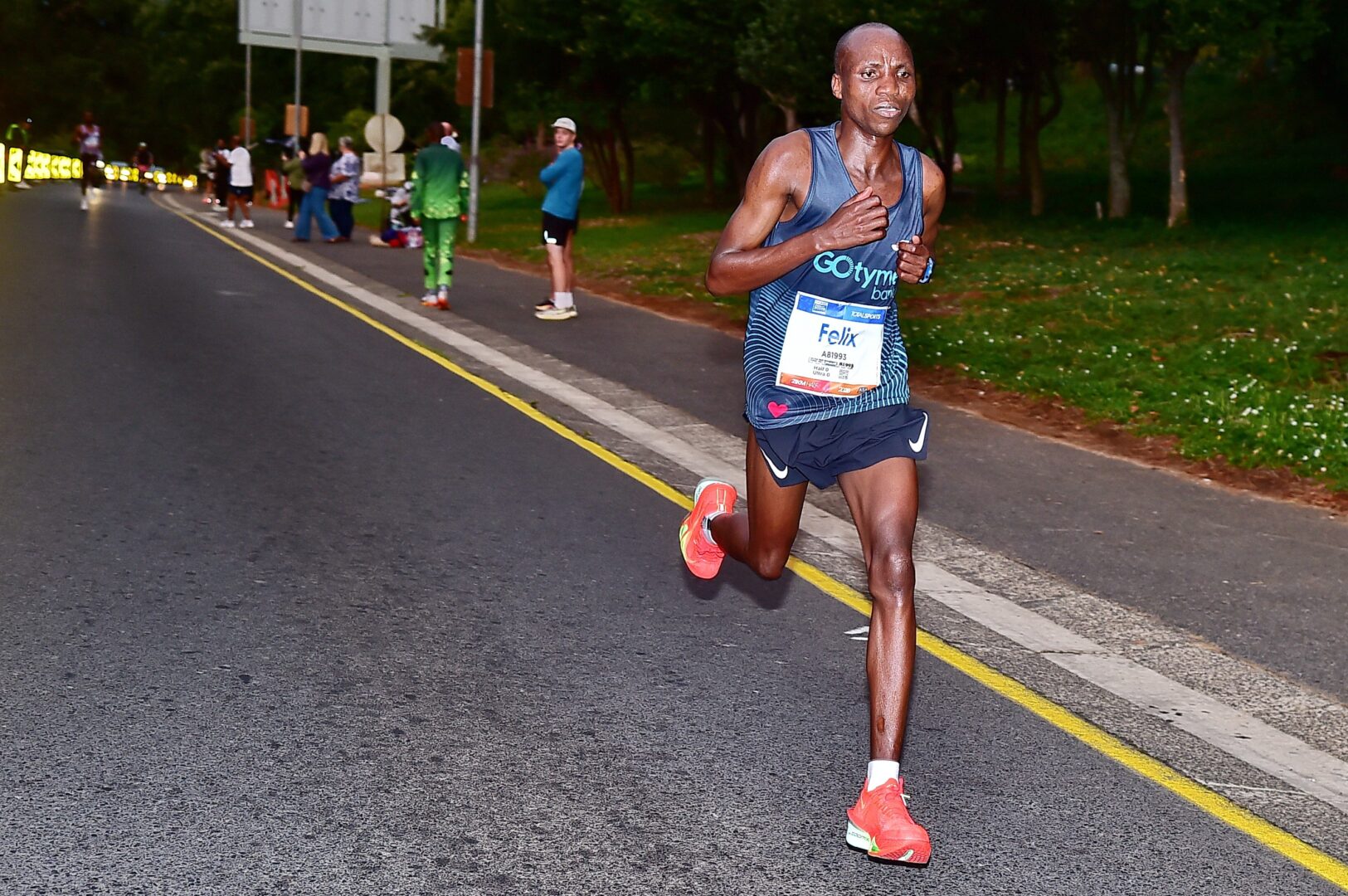
Felix Masai (Kenya) has a 10km PB of 27:24. PHOTO CREDIT: Action Photo
“He is one of the greatest distance runners of all time, and competing alongside him raises the level of the entire field,” said Masai.
“My race target is to give my best. I like competing in South Africa.”
Another athlete to watch is Kenyan Gilbert Kiprotich, who arrives in Durban with confidence after a strong performance at the Lisbon Half Marathon.
“I’m feeling well after the Lisbon Half Marathon. I took some time to recover before shifting my focus to preparing for racing in South Africa,” said Kiprotich.
“Looking back to the Half Marathon, where I recorded a 10km split of 27:01 and considering how the second half of the race unfolded, I believe I am capable of running comfortably under 27:00 in Durban.”
Kiprotich believes favourable conditions and strong pacing could produce something special.
Gilbert Kiprotich (Kenya) has a 10km PB of 27:43. PHOTO SUPPLIED
“We are hoping for favourable weather conditions and strong pacing on race day. I feel inspired by the opportunity to race against Joshua Cheptegei. He is a world-class athlete, and competing alongside him will provide valuable experience and contribute significantly to my development as a professional athlete.”
Lesotho national record holder Kamohelo Mofolo returns to the race where he set his country’s 10km mark in 2025 and believes the course remains one of the fastest on the continent.
“The Absa RUN YOUR CITY DURBAN 10K is a flat, fast course with few turns, and if the conditions are right it allows for very quick times,” said Mofolo.
“Every race here feels like it has the potential to be something special, and I’m honoured to be part of such an impressive lineup.”
Mofolo added that racing against athletes of Cheptegei’s calibre presents a valuable opportunity.
“Racing against athletes like Joshua Cheptegei is a great opportunity because he is an amazing runner, and I’m excited to learn from the best while sharing the start line with him.”
South African hopes will rest largely on Kabelo Mulaudzi, whose development has been closely linked to the Absa RUN YOUR CITY Series.
“I am grateful to the Absa RUN YOUR CITY Series because it created a platform for me to obtain an invitation to a big international race,” said Mulaudzi.
“I am extremely excited to be part of this event and it is always great to run in South Africa against the world’s best athletes.”
The South African believes competing alongside Cheptegei can bring out the best in the field.
“I have always enjoyed the challenge of racing against better athletes than myself and it is great to be lining up with Joshua. I hope that he will help bring out the best in me and all the other athletes competing in the race.”
Adding further depth is Cheptegei’s Ugandan training partner Emanuel Kibet, who boasts a personal best of 27:37 and is expected to play a significant role at the front of the race.
Stillwater Sports Managing Director and Series FounderMichael Meyer believes Cheptegei’s participation has transformed the event.
“Joshua Cheptegei’s participation has drawn a truly extraordinary depth of field to the Absa RUN YOUR CITY DURBAN 10K, bringing together world champions, record holders, and some of the fastest road runners on the planet,” Meyer said.
“This level of quality not only elevates the competitive standard of road running in South Africa, but firmly cements the 2026 Absa RUN YOUR CITY DURBAN 10K as the Greatest 10K on African Soil.”
Meyer added that the strength of the field could produce a historic result.
“In conditions like these, with such depth and intent at the front of the race, the possibility of a historic performance, even a breakthrough sub-27-minute 10km, becomes a real possibility.”