

Inside the mind of Comrades Champion George Kusche

By Adnaan Mohamed

With two kilometres remaining, George Kusche glanced at the race clock for the first time all day.

The display showed roughly 5:08.

His body felt like a battered vehicle limping home after a cross-country expedition. His left calf had been threatening mutiny for more than 30 kilometres. Every stride sent warning signals through weary muscles. The road tilted and twisted ahead like a mischievous serpent refusing to surrender its final secrets.

Yet something curious happened.

The mathematics suddenly made sense.

“I remember thinking, if I run 10 minutes in these last two kilometres, I’m still going to run 5:18.”

For most runners, that would be astonishing pace after nearly 86 kilometres.

For Kusche, it was a moment of realisation.

History was waiting at the finish line.

The remarkable part is that he still wasn’t thinking about winning.

“I wasn’t thinking about winning. I was honestly afraid,” he told nine-time Comrades champion Bruce Fordyce.

“I thought to myself, I can’t think about anything else now. I need to focus on putting my foot in front of the other and running as fast as I can.”

That fear may have been his greatest ally.

Because while many runners arrive at Comrades armed with bravado and bold predictions, Kusche approached the race like a scientist approaching an unsolved equation.

Carefully.

Methodically.

Relentlessly.

And in doing so, he produced one of the greatest performances the race has ever witnessed.

THE UNDERDOG WHO WAS NEVER CHASING A TROPHY

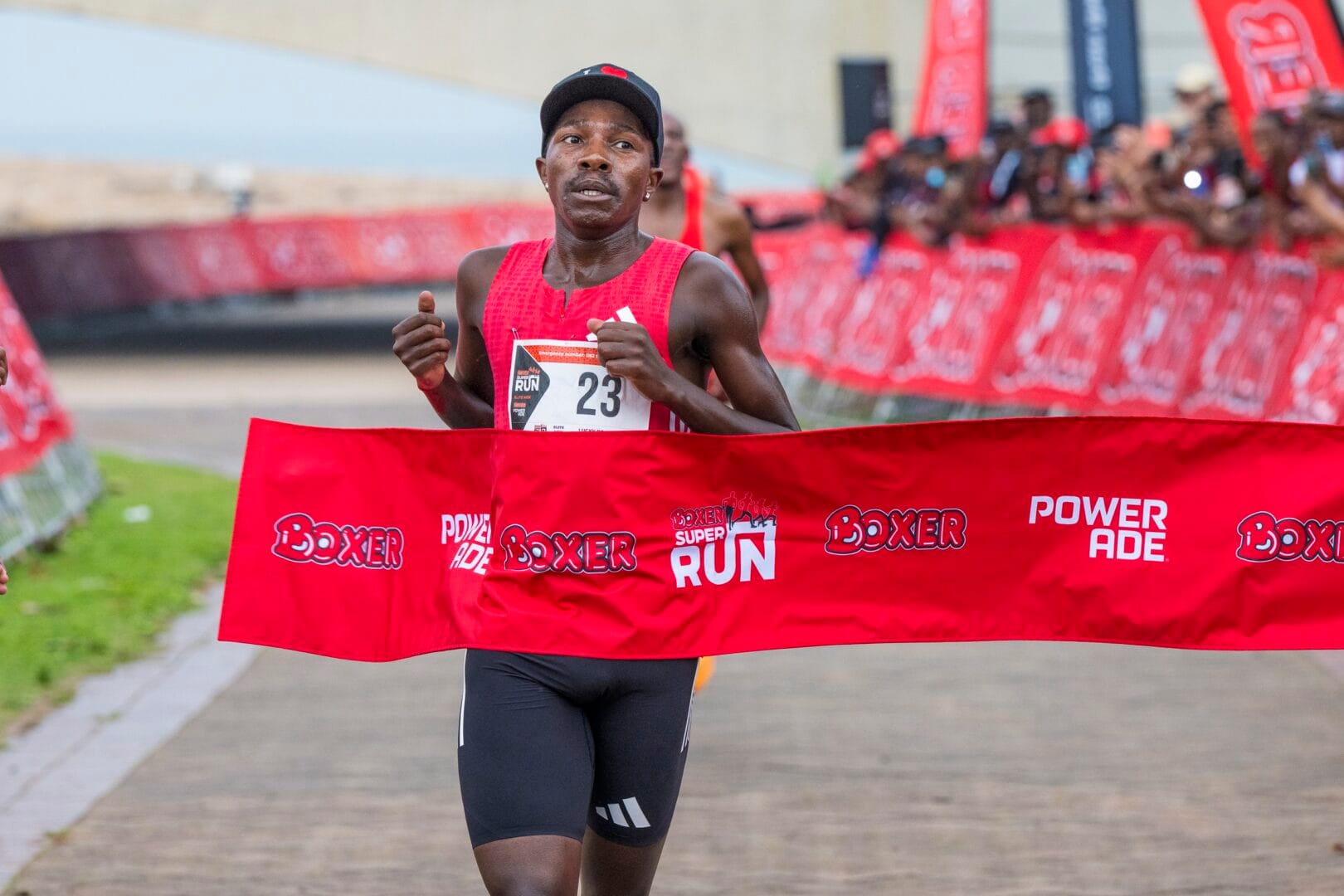
When Kusche crossed the finish line at Hollywoodbets Scottsville Racecourse in Pietermaritzburg, the clock stopped at 5:15:56.

The time demolished Russian Leonid Shvetsov’s 18-year-old Up Run record of 5:24:49 by almost nine minutes.

It also delivered the fastest average pace ever recorded in the history of the Comrades Marathon.

Yet the journey began not with victory but with disappointment disguised as success.

A year earlier, the former NCAA athlete had finished 12th in his Comrades debut.

Many runners would have celebrated.

Kusche analysed.

“On the day I knew that was the absolute best I could have done,” he said.

“But I know I made a lot of mistakes preparing for that Comrades because it was my first one. I was naive about what it takes to run Comrades.”

The race became a classroom.

The student paid attention.

PROJECT 2026
George Kusche at the 2026 Comrades Winners Breakfast Photo: Adnaan Mohamed

Most athletes emerging from a strong debut create a target.

Kusche created a process.

“It was Project 2026, but not to win.”

That statement sounds almost absurd after what followed.

“It was Project 2026 to focus on the process as much as I can and make sure that on June 14, 2026, I show up as the absolute best version that I could be.”

“If that means a win, then I’m happy.”

The distinction matters.

The goal was not a trophy.

The goal was optimisation.

Every kilometre became a data point.

Every session became an experiment.

Every mistake became valuable information.

THE SCIENTIST IN THE RUNNING SHOES

Away from racing, Kusche works full-time as a Data Scientist at Pepkor Lifestyle.

The numbers are woven into his DNA.

Born in Malalane in Mpumalanga, educated at Laerskool Malelane and Affies in Pretoria, he earned a Master’s degree in Statistics and passed eight Actuarial Society of South Africa examinations on his first attempt.

He coaches himself.

That revelation surprised Fordyce.

In an era overflowing with coaches, consultants and performance gurus, Kusche remains his own architect.

“I coach myself.”

His approach combines science and instinct.

“I accumulated a lot of volume, but that came over a period of a year.”

“It’s a gradual increase in both volume and intensity and elevation gain.”

“I meticulously tracked various metrics over time and ensured that they increased and peaked at the right time.

The scientist measured everything.

The athlete listened to his body.

The combination proved potent.

THE HILL THAT BUILT A CHAMPION

Every Tuesday, a hill in Pretoria became his laboratory.

He repeatedly climbed and descended Platheus Hill.

No dramatic sprinting.

No social media heroics.

No chest-thumping workouts.

“I simply jogged up and jogged down.”

“And I just let the elevation gain do the damage it had to do.”

Slowly, the hill surrendered.

“Without increasing my effort, I could see my pace increasing and my heart rate decreasing.”

Like water carving a canyon, the work accumulated quietly until the results became impossible to ignore.

THE OVERTRAINING MYTH

As race day approached, whispers began circulating.

Some observers believed Kusche was training too much.

Even Fordyce and former champion Nick Bester had concerns.

“We said George is terribly overtrained.”

Kusche knew the rumours.

“I know about the overtraining allegations.”

His answer reflected the analytical mindset that defines him.

“You can’t look at one number and say someone’s overtraining.”

“My workouts kept improving.”

His peak week reached an eye-watering 259 kilometres.

Yet he remembers feeling restrained.

“I felt like I could have done 300.”

“I felt guilty not running more.”

The engine was humming.

The data agreed.

THE SURGES THAT BROKE THE RACE

The winning move arrived long before he took the lead.

Running within a pack, Kusche sensed comfort spreading among his rivals.

Comfort is dangerous in championship racing.

So he attacked it.

“I didn’t want the pack to be comfortable.”

Climbing Inchanga, he repeatedly surged.

Not wildly.

Not recklessly.

Simply enough to raise the temperature.

“I felt really strong.”

“I just decided to go in front of the pack and gradually increase the pace.”

The surges acted like tiny cracks in a dam wall.

Invisible at first.

Devastating later.

“After about four of those surges, I decided it’s now time to go for gold.”

The race had changed.

The field simply had not realised it yet.

FEAR ON POLLY SHORTTS

For television viewers, Kusche looked magnificent.

Fordyce remembers watching him move through Harrison Flats and immediately predicting victory.

“George is going to win.”

The reality unfolding inside Kusche’s body was far less glamorous.

“My left calf was cramping.”

“My legs were sore.”

“I kind of felt tired.”

Then came Polly Shortts.

The notorious climb often acts like a final judge standing between contenders and champions.

Fortunately, Kusche had studied every metre.

“I knew exactly how long that hill would be.

That knowledge became a psychological weapon.

“I knew it’s two kilometres.”

“I knew that if I could get to the top in the lead and feeling strong and maintain my pace, then the odds are good of winning.”

What happened next was pure courage.

“I didn’t feel good.”

“But I went up that hill giving it everything I had.”

The hill blinked first.

WHAT IT FEELS LIKE TO BE COMRADES CHAMPION

Fordyce ended their conversation with a question few champions answer easily.

What does it actually feel like to be Comrades champion?

Kusche paused.

The answer was strikingly simple.

“It’s a confirmation that the work I’ve been putting in over the past year has paid off.”

Perhaps that response explains everything.

The record.

The preparation.

The humility.

The fear.

The patience.

For George Kusche, Comrades was never about chasing applause.

It was about discovering whether the equation was correct.

On a cold winter morning between Durban and Pietermaritzburg, the answer arrived.

Loudly.

The data scientist had solved the biggest puzzle in South African road running.

And the solution may only be the beginning.

With the Down Run waiting in 2027 and Fordyce joking that the record should be “quite scared“, Kusche remains cautious.

“You need to be afraid of Comrades.”

“If you’re not afraid, you’re not going to perform at the highest level.”

Those words may sound strange coming from a champion.

Then again, George Kusche has never approached Comrades like everybody else.

That is precisely why his name now stands above everybody else’s.

Sub-27 Dream alive as Cheptegei leads World-Class Durban 10K field

By Adnaan Mohamed

Joshua Cheptegei’s appearance at the 2026 Absa RUN YOUR CITY DURBAN 10K has attracted what organisers believe is the strongest men’s field ever assembled for a 10km road race on African soil.

The Ugandan superstar, an Olympic champion, multiple world champion and world record holder over 5 000m and 10 000m, will line up in Durban on 12 July against a field packed with international winners, national record holders and emerging stars eager to test themselves against one of the sport’s modern greats.

Leading the list of challengers is Kenya’s Felix Masai, whose 27:24 personal best makes him one of the fastest men in the race. The Totalsports Two Oceans Half Marathon champion expects Cheptegei’s presence to elevate the standard of competition.

Felix Masai (Kenya) has a 10km PB of 27:24. PHOTO CREDIT: Action Photo

“He is one of the greatest distance runners of all time, and competing alongside him raises the level of the entire field,” said Masai.

“My race target is to give my best. I like competing in South Africa.”

Another athlete to watch is Kenyan Gilbert Kiprotich, who arrives in Durban with confidence after a strong performance at the Lisbon Half Marathon.

“I’m feeling well after the Lisbon Half Marathon. I took some time to recover before shifting my focus to preparing for racing in South Africa,” said Kiprotich.

“Looking back to the Half Marathon, where I recorded a 10km split of 27:01 and considering how the second half of the race unfolded, I believe I am capable of running comfortably under 27:00 in Durban.”

Kiprotich believes favourable conditions and strong pacing could produce something special.

Gilbert Kiprotich (Kenya) has a 10km PB of 27:43. PHOTO SUPPLIED

“We are hoping for favourable weather conditions and strong pacing on race day. I feel inspired by the opportunity to race against Joshua Cheptegei. He is a world-class athlete, and competing alongside him will provide valuable experience and contribute significantly to my development as a professional athlete.”

Lesotho national record holder Kamohelo Mofolo returns to the race where he set his country’s 10km mark in 2025 and believes the course remains one of the fastest on the continent.

“The Absa RUN YOUR CITY DURBAN 10K is a flat, fast course with few turns, and if the conditions are right it allows for very quick times,” said Mofolo.

“Every race here feels like it has the potential to be something special, and I’m honoured to be part of such an impressive lineup.”

Mofolo added that racing against athletes of Cheptegei’s calibre presents a valuable opportunity.

“Racing against athletes like Joshua Cheptegei is a great opportunity because he is an amazing runner, and I’m excited to learn from the best while sharing the start line with him.”

South African hopes will rest largely on Kabelo Mulaudzi, whose development has been closely linked to the Absa RUN YOUR CITY Series.

“I am grateful to the Absa RUN YOUR CITY Series because it created a platform for me to obtain an invitation to a big international race,” said Mulaudzi.

“I am extremely excited to be part of this event and it is always great to run in South Africa against the world’s best athletes.”

The South African believes competing alongside Cheptegei can bring out the best in the field.

“I have always enjoyed the challenge of racing against better athletes than myself and it is great to be lining up with Joshua. I hope that he will help bring out the best in me and all the other athletes competing in the race.”

Adding further depth is Cheptegei’s Ugandan training partner Emanuel Kibet, who boasts a personal best of 27:37 and is expected to play a significant role at the front of the race.

Stillwater Sports Managing Director and Series Founder Michael Meyer believes Cheptegei’s participation has transformed the event.

“Joshua Cheptegei’s participation has drawn a truly extraordinary depth of field to the Absa RUN YOUR CITY DURBAN 10K, bringing together world champions, record holders, and some of the fastest road runners on the planet,” Meyer said.

“This level of quality not only elevates the competitive standard of road running in South Africa, but firmly cements the 2026 Absa RUN YOUR CITY DURBAN 10K as the Greatest 10K on African Soil.”

Meyer added that the strength of the field could produce a historic result.

“In conditions like these, with such depth and intent at the front of the race, the possibility of a historic performance, even a breakthrough sub-27-minute 10km, becomes a real possibility.”

Visit Absa RUN YOUR CITY DURBAN 10K for more info.

Oldest (84) and Youngest (20) conquer 2026 Comrades

By Adnaan Mohamed

The 2026 Comrades Marathon delivered many memorable performances on the gruelling 85.777km journey from Durban to Pietermaritzburg, though few stories captured the spirit of the race quite like those of Johannes Mosehla and Bailey O’Leary.

Separated by 64 years in age, the pair finished the 99th edition of the Ultimate Human Race as its oldest and youngest official finishers.

Mosehla, 84, crossed the line in 11:12:26 on Sunday to break his own record as the oldest finisher in Comrades history. In doing so, the Polokwane Running Club member finished ahead of thousands of runners many decades his junior.

The veteran runner, who began his running journey in 1963, said the achievement was a source of pride and gratitude.

“To be the oldest finisher at Comrades is a great honour,” said Mosehla.

“This race continues to inspire me every year. Running has given me so much throughout my life. I hope my journey encourages people to stay active, stay disciplined and keep chasing their goals regardless of age.”

Mosehla credits his remarkable longevity to consistency, moderation and a healthy lifestyle.

“You must listen to your body, eat well, rest properly and enjoy what you are doing. Running should bring happiness. I still love training in the mountains and spending time outdoors.”

While Mosehla represented experience and endurance, O’Leary embodied youthful ambition.

The 20-year-old, who lives in the United Kingdom and whose parents are both originally from Durban, finished her Comrades debut in 10:42:51 to become the youngest female finisher in this year’s race.

Her first Comrades was made even more special by sharing the journey with her father, Jon O’Leary.

Proud dad Jon O’ Leary with his daughter Bailey O’ Leary at the Comrades Winners breakfast on Monday 15 June 2026. Photo: Adnaan Mohamed

“I grew up supporting my dad and listening to stories about Comrades,” said Bailey.

He inspired my love for the race and it was always my dream to run my first Comrades with him. He helped me a lot, especially in the first half, and crossing the finish line was incredibly special.”

For Jon, the day was about far more than another medal.

“It was one of the proudest moments of my life,” he said.

“Comrades means so much to our family. To see Bailey achieve her goal and share the experience with her from start to finish was unforgettable.”

As the Comrades Marathon prepares to celebrate its centenary in 2027, both runners have already confirmed their intention to return.

Mosehla will aim to extend his remarkable record, while O’Leary hopes to secure a special back-to back medal awarded to novices for consecutive finishes.

Bailey O’ Leary in action on the 2026 Comrades Marathon Up Run Route Photo: Supplied

Their stories served as a powerful reminder that Comrades remains a race where generations meet, dreams endure and the finish line belongs to anyone willing to keep moving forward.

How Springbok coach Rassie Erasmus’ philosophy inspired George Kusche’s historic Comrades triumph

By Adnaan Mohamed

After shattering one of South African sport’s most enduring records and banking more than R2.3 million George Kusche revealed that Springbok mastermind Rassie Erasmus ‘Pressure is a privilege’ philosophy had a profound impact on him being crowned 2026 Comrades Marathon champion.

Kusche says one of the most influential ideas shaping his outlook is Erasmus’ belief that pressure is not something to fear, but a privilege earned by doing what you love while millions of others face far greater daily struggles.

For Kusche, that perspective proved as valuable as any training session in helping him navigate the weight of expectation before producing a breathtaking 5:15:56 from Durban to Pietermaritzburg, obliterating Leonid Shvetsov’s 18-year-old course record and writing himself into Comrades folklore.

“In terms of pressure, I’ve got huge respect for Piet and the way he shows up every year and hits it out of the park. It takes a lot of guts to do that and obviously Gerda does that as well,” Kusche said.

“I often think of Rassie Erasmus when he said this is not pressure, this is a privilege to do what you love and hopefully I can keep that mindset next year.”

Those words perhaps explain why Kusche looked so composed while executing one of the boldest race plans in recent Comrades history.

He surged to the front early, trusted months of meticulous preparation and refused to blink as the kilometres mounted. The calculated gamble dismantled a record that had survived for nearly two decades and left defending champion Piet Wiersma and surprise package Mbuti Mollo chasing shadows, despite both finishing beneath the previous record.

Ironically, the race that delivered one of the richest prize hauls in South African road running history reinforced Kusche’s belief that money should never be the driving force.

At Monday’s winners’ breakfast, the 28-year-old received a standing ovation while collecting a series of bonus cheques, including R602,000 for breaking the Up Run record. Together with the winner’s prize, average pace incentive, first South African bonus and other rewards, his earnings climbed beyond R2.3 million, with further sponsor incentives still possible.

Yet financial reward barely featured in his thoughts.

“I haven’t really thought about the financial aspect yet,” Kusche admitted.

“If you’re running for the money I think you’re in the wrong sport.”

Instead, his greatest satisfaction appeared to come from achieving something that only a year ago seemed improbable.

The Pretoria-based runner laughed that he woke up on Monday morning and checked the date to make sure he was not dreaming.

“I think it’s slowly starting to sink in.”

His journey has never followed a conventional route.

Born in Malalane, Kusche left South Africa as an 800m athlete before studying in the United States, eventually earning a Masters in Statistics after spells at the University of Nebraska-Lincoln and Northern Arizona University.

When a professional running contract failed to materialise, he returned home, built a career as a data scientist and stepped away from competitive athletics.

Running, however, refused to loosen its grip.

With the backing of Nedbank Running Club manager and 1991 Comrades champion Nick Bester, Kusche rebuilt himself from scratch, applying the same analytical discipline to training that he uses in his professional life.

He still balances elite competition with full-time work, believing that stability away from the roads has strengthened rather than hindered his performances.

His fourth-place finish in the Totalsports Two Oceans Half Marathon, rapid marathon progression and 12th-place finish on his Comrades debut last year all hinted at enormous potential.

Sunday confirmed it.

There was no visible panic, no signs of a man burdened by expectation, only calm execution from the first stride to the last.

Perhaps that is the real legacy of Erasmus’ philosophy.

Pressure is not a crushing weight carried by champions.

It is a privilege earned through sacrifice, embraced with gratitude and rewarded through preparation.

George Kusche did not merely win the 2026 Comrades Marathon.

He embodied that idea every step of the way.

Featured Image: Adnaan Mohamed

Comrades 2026: Kusche and Steyn rewrite history and win millions

By Adnaan Mohamed

PIETERMARITZBURGGeorge Kusche and Gerda Steyn delivered one of the most remarkable days in Comrades Marathon history on Sunday, smashing long-standing Up Run records and each walking away with more than R2.3 million in prize money and incentive bonuses.

On a shortened 85.777km route, the fastest in recorded Up Run history, expectations of rapid times proved well founded as both champions produced performances that rewrote the record books.

Kusche stormed to victory in 5:15:56, obliterating the previous men’s Up Run record of 5:24:49 set by Leonid Shvetsov in 2008. His average pace of 3:40.99 per kilometre also eclipsed Vladimir Kotov’s long-standing benchmark for the best average pace.

Dutch defending champion Piet Wiersma finished second in 5:19:36, with South Africa’s Mbuti Mollo taking third in 5:21:31 after leading for much of the race. Great Britain’s Alex Milne and Japan’s Haruki Okayama also dipped beneath the previous course record, underlining the extraordinary pace of the contest.

For Kusche, the victory only became real at the finish line.

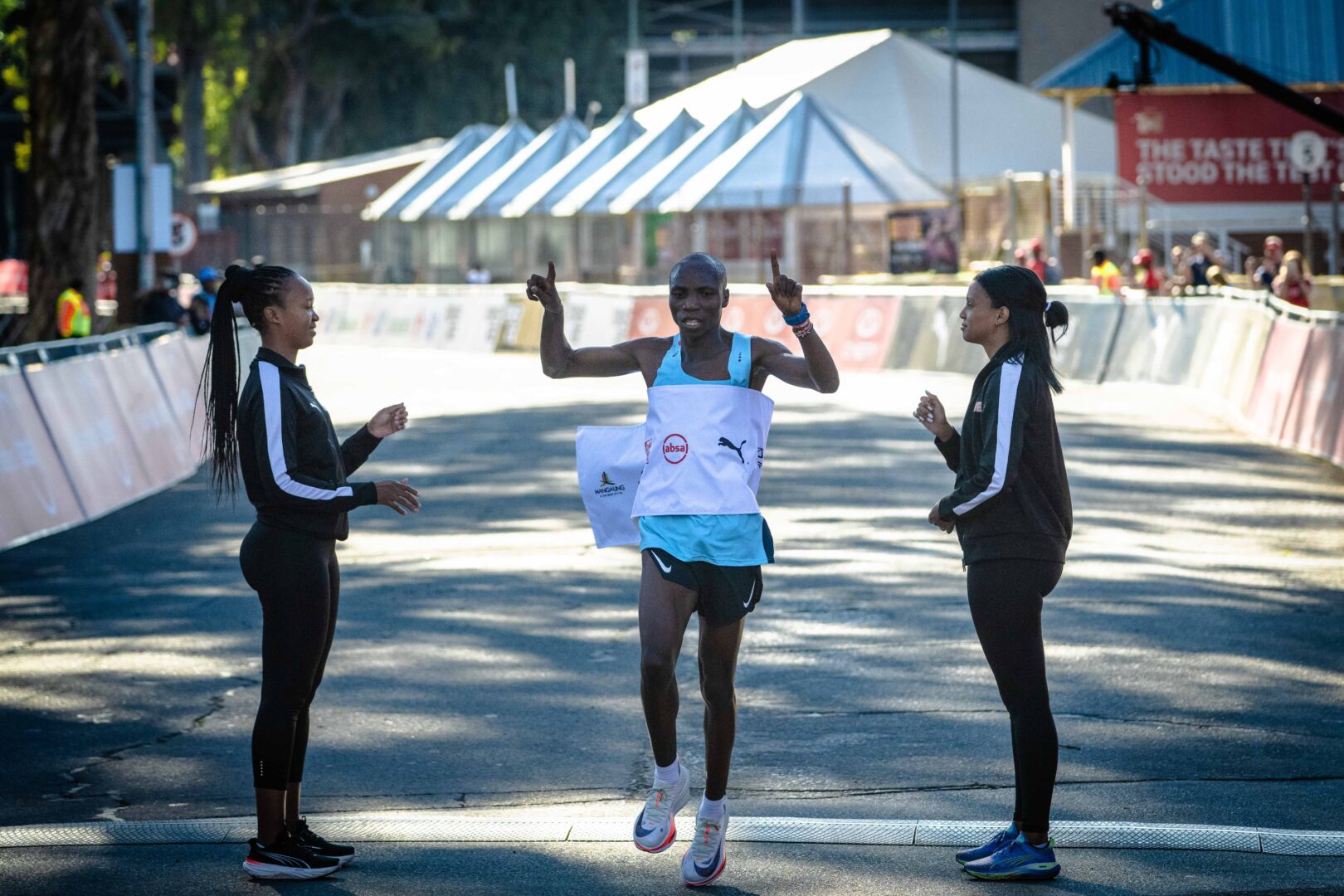
George Kusche stormed to victory and obliterated the previous men’s Up Run record and set a new benchmark for the best average pace.

“I honestly didn’t believe I was going to win until I crossed the finish line. Comrades is extremely hard mentally, and there was no way I could know that they were not going to catch me, so I pushed as hard as I could and hoped that nobody would pass me.”

The South African, who finished 12th on debut a year ago, made his decisive move after Mollo began to struggle late in the race and never looked back.

“Comrades is a nerve-wrecking experience. This past week it was very hard to think about anything except the Comrades, and I’m very grateful that everything worked out as planned. It’s a bit of a gamble by going out early, but luckily it paid off this time around,” he said.

Steyn was equally dominant in the women’s race, clocking 5:44:53 to improve on the Up Run record she established in 2024. She also lowered her own best average pace mark while securing a fifth Comrades title, made up of three Up Run victories and two Down Run triumphs.

“It is an honour to come away with another Comrades Marathon win and a new course record. It’s what I have been dreaming of and working for since the start of the year,” Steyn said.

“I ran this Comrades as if it was my last race, but after crossing the finish line I already know it was far from my last. I can’t imagine my life without this race and I’m already looking forward to the 2027 centenary edition.”

Zimbabwe’s Nobukhosi Tshuma claimed second in 5:53:36 after overcoming significant personal sacrifices during her preparation, while South Africa’s Irvette van Zyl completed the podium in 6:02:30.

The record-breaking performances also produced record-breaking rewards.

Kusche and Steyn each earned R2.322 million through victory prize money, the Cell C top-up, first South African incentives, Up Run record bonuses and the Cell C average pace incentive.

Comrades Marathon Association general manager Alain Dalais described the event as an outstanding rehearsal for next year’s centenary edition.

“We are incredibly proud of the 2026 race and our two record-breaking winners. George Kusche lived up to the pre-race expectation by shattering the men’s Up Run record, while Gerda Steyn joined some of the most illustrious legends of this great race with five wins.

“It was a fantastic elite race with record-breaking performances and a truly fitting spectacle for the 50th edition of the Up Run.”

Results of the 2026 Comrades Marathon

Top 10 Men
1 George Kusche              Nedbank Running Club GN                         South Africa                            5:15:56
2 Piet Wiersma                 Nedbank Running Club International           Netherlands                              5:19:36
3 Mbuti Mollo                  Maxed Elite KZN                                          South Africa                             5:21:31
4 Alex Milne                    Nedbank Running Club International           Great Britain                             5:22:29
5 Haruki Okayama           Nedbank Running Club International           Japan                                      5:24:46
6 Charles Lawrence          adidas                                                           United States of America         5:27:08
7 Lloyd Bosman               Nedbank Running Club SWD                      South Africa                             5:28:53
8 Nikolai Volkov               Nedbank Running Club International          ANA                                         5:28:59
9 Vasilii Korytkin             Kemerovo Runners                                      ANA                                         5:29:29
10 Tebogo Pulusa             Dwarsrivier Mine Athletic Club                   South Africa                             5:29:40

Top 10 Women
1 Gerda Steyn                   Hollywood Athletic Club CGA                      South Africa 5:44:53
2 Nobukhosi Tshuma        Entsika                                                         Zimbabwe 5:53:36
3 Irvette van Zyl                Hollywood Athletic Club CGA                      South Africa 6:02:30
4 Shelmith Muruiki           Entsika                                                         Kenya 6:06:38
5 Naomi Robinson            Nedbank Running Club International Great Britain 6:07:55
6 Loveness Madziva         Nedbank Running Club Zimbabwe Zimbabwe 6:09:54
7 Courtney Olsen             Hollywood Athletic Club International          United States of America 6:11:20
8 Dikiledi Majara             Nedbank Running Club AFS                       Lesotho 6:12:29
9 Jenet Mbhele                 Umzimkhulu Striders                                    South Africa 6:13:08
10 Carla Molinaro             Hollywood Athletic Club International        Great Britain 6:14:04

Tete Dijana and Piet Wiersma in blockbuster Comrades showdown

Adnaan Mohamed

Three proven Comrades Marathon champions. Three very different motivations. One famous road between Durban and Pietermaritzburg.

The men’s elite race at Sunday’s Comrades Marathon has the ingredients of a modern classic, with defending Down Run champion Tete Dijana chasing history, 2024 Up Run winner Piet Wiersma hunting unfinished business and 2019 champion Edward Mothibi quietly building confidence inside a formidable Hollywood Athletics Club squad.

For Dijana, preparation has followed a familiar script.

The three-time Down Run champion says an injury-free training block and altitude camp in Dullstroom have laid a solid platform for another assault on the title, with the biggest adjustment coming in mindset rather than methodology.

“The preparation went well and injury free,” Dijana said.

“Our training stays more or less the same because the hills are always there, but mentally you have to approach it differently and put more emphasis on strength.”

Hollywood’s backing has also given him confidence throughout the campaign, although the defending champion is not buying into suggestions that there is no pressure.

“I’m defending. I have to deliver and make history for myself,” he said.

Alongside him is Mothibi, whose move to Hollywood has strengthened an already imposing purple challenge.

The 2019 winner says he has largely trusted the methods that brought success in previous years, with extra focus placed on improving speed to match a younger generation of contenders.

Hollywood AC’s Happy Bunch taking a break during training. Photo: Supplied

He believes some of his biggest rivals are the athletes he trains with every day.

“Tete is part of our Happy Bunch,” Mothibi said. “I know how fit those guys are because I train with them. Those are the competitors I understand best.”

Mothibi also praised Hollywood’s athlete-first approach, saying the club creates an environment free from unnecessary pressure while giving runners every opportunity to perform.

Standing in their way is Wiersma, whose remarkable rise has transformed him into one of the race’s biggest stars.

The Dutchman insists being labelled defending champion feels strange after winning the last Up Run rather than last year’s Down Run, though he believes this could be the strongest preparation of his career.

“I’ve done the best training of my life,” Wiersma said.

After overcoming illness earlier in the season and maintaining a carefully controlled routine, he arrives convinced he has given himself every possible chance.

His respect for Dijana and Mothibi remains evident despite the changing club colours.

“Before the race and after the race we’re friends,” he said.

“During the race we don’t show each other mercy, no matter what colours we’re wearing.”

Perhaps the strongest insight into Wiersma’s mindset comes from his description of unfinished business.

He has finished second by seconds, won while narrowly missing the course record and again fallen agonisingly short of victory.

Now he believes the depth of this year’s field could produce something special.

“With a field this strong, there’s a very high chance the course record will be broken,” he said.

For Wiersma, Comrades has changed his life, providing the platform to pursue professional running full time after shelving plans for a PhD.

Living and training in Kenya has also reshaped his perspective.

“The mindset there is incredible,” he said. “People wake up every day knowing they have to do everything right because it affects what happens months later.”

By sunrise on Sunday, predictions will count for little.

The road from Durban to Pietermaritzburg has a habit of humbling favourites and elevating dreamers.

If Dijana’s pursuit of history, Mothibi’s experience and Wiersma’s relentless ambition unfold as expected, the 2026 Comrades Marathon could produce another chapter worthy of its legendary status.

Queen Gerda ready to climb again as fifth title beckons

By Adnaan Mohamed

The numbers attached to Gerda Steyn’s career are extraordinary, though the woman herself continues to speak with the calm certainty of someone more interested in preparation than praise.

Four Comrades Marathon victories. Seven Two Oceans Ultra Marathon titles. Countless records and unforgettable performances.

On Sunday, the Hollywood Athletics Club star will line up in Durban chasing a fifth Comrades crown, convinced that another carefully crafted build-up has left her exactly where she wants to be.

“I can’t believe we are here again. It feels like yesterday that we were lining up for the down run of 2025,” Steyn told Modern Athlete in an exclusive interview.

“I’m very excited to line up this year. The training has gone really well. The Up Run is my favourite direction. I’m really excited, so I can’t wait for Sunday.”

That preference is rooted in both emotion and experience.

Steyn says the climb to Pietermaritzburg rewards discipline, patience and intelligent pacing, qualities that have become trademarks of her racing style.

“I think the Up Run suits me as a type of athlete that I am. It is a lot to do with pacing yourself well, conserving your energy very well in the first half and running smart. You need a lot of strength to compete well in the Up Run.”

It also carries sentimental value.

“It was my first ever Comrades Marathon, so that’s how I fell in love with the race. To line up again this year is very special.”

As in previous campaigns, Steyn spent much of her preparation in the Alps following the Two Oceans Ultra Marathon, using the relentless climbs and descents to sharpen her endurance.

“I’ve always done the exact same routine. I feel like it’s the right thing for me to do. I can focus 100% on running and you either go steep up or steep down, which really complements the training.”

She returned to South Africa earlier than usual and settled in Dullstroom, where familiar surroundings and sessions alongside Hollywood teammates provided a valuable psychological lift.

“We were fortunate enough to share the roads with Tete, Edward and Johannes and the rest of the Hollywood guys. They are such a positive group with a wonderful dynamic. It was a great way to finish the training and line up with excitement.”

With another slightly shortened Up Run route, speculation around a possible course record has gathered momentum.

Steyn refuses to be distracted.

“My first goal is really to defend my title. If that comes with a record and I feel good on the day and everything goes according to plan, I’m sure it is possible.”

Looking back at her preparation compared to 2024, she believes there is room for something special.

“I think there’s room for it. Everything has to go according to plan and I mustn’t focus on the record so much that I forget to focus.”

It is a mindset that has carried her to the summit of South African ultra-distance running before.

On Sunday, she will trust it again.

Cape Town races into history as Africa’s first Marathon Major

By Adnaan Mohamed

Cape Town has crossed a finish line decades in the making.

The Sanlam Cape Town Marathon has officially become the first Abbott World Marathon Major on African soil after passing the second and final stage of its assessment process, securing its place among the sport’s most prestigious races.

From 2027, Cape Town will stand alongside Tokyo, Boston, London, Sydney, Berlin, Chicago and New York in what has long been marathon running’s most exclusive club, a landmark moment for a continent that has produced generations of distance-running greats.

CAPE TOWN MARATHON. 24 MAY 2026.

“It gives me huge pleasure to welcome Cape Town to the family,” said Abbott World Marathon Majors CEO Dawna Stone.

“After watching the race grow in size and stature during its candidacy and also seeing the resilience and dedication of the team lead so wonderfully by Clark Gardner, Africa’s first Major has finally arrived. The unique culture, the welcome from the people of the city and the wonderful setting Cape Town provides will bring a whole new dimension to our series. I know runners in Africa and across the world will have a phenomenal experience at this race.”

The announcement marks the culmination of years of planning and community support, with organisers repeatedly highlighting the role played by runners, volunteers, clubs, sponsors and city partners in helping the event meet the demanding criteria.

“This achievement belongs to every person who believed in and committed to this vision,” said race director and CEO Clark Gardner.

“We could never have reached this moment alone. Our runners carried us to the numbers we needed, our sponsors and partners stood firm beside us even when the 2025 race could not go ahead, and our supporters, club captains, residents and service providers each played their part. The Sanlam Cape Town Marathon stands as proof that when Africa comes together, we can achieve anything. This victory belongs to all of them.”

The significance stretches far beyond one city or one race.

For years, African athletes have dominated the global marathon scene while many recreational runners faced the financial burden of travelling overseas to experience a Major. Cape Town’s elevation changes that equation, with organisers committing to keeping two-thirds of race entries available to African participants.

Sanlam Group CEO Paul Hanratty described the announcement as “a collective victory”.

“For 13 years, Sanlam has been part of this journey, walking alongside the event as a committed partner and supporting its growth into a world-class platform. We hope this moment inspires people across Africa to dream bigger, go further and live with confidence.”

The event also carries significant economic value, with projections suggesting it could contribute around R800 million through tourism, accommodation and related spending.

Cape Town Mayor Geordin Hill-Lewis. Image Fahwaaz Cornelius

“For Cape Town to be the home of an Abbott World Marathon Majors race is an incredible moment for our city,” said Mayor Geordin Hill-Lewis.

“Achieving this milestone will contribute greatly to Cape Town’s economy, inspire future generations of runners, and leave a legacy for the sport across Africa.”

For a continent that has long supplied many of marathon running’s brightest stars, the road has finally curved home. Africa is no longer chasing the world’s biggest races. It now hosts one.

Gerda Steyn says Comrades’ real race begins in the mind

By Adnaan Mohamed

Defending champion Gerda Steyn believes every Comrades Marathon runner reaches a point where determination matters more than physical strength, with the 2026 edition set to celebrate the 50th official Up Run from Durban to Pietermaritzburg.

Steyn’s message comes as thousands prepare for one of South Africa’s most iconic sporting events, a race renowned for its unforgiving climbs and emotional finish-line drama.

“Comrades will always humble you at some point in the journey,” said the South African Olympian and ultra-marathon star. “The hardest moments are often where the race truly begins mentally. Sometimes all it takes is one reminder to keep moving forward.”

The Hollywood Athletic Club runner’s comments resonate with one of the race’s anticipated focal points, the gruelling 70km Raptor Rescue turnoff, where OMO will host its Stay Unbeatable Arch and water station to encourage runners during one of the route’s most demanding stretches.

OMO’s Stay Unbeatable Arch will be stationed at 70km on the Comrades 2026 Up Run route Photo: Credit OMO

The 2026 race also embraces the theme “Ska Fela Moya”, meaning “Don’t Give Up”, a message that reflects the resilience associated with the Comrades Marathon and the mental battle Steyn believes defines the event.

Another highlight will be the celebration of the Green Number Club, reserved for athletes who have completed 10 or more Comrades Marathons, earned five gold medals or claimed three victories. Their permanent race numbers remain among the event’s most respected symbols of consistency and endurance.

The 50th official Up Run adds further significance to this year’s race, with competitors facing famous climbs including Cowies Hill, Fields Hill and Polly Shortts before reaching Pietermaritzburg.

OMO, now in its second year of involvement with the ultra-marathon, says its Stay Unbeatable campaign aligns closely with the resilience displayed by runners and supporters throughout the event.

“Every year, the Comrades Marathon reminds South Africans what resilience truly looks like,” said Elizabeth Mokwena, Unilever South Africa’s Executive Marketing Director: Home Care.

“At OMO, we celebrate the people who keep going when life gets tough, whether it’s runners pushing through pain, families supporting from the sidelines, or everyday South Africans overcoming stains in their own lives. That’s why Comrades is such a powerful platform for our Stay Unbeatable message. It reflects the determination, heart, and refusal to give up that inspire the nation every year.”

The race’s emotional climax will once again arrive at the 12-hour cut-off, where exhausted runners chase the finish line against the clock in scenes that have become synonymous with the Comrades Marathon.

For Steyn, that spirit defines the event more than medals or records. The road eventually tests every athlete, and the greatest challenge often begins long after the legs have started to fade.

More than a race: The road knows why you’re here 

Six Comrades runners. Six deeply personal motivations that go beyond the race

There is a moment, somewhere around the 60km mark, when the Comrades Marathon stops being a race. The legs begin to resist. The maths of time and distance turns unforgiving. And what’s left, what has always been left, is the reason you came. Not the training plan. Not the medal. The reason why you’re running.

Every June, tens of thousands of South Africans arrive at that moment. And what defines this race is not just how far people run, but what meets them there: a memory, a person, a promise, a purpose. Something far bigger than the road itself.

This year, six runners are carrying something deeply personal with them onto that road. Their stories are different. Their reasons are their own. But together, they show what resilience really looks like – not as a concept, but as something lived, step by step.

When Grief Becomes Direction

Andreas Efthymiou doesn’t talk about the race in terms of kilometres. He talks about his son.

Andreas Efthymiou is running in memory of his son, Stelio – because the road is the one place where the love still feels close. Every step a tribute. Every kilometre a conversation only he can hear. He is raising funds for CHOC, the Children’s Haematology Oncology Clinics, for the families still walking the road he knows.

Simphiwe Zwane is also running with loss. After losing his mother, he chose not to retreat, but to show up – for children battling cancer, and for families who need support in the hardest of moments. “Every kilometre,” he says, “is dedicated to helping these children access the care and support they need.”

Second Chances

Sada Padiyachy was diagnosed with Guillain-Barré Syndrome – a neurological condition that, at its worst, can strip a person of the ability to move, to breathe independently – turning everyday life into a long fight for recovery. For Sada, recovery was long. It was frightening. It reshaped everything he thought he understood about his own body.

This Comrades, he runs as a declaration. Not a statement for anyone else’s benefit, but simply the act of a man planting his feet on a road that once felt impossibly far away and moving forward. Every step says: “I am still here, I am still moving forward”.

Showing Up for Others

Boitumelo Ndlovu is running her first Comrades in honour of loved ones lost to cancer, and in support of children who are still fighting. For her, the race is about presence – about showing up in a way that counts.

“Each kilometre I run represents strength, remembrance, and hope,” she says.


It’s her first race, but the purpose she carries is anything but new.

Service in Action 

Bronwyn Roussot – a nurse for nearly 30 years – has spent her career at the intersection of suffering and service. She has seen what hunger does to a child’s body. She has held the hands of families with nothing left. She walks, not runs to fund sustainable food programmes, because witnessing is no longer enough. “My goal,” she says simply, “is to help ensure that no one has to go to bed hungry.”

When pain is loud, purpose is louder

For Sphiwe, the Comrades Marathon is a battlefield that pushes your body, your mind, and your spirit to the edge. What keeps him going is knowing his journey might give someone else the strength not to give up, even when the pain, doubt, and exhaustion hit hardest.

Last year, that battle came down to the final stretch. Exhausted, falling, almost crawling, he kept moving. Because that moment wasn’t just about finishing. It was about refusing to quit. 

That’s why this year’s Comrades theme, “Ska Fela Moya”, speaks directly to Sphiwe’s journey in that moment. When his body gave in, his spirit carried him through. Now, he runs for more than himself – he’s running for those who need hope, for those who are watching, and for anyone fighting their own battle.

The race you don't run alone

What connects these runners is not the distance. It’s what they carry, and the invisible thread connecting them to others.

A memory. A person. A cause. A promise.

This is the truth about the Comrades that the race has always known, even when the outside world reduces it to statistics and finishing times: the road is personal, but it is never walked alone. 

Cell C, the official partner of the Comrades Marathon, understands that an important part of what sustains a runner across nearly 90km is not just  the training plan alone. It is the WhatsApp message that arrives at 70km. The family refreshing a tracker in real time. The connection that makes the distance feel, if not smaller, then at least shared. Purpose carries runners forward. Connection keeps them going, not just made possible by technology, but even more meaningfully, connection to their why. 

This year’s Comrades Marathon has a phrase that runners carry with them the way others carry a mantra. Ska Fela Moya – don’t give up. It is not a motivational slogan. It is an acknowledgement – of everyone who has ever reached that moment at kilometre 60 when the legs have stopped cooperating, and found, somehow, that they kept going anyway.

On Sunday, 14 June. Somewhere between Durban and Pietermaritzburg, tens of thousands more runners will find their own.

And when they do, it won’t just be about endurance.

It will be about remembering why they started – and refusing to stop.

A reminder that whatever you’re running for, nothing should stop you.

What’s yours?

#WhatAreYouRunningFor #NothingShouldStopYou #SkaFelaMoya  

Cell C is the official partner of the Comrades Marathon Association since 2024. Visit https://www.cellc.co.za/cellc/comrades for more information.