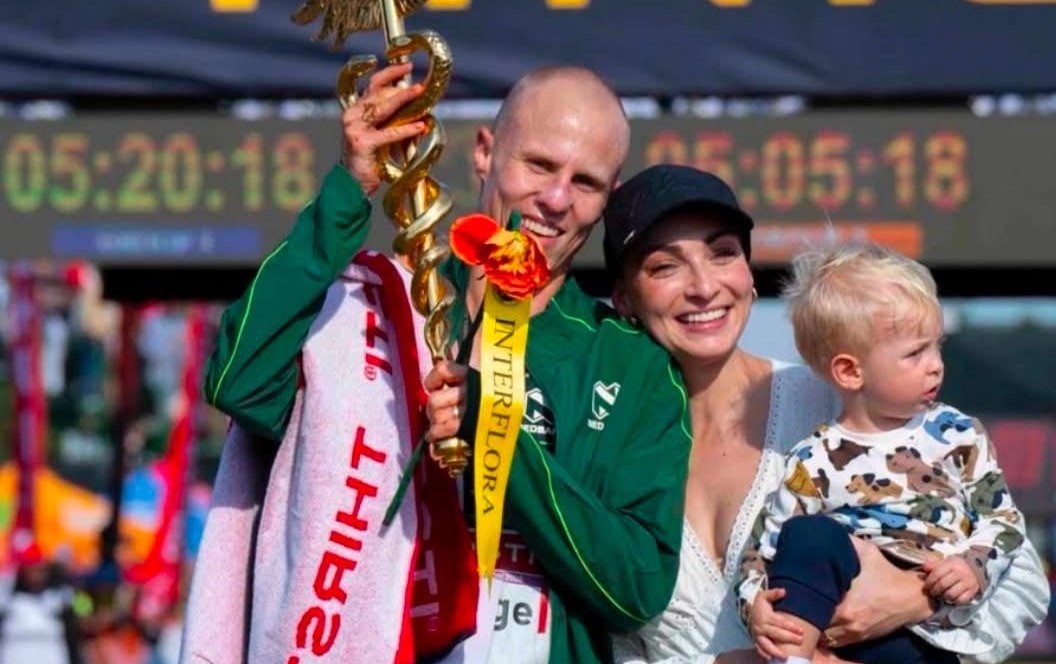
Inside the mind of Comrades Champion George Kusche

By Adnaan Mohamed

With two kilometres remaining, George Kusche glanced at the race clock for the first time all day.

The display showed roughly 5:08.

His body felt like a battered vehicle limping home after a cross-country expedition. His left calf had been threatening mutiny for more than 30 kilometres. Every stride sent warning signals through weary muscles. The road tilted and twisted ahead like a mischievous serpent refusing to surrender its final secrets.

Yet something curious happened.

The mathematics suddenly made sense.

“I remember thinking, if I run 10 minutes in these last two kilometres, I’m still going to run 5:18.”

For most runners, that would be astonishing pace after nearly 86 kilometres.

For Kusche, it was a moment of realisation.

History was waiting at the finish line.

The remarkable part is that he still wasn’t thinking about winning.

“I wasn’t thinking about winning. I was honestly afraid,” he told nine-time Comrades champion Bruce Fordyce.

“I thought to myself, I can’t think about anything else now. I need to focus on putting my foot in front of the other and running as fast as I can.”

That fear may have been his greatest ally.

Because while many runners arrive at Comrades armed with bravado and bold predictions, Kusche approached the race like a scientist approaching an unsolved equation.

Carefully.

Methodically.

Relentlessly.

And in doing so, he produced one of the greatest performances the race has ever witnessed.

THE UNDERDOG WHO WAS NEVER CHASING A TROPHY
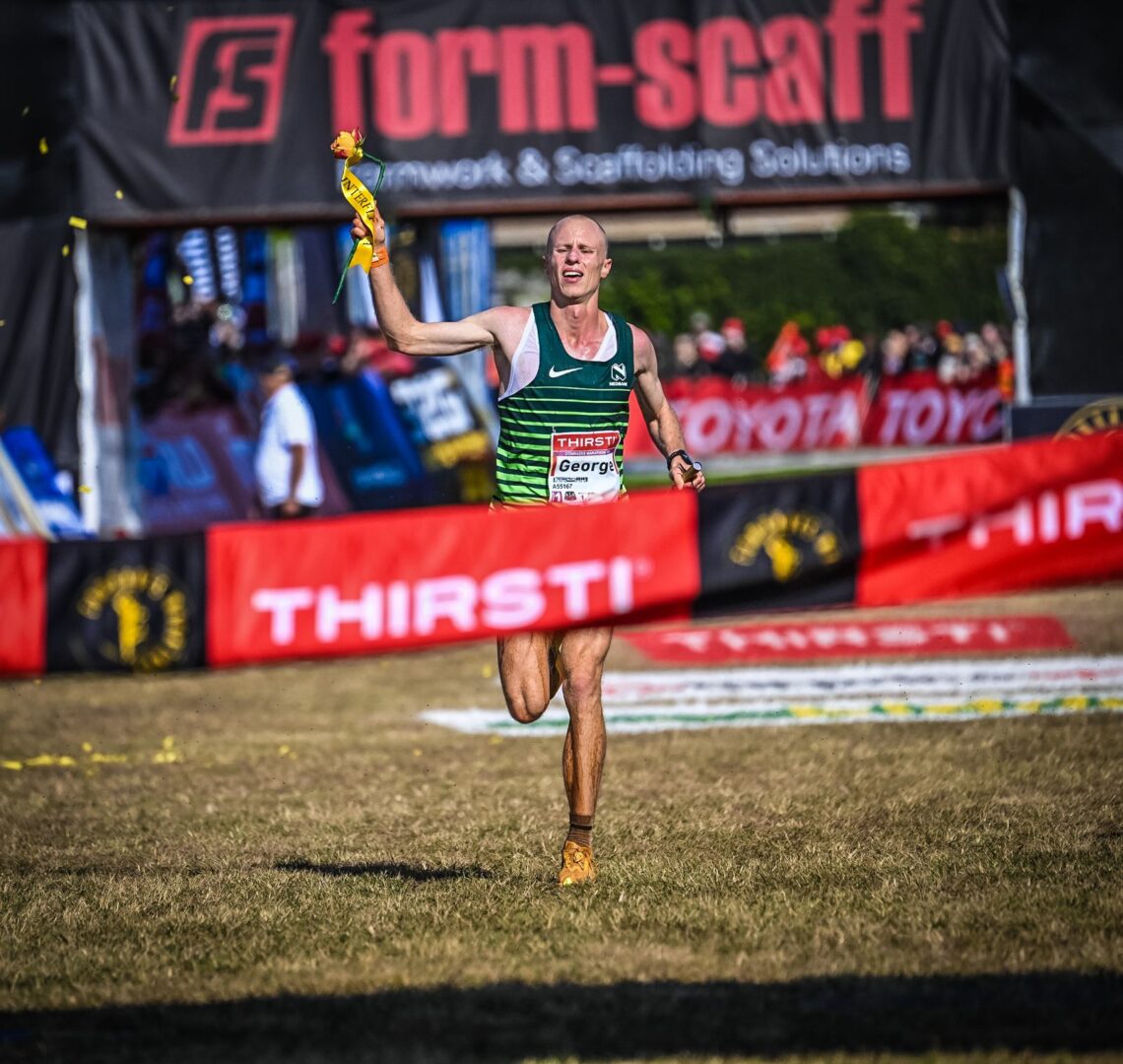
When Kusche crossed the finish line at Hollywoodbets Scottsville Racecourse in Pietermaritzburg, the clock stopped at 5:15:56.

The time demolished Russian Leonid Shvetsov’s 18-year-old Up Run record of 5:24:49 by almost nine minutes.

It also delivered the fastest average pace ever recorded in the history of the Comrades Marathon.

Yet the journey began not with victory but with disappointment disguised as success.

A year earlier, the former NCAA athlete had finished 12th in his Comrades debut.

Many runners would have celebrated.

Kusche analysed.

“On the day I knew that was the absolute best I could have done,” he said.

“But I know I made a lot of mistakes preparing for that Comrades because it was my first one. I was naive about what it takes to run Comrades.”

The race became a classroom.

The student paid attention.

PROJECT 2026
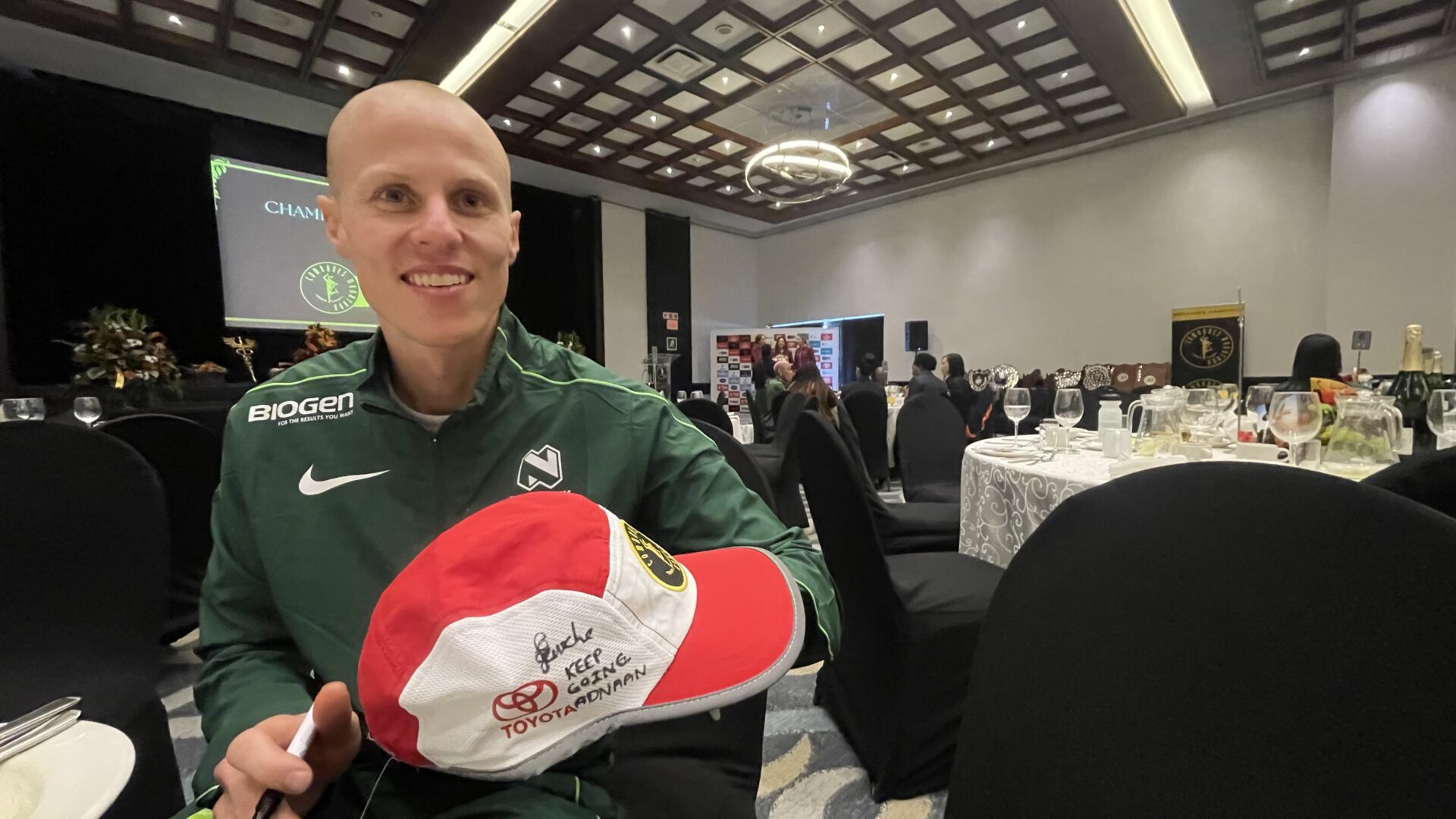
George Kusche at the 2026 Comrades Winners Breakfast Photo: Adnaan Mohamed

Most athletes emerging from a strong debut create a target.

Kusche created a process.

“It was Project 2026, but not to win.”

That statement sounds almost absurd after what followed.

“It was Project 2026 to focus on the process as much as I can and make sure that on June 14, 2026, I show up as the absolute best version that I could be.”

“If that means a win, then I’m happy.”

The distinction matters.

The goal was not a trophy.

The goal was optimisation.

Every kilometre became a data point.

Every session became an experiment.

Every mistake became valuable information.

THE SCIENTIST IN THE RUNNING SHOES

Away from racing, Kusche works full-time as a Data Scientist at Pepkor Lifestyle.

The numbers are woven into his DNA.

Born in Malalane in Mpumalanga, educated at Laerskool Malelane and Affies in Pretoria, he earned a Master’s degree in Statistics and passed eight Actuarial Society of South Africa examinations on his first attempt.

He coaches himself.

That revelation surprised Fordyce.

In an era overflowing with coaches, consultants and performance gurus, Kusche remains his own architect.

“I coach myself.”

His approach combines science and instinct.

“I accumulated a lot of volume, but that came over a period of a year.”

“It’s a gradual increase in both volume and intensity and elevation gain.”

“I meticulously tracked various metrics over time and ensured that they increased and peaked at the right time.

The scientist measured everything.

The athlete listened to his body.

The combination proved potent.

THE HILL THAT BUILT A CHAMPION

Every Tuesday, a hill in Pretoria became his laboratory.

He repeatedly climbed and descended Platheus Hill.

No dramatic sprinting.

No social media heroics.

No chest-thumping workouts.

“I simply jogged up and jogged down.”

“And I just let the elevation gain do the damage it had to do.”

Slowly, the hill surrendered.

“Without increasing my effort, I could see my pace increasing and my heart rate decreasing.”

Like water carving a canyon, the work accumulated quietly until the results became impossible to ignore.

THE OVERTRAINING MYTH

As race day approached, whispers began circulating.

Some observers believed Kusche was training too much.

Even Fordyce and former champion Nick Bester had concerns.

“We said George is terribly overtrained.”

Kusche knew the rumours.

“I know about the overtraining allegations.”

His answer reflected the analytical mindset that defines him.

“You can’t look at one number and say someone’s overtraining.”

“My workouts kept improving.”

His peak week reached an eye-watering 259 kilometres.

Yet he remembers feeling restrained.

“I felt like I could have done 300.”

“I felt guilty not running more.”

The engine was humming.

The data agreed.

THE SURGES THAT BROKE THE RACE

The winning move arrived long before he took the lead.

Running within a pack, Kusche sensed comfort spreading among his rivals.

Comfort is dangerous in championship racing.

So he attacked it.

“I didn’t want the pack to be comfortable.”

Climbing Inchanga, he repeatedly surged.

Not wildly.

Not recklessly.

Simply enough to raise the temperature.

“I felt really strong.”

“I just decided to go in front of the pack and gradually increase the pace.”

The surges acted like tiny cracks in a dam wall.

Invisible at first.

Devastating later.

“After about four of those surges, I decided it’s now time to go for gold.”

The race had changed.

The field simply had not realised it yet.

FEAR ON POLLY SHORTTS

For television viewers, Kusche looked magnificent.

Fordyce remembers watching him move through Harrison Flats and immediately predicting victory.

“George is going to win.”

The reality unfolding inside Kusche’s body was far less glamorous.

“My left calf was cramping.”

“My legs were sore.”

“I kind of felt tired.”

Then came Polly Shortts.

The notorious climb often acts like a final judge standing between contenders and champions.

Fortunately, Kusche had studied every metre.

“I knew exactly how long that hill would be.

That knowledge became a psychological weapon.

“I knew it’s two kilometres.”

“I knew that if I could get to the top in the lead and feeling strong and maintain my pace, then the odds are good of winning.”

What happened next was pure courage.

“I didn’t feel good.”

“But I went up that hill giving it everything I had.”

The hill blinked first.

WHAT IT FEELS LIKE TO BE COMRADES CHAMPION

Fordyce ended their conversation with a question few champions answer easily.

What does it actually feel like to be Comrades champion?

Kusche paused.

The answer was strikingly simple.

“It’s a confirmation that the work I’ve been putting in over the past year has paid off.”

Perhaps that response explains everything.

The record.

The preparation.

The humility.

The fear.

The patience.

For George Kusche, Comrades was never about chasing applause.

It was about discovering whether the equation was correct.

On a cold winter morning between Durban and Pietermaritzburg, the answer arrived.

Loudly.

The data scientist had solved the biggest puzzle in South African road running.

And the solution may only be the beginning.

With the Down Run waiting in 2027 and Fordyce joking that the record should be “quite scared“, Kusche remains cautious.

“You need to be afraid of Comrades.”

“If you’re not afraid, you’re not going to perform at the highest level.”

Those words may sound strange coming from a champion.

Then again, George Kusche has never approached Comrades like everybody else.

That is precisely why his name now stands above everybody else’s.
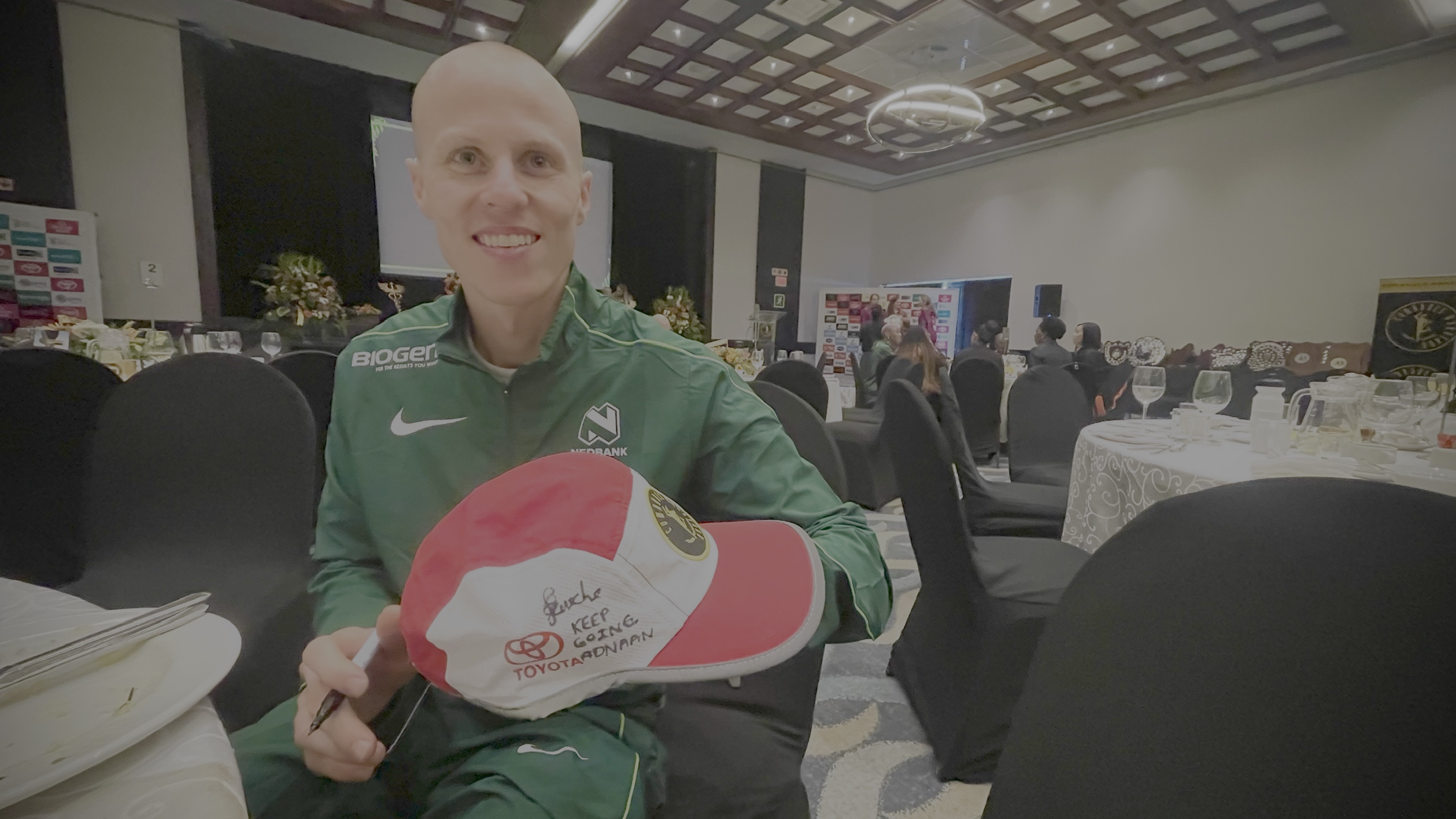
How Springbok coach Rassie Erasmus’ philosophy inspired George Kusche’s historic Comrades triumph

By Adnaan Mohamed

After shattering one of South African sport’s most enduring records and banking more than R2.3 million George Kusche revealed that Springbok mastermind Rassie Erasmus ‘Pressure is a privilege’ philosophy had a profound impact on him being crowned 2026 Comrades Marathon champion.

Kusche says one of the most influential ideas shaping his outlook is Erasmus’ belief that pressure is not something to fear, but a privilege earned by doing what you love while millions of others face far greater daily struggles.

For Kusche, that perspective proved as valuable as any training session in helping him navigate the weight of expectation before producing a breathtaking 5:15:56 from Durban to Pietermaritzburg, obliterating Leonid Shvetsov’s 18-year-old course record and writing himself into Comrades folklore.

“In terms of pressure, I’ve got huge respect for Piet and the way he shows up every year and hits it out of the park. It takes a lot of guts to do that and obviously Gerda does that as well,” Kusche said.

“I often think of Rassie Erasmus when he said this is not pressure, this is a privilege to do what you love and hopefully I can keep that mindset next year.”

Those words perhaps explain why Kusche looked so composed while executing one of the boldest race plans in recent Comrades history.

He surged to the front early, trusted months of meticulous preparation and refused to blink as the kilometres mounted. The calculated gamble dismantled a record that had survived for nearly two decades and left defending champion Piet Wiersma and surprise package Mbuti Mollo chasing shadows, despite both finishing beneath the previous record.

Ironically, the race that delivered one of the richest prize hauls in South African road running history reinforced Kusche’s belief that money should never be the driving force.

At Monday’s winners’ breakfast, the 28-year-old received a standing ovation while collecting a series of bonus cheques, including R602,000 for breaking the Up Run record. Together with the winner’s prize, average pace incentive, first South African bonus and other rewards, his earnings climbed beyond R2.3 million, with further sponsor incentives still possible.

Yet financial reward barely featured in his thoughts.

“I haven’t really thought about the financial aspect yet,” Kusche admitted.

“If you’re running for the money I think you’re in the wrong sport.”

Instead, his greatest satisfaction appeared to come from achieving something that only a year ago seemed improbable.

The Pretoria-based runner laughed that he woke up on Monday morning and checked the date to make sure he was not dreaming.

“I think it’s slowly starting to sink in.”

His journey has never followed a conventional route.

Born in Malalane, Kusche left South Africa as an 800m athlete before studying in the United States, eventually earning a Masters in Statistics after spells at the University of Nebraska-Lincoln and Northern Arizona University.

When a professional running contract failed to materialise, he returned home, built a career as a data scientist and stepped away from competitive athletics.

Running, however, refused to loosen its grip.

With the backing of Nedbank Running Club manager and 1991 Comrades champion Nick Bester, Kusche rebuilt himself from scratch, applying the same analytical discipline to training that he uses in his professional life.

He still balances elite competition with full-time work, believing that stability away from the roads has strengthened rather than hindered his performances.

His fourth-place finish in the Totalsports Two Oceans Half Marathon, rapid marathon progression and 12th-place finish on his Comrades debut last year all hinted at enormous potential.

Sunday confirmed it.

There was no visible panic, no signs of a man burdened by expectation, only calm execution from the first stride to the last.

Perhaps that is the real legacy of Erasmus’ philosophy.

Pressure is not a crushing weight carried by champions.

It is a privilege earned through sacrifice, embraced with gratitude and rewarded through preparation.

George Kusche did not merely win the 2026 Comrades Marathon.

He embodied that idea every step of the way.

Featured Image: Adnaan Mohamed

Comrades 2026: Kusche and Steyn rewrite history and win millions

By Adnaan Mohamed

PIETERMARITZBURGGeorge Kusche and Gerda Steyn delivered one of the most remarkable days in Comrades Marathon history on Sunday, smashing long-standing Up Run records and each walking away with more than R2.3 million in prize money and incentive bonuses.

On a shortened 85.777km route, the fastest in recorded Up Run history, expectations of rapid times proved well founded as both champions produced performances that rewrote the record books.

Kusche stormed to victory in 5:15:56, obliterating the previous men’s Up Run record of 5:24:49 set by Leonid Shvetsov in 2008. His average pace of 3:40.99 per kilometre also eclipsed Vladimir Kotov’s long-standing benchmark for the best average pace.

Dutch defending champion Piet Wiersma finished second in 5:19:36, with South Africa’s Mbuti Mollo taking third in 5:21:31 after leading for much of the race. Great Britain’s Alex Milne and Japan’s Haruki Okayama also dipped beneath the previous course record, underlining the extraordinary pace of the contest.

For Kusche, the victory only became real at the finish line.

George Kusche stormed to victory and obliterated the previous men’s Up Run record and set a new benchmark for the best average pace.

“I honestly didn’t believe I was going to win until I crossed the finish line. Comrades is extremely hard mentally, and there was no way I could know that they were not going to catch me, so I pushed as hard as I could and hoped that nobody would pass me.”

The South African, who finished 12th on debut a year ago, made his decisive move after Mollo began to struggle late in the race and never looked back.

“Comrades is a nerve-wrecking experience. This past week it was very hard to think about anything except the Comrades, and I’m very grateful that everything worked out as planned. It’s a bit of a gamble by going out early, but luckily it paid off this time around,” he said.

Steyn was equally dominant in the women’s race, clocking 5:44:53 to improve on the Up Run record she established in 2024. She also lowered her own best average pace mark while securing a fifth Comrades title, made up of three Up Run victories and two Down Run triumphs.

“It is an honour to come away with another Comrades Marathon win and a new course record. It’s what I have been dreaming of and working for since the start of the year,” Steyn said.

“I ran this Comrades as if it was my last race, but after crossing the finish line I already know it was far from my last. I can’t imagine my life without this race and I’m already looking forward to the 2027 centenary edition.”

Zimbabwe’s Nobukhosi Tshuma claimed second in 5:53:36 after overcoming significant personal sacrifices during her preparation, while South Africa’s Irvette van Zyl completed the podium in 6:02:30.

The record-breaking performances also produced record-breaking rewards.

Kusche and Steyn each earned R2.322 million through victory prize money, the Cell C top-up, first South African incentives, Up Run record bonuses and the Cell C average pace incentive.

Comrades Marathon Association general manager Alain Dalais described the event as an outstanding rehearsal for next year’s centenary edition.

“We are incredibly proud of the 2026 race and our two record-breaking winners. George Kusche lived up to the pre-race expectation by shattering the men’s Up Run record, while Gerda Steyn joined some of the most illustrious legends of this great race with five wins.

“It was a fantastic elite race with record-breaking performances and a truly fitting spectacle for the 50th edition of the Up Run.”

Results of the 2026 Comrades Marathon

Top 10 Men
1 George Kusche              Nedbank Running Club GN                         South Africa                            5:15:56
2 Piet Wiersma                 Nedbank Running Club International           Netherlands                              5:19:36
3 Mbuti Mollo                  Maxed Elite KZN                                          South Africa                             5:21:31
4 Alex Milne                    Nedbank Running Club International           Great Britain                             5:22:29
5 Haruki Okayama           Nedbank Running Club International           Japan                                      5:24:46
6 Charles Lawrence          adidas                                                           United States of America         5:27:08
7 Lloyd Bosman               Nedbank Running Club SWD                      South Africa                             5:28:53
8 Nikolai Volkov               Nedbank Running Club International          ANA                                         5:28:59
9 Vasilii Korytkin             Kemerovo Runners                                      ANA                                         5:29:29
10 Tebogo Pulusa             Dwarsrivier Mine Athletic Club                   South Africa                             5:29:40

Top 10 Women
1 Gerda Steyn                   Hollywood Athletic Club CGA                      South Africa 5:44:53
2 Nobukhosi Tshuma        Entsika                                                         Zimbabwe 5:53:36
3 Irvette van Zyl                Hollywood Athletic Club CGA                      South Africa 6:02:30
4 Shelmith Muruiki           Entsika                                                         Kenya 6:06:38
5 Naomi Robinson            Nedbank Running Club International Great Britain 6:07:55
6 Loveness Madziva         Nedbank Running Club Zimbabwe Zimbabwe 6:09:54
7 Courtney Olsen             Hollywood Athletic Club International          United States of America 6:11:20
8 Dikiledi Majara             Nedbank Running Club AFS                       Lesotho 6:12:29
9 Jenet Mbhele                 Umzimkhulu Striders                                    South Africa 6:13:08
10 Carla Molinaro             Hollywood Athletic Club International        Great Britain 6:14:04