
Stormers Furious Over Pitch After Smith’s Hospitalisation

By Adnaan Mohamed

What should be a fortress has become a minefield.

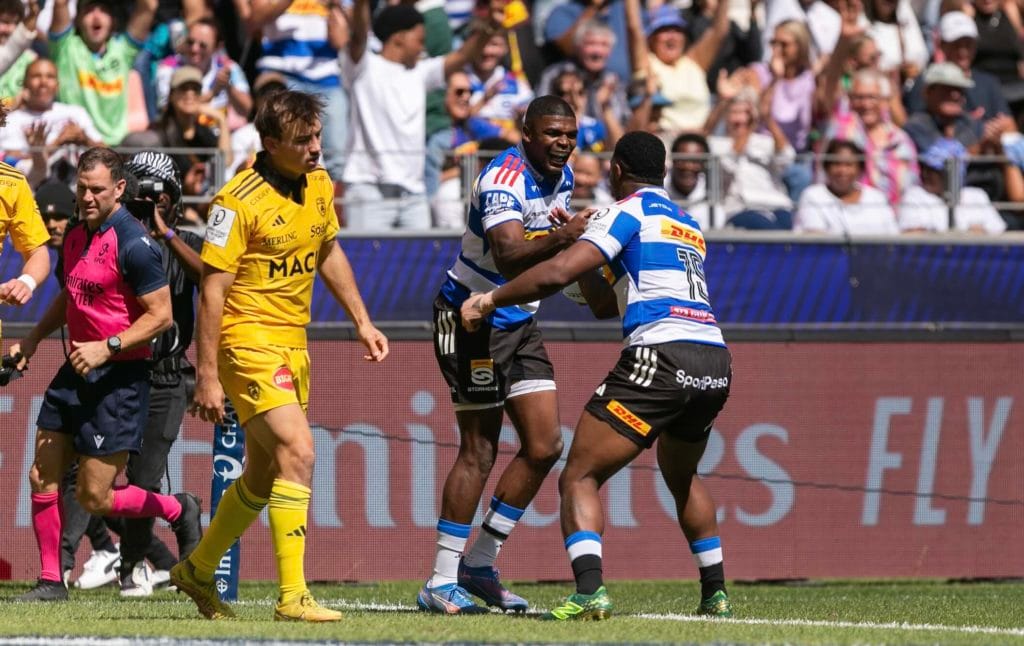
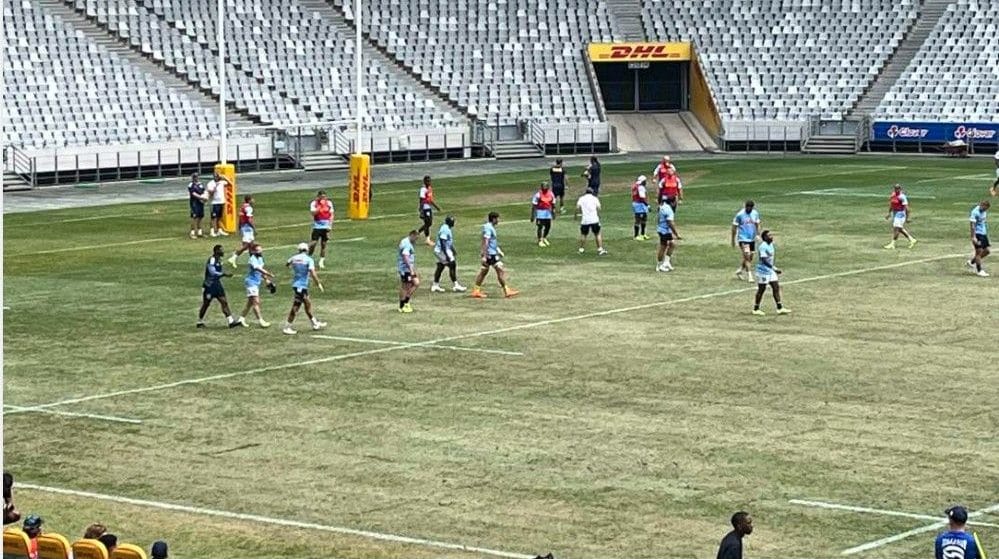
Stormers Director of Rugby John Dobson has launched a blistering broadside at the Cape Town Stadium pitch, blaming its deteriorating condition for an alarming injury toll that has now left lock Adré Smith hospitalised with a serious knee infection.

“We were promised a world-class pitch, and we certainly don’t have one,” Dobson said, his words cutting sharper than a loose stud.

Speaking from London, where the Stormers are preparing for a pivotal Champions Cup clash against Harlequins on Sunday, a visibly agitated Dobson revealed that Smith is undergoing intensive medical treatment after suffering a deep knee wound during last weekend’s gritty 13–8 win over the Bulls.

Smith, who came off the bench in the bruising North–South derby, split his knee open on what Dobson described as a surface more suited to a ploughed field than elite rugby.

“There is no way to beat around the bush, or be polite about it,” Dobson said. “He split his knee and got an infection, where the field wasn’t adequately covered with grass. The doctors put it directly down to the condition of the field.”

Smith has already spent two days in hospital and is expected to remain under close medical supervision for at least another two, as the Stormers count the cost of what Dobson labelled an “enormous frustration” for management.

The lock is not alone. Dobson confirmed multiple players have emerged bloodied and burned by the abrasive surface, with turf toe, severe abrasions and infections becoming increasingly common.

“We’ve seen turf toe injuries, abrasions, infections and even an increased risk of concussion on an unpadded surface,” Dobson said. “Player safety is the biggest concern.”

The pitch woes trace back to the World Supercross Championship staged at the stadium on December 13, an event that ripped up the surface and left it struggling to recover. Despite that, 53,000 supporters packed the stands just three weeks later to witness the Stormers edge the Bulls, even as the grass remained thin, brown and bare.

World Supercross Championships

Stormers Rugby CEO Johan le Roux previously described the surface as “absolutely sad”, while Cape Town Stadium Chief Operating Officer Louw Visagie has insisted the pitch is fit for purpose and meets World Rugby standards. It’s a view Dobson clearly does not share.

As if the surface scars were not enough, the Stormers’ casualty ward continues to swell. Veteran prop Ali Vermaak has ruptured his Achilles, while combative loose forward Ruan Ackermann faces months on the sidelines with a serious neck injury.

“Ali has ruptured his Achilles, which is a serious injury for any rugby player,” Dobson said. “It’s incredibly disappointing because of how popular and effective he’s been for us.

“Ruan has a bulging disc in his neck. Those injuries can be three months if you’re very lucky, but they can also be longer. I’d say it’s a good few months, which is a massive blow because he was exceptional, especially on defence.”

For a team built on physical dominance and relentless pressure, the Stormers now face a battle on two fronts, one against elite European opposition, and another against a home surface Dobson believes is breaking his players faster than any opponent ever could.

Mauls, Minutes and Mindset: The Formula Driving the Stormers’ Relentless Winning Run

By Adnaan Mohamed

The DHL Stormers’ march to 10 consecutive victories has followed a familiar pattern for elite teams operating at the sharp end of European competition. Nothing is rushed. Nothing is improvised. Everything is rehearsed.

As they prepare for their next Investec Champions Cup assignment against Harlequins, the Stormers arrive with a growing reputation as one of the competition’s most physically cohesive sides. It’s a team that wins collisions and squeezes opponents through precision rather than volume.

For forwards coach Rito Hlungwani, the explanation is disarmingly simple.

“It was a very tough game, lots of sore bodies,” Hlungwani said earlier this week. “But business carries on as usual. We’ve got a massive game waiting for us in London and we want to make sure we’re ready – and we will be ready.”

Winning the Week Before Winning the Weekend

Across both domestic and European competition, the Stormers remain unbeaten this season, combining a perfect league record with two Champions Cup victories that announced their credentials beyond their own borders.

But Hlungwani is clear that the difference is created midweek, not under stadium lights.

“We spend Mondays, Tuesdays and Wednesdays training against each other, and that’s actually more time than an 80-minute game,” he said.

That framing matters. In modern rugby, ball-in-play time is limited and moments are decisive.

“[A game] is usually like 36 minutes ball in play.”

The Stormers have leaned into that reality by ensuring their training environment mirrors and exceeds match intensity, particularly in the set-piece exchanges that shape European knockout rugby.

Maul Volume, Not Maul Mystique

Few sides in this season’s Champions Cup have leaned as heavily on controlled maul pressure, and fewer still have executed it with the same consistency. But the Stormers’ maul is not a surprise weapon, it is a rehearsed sequence built on repetition.

“This weekend we had 18 lineouts, and 12 of those were mauls,” Hlungwani explained. “At training we’ll do 40 or 50 lineouts and more than 20 mauls. The cohesion is built there.
“What people see on a Saturday is just the result.”

For European opponents, the warning is clear. The Stormers do not need chaos to score. They are content to grind, squeeze and recycle pressure until the resistance buckles. It profile that travels well in Champions Cup rugby.

Selection Is Irrelevant, Engagement Is Not

Another hallmark of the Stormers’ rise has been squad-wide ownership, a trait often visible in teams that sustain winning runs rather than peak briefly.

“Whether you played or not, everyone watches the game, everyone reviews it,” Hlungwani said. “In meetings, anyone can be asked a question. Everyone is engaged in the process. The guys who didn’t play are often the first to speak about what we need to fix. It’s a collective mindset.”

That collective sharpness has fostered internal competition, particularly among the forwards, where depth is increasingly non-negotiable in a tournament that demands rotation without dilution.

A Champions Cup Test Built for the Front Rows

Prop Oli Kebble, who is closing in on a personal milestone, believes the Stormers’ physical authority is forged through internal challenge rather than opposition fear.

“Training sessions are sometimes harder than games,” Kebble said. “We challenge each other all week, whoever’s playing and whoever’s not. That’s bred the scrum culture we take into matches.”

Against a Harlequins side known for mobility and depth, Kebble expects the contest to hinge on whether physical parity can be maintained across 80 minutes.

“They’ve got good front-row depth, but so do we,” he said. “To compete in the URC and Champions Cup, you need two frontline packs. It doesn’t matter who wears the jersey, we’re going there to take them on.”

Why This Stormers Model Travels in Europe

For international observers, the Stormers’ profile now feels familiar. The Cape side is built around set-piece accuracy, collective clarity and repeatable pressure. In Champions Cup rugby, where margins shrink and emotion spikes, those traits often matter more than flair.

The Stormers are manufacturing inevitability. And as Hlungwani suggests, by the time the weekend arrives, most of the work is already done.

Stormers shift focus to European Champions Cup after edging Bulls in derby

By Adnaan Mohamed

The bruises from the north–south derby are still tender, but the Stormers have little time to admire their handiwork. The Vodacom Bulls were a familiar foe, a known storm navigated through discipline and resolve. Europe, however, offers a different climate altogether, and Champions Cup week arrives with no mercy for hesitation.

The Stormers’ 13–8 URC win over the Bulls was a contest decided by defensive steel and belief rather than fluency. Yet it was precisely that type of victory which sharpened the focus of head coach John Dobson as the conversation turned north, toward London and a showdown with Harlequins.

Dobson revealed that even as the derby teetered on a knife-edge at 8–8, his faith in the Stormers’ defensive structure never wavered.

“It’s going to sound a bit full of hubris, but I never was worried in that game,” Dobson said.

“It sounds curious and I really don’t mean that with any kind of arrogance, but the way we defended even in the first half, it just didn’t feel like we were under any sort of defensive pressure.

“Our defence was really, really good and I didn’t feel like they were going to open us up.”

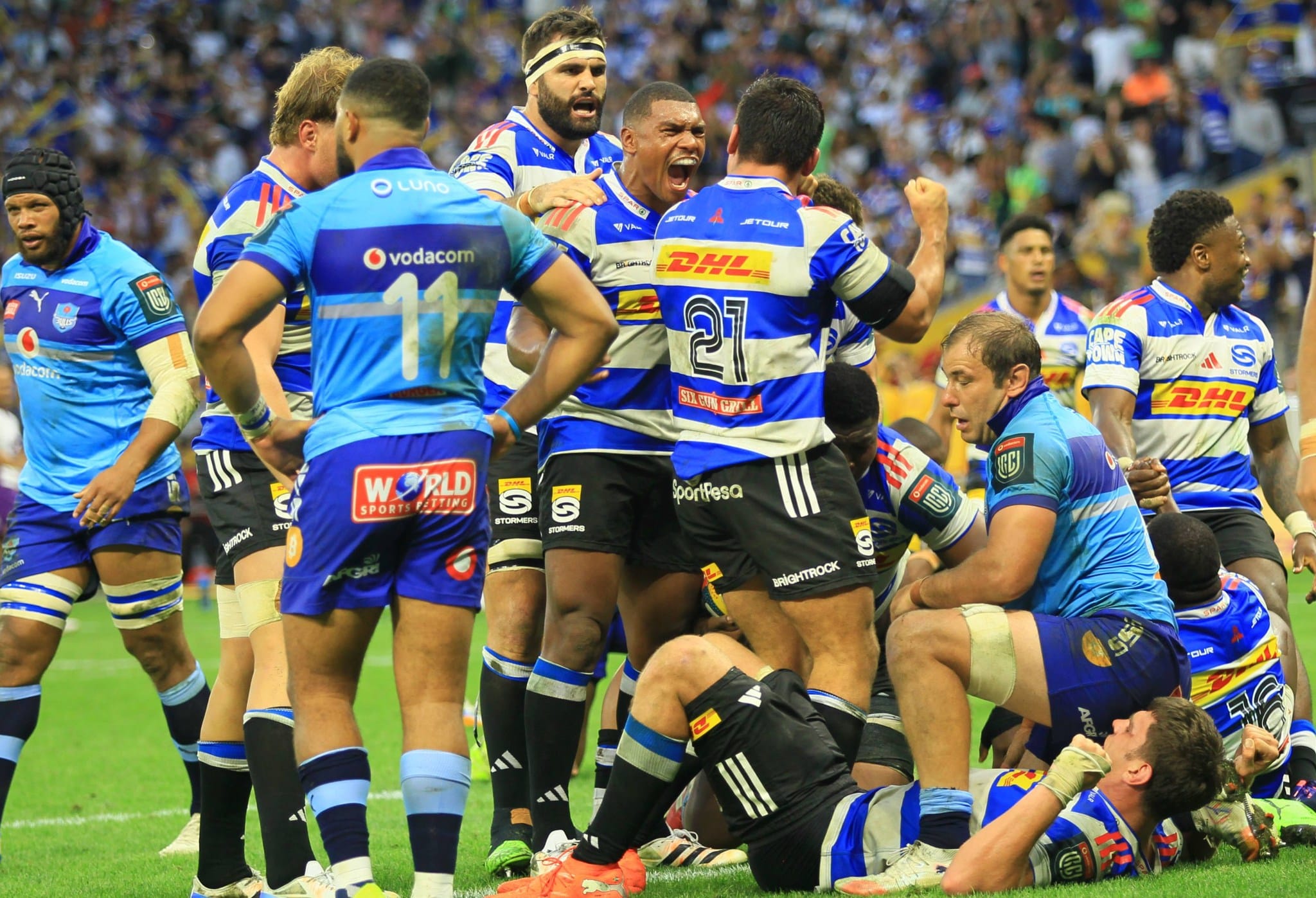
That confidence was rewarded when Ntuthuko Mchunu powered over in the 79th minute, extending the Stormers’ unbeaten run across the URC and Investec Champions Cup to 10 matches. More importantly, it reinforced a mindset which captain Salmaan Moerat believes has become second nature within the squad.

“I do think it becomes a habit. We don’t want to sound arrogant at all, but we’ve been in deeper holes before,” Moerat said.
“If you look back at that Munster game in Limerick, I don’t think many people gave us a chance. In that first half we were down to 13 men for 20 minutes away from home, and we managed to win that game.
“That does give you belief that there’s something in the tank and that the boys will pull it through.”

That belief now travels with the Stormers into Europe, where the broader stakes extend beyond a single fixture. Dobson has been clear that South African teams must shift from participants to contenders if they are to reshape the Champions Cup landscape.

“I think South African teams need to try and make a statement to host playoffs in Europe, and we’re in a position after that Bayonne win where we can have a go at it,” he said.
“But to win in London will be really tough.”

Harlequins pose a very different puzzle to the Bulls’ direct approach. Their game thrives on tempo, width and broken-field chaos. It’s he rugby equivalent of moving from trench warfare to aerial combat. For the Stormers, the challenge will be maintaining defensive cohesion without blunting their own ambition.

Yet if the derby victory offered a glimpse of anything, it is that this Stormers side is increasingly comfortable living in the tension. They may not dominate territory or possession, but they dominate moments. And in Europe, moments decide seasons.

Champions Cup week will test their depth, discipline and nerve, but the Stormers arrive not as tourists, but as a team convinced it belongs on this stage.

Stormers top pool but Dobson sees derby danger after La Rochelle win

By Adnaan Mohamed

The DHL Stormers may have crossed the whitewash six times, but Director of Rugby John Dobson insists the performance that dismantled a youthful Stade Rochelais outfit would be stopped cold by South African rivals if repeated in the coming weeks.

The 42–21 Investec Champions Cup win at Nelson Mandela Bay Stadium, the Capetonians’ eighth straight victory in all competitions, lifted them to the top of Pool Three, ahead of four-time champions Leinster. Yet beneath the glossy scoreline, Dobson saw cracks that could be ruthlessly exposed in the Vodacom URC derbies that loom next.

The Stormers flew out of the blocks. Wings Dylan Maart and Leolin Zas struck inside the opening seven minutes, the hosts surging ahead as if the contest might be over before it began. Instead, composure ebbed, forced passes crept in, and an understrength La Rochelle, stacked with academy talent, were invited back into the arm-wrestle.

“I thought we were so energised at the start and so good, and it just felt like we got seduced into it being too easy,” said Dobson.

“To produce the intensity that we started that game with was really good for us. However, it was a learning experience, and we had to manage that game better at the 15-to-20-minute mark.”

That window proved pivotal. Infringements and errors disrupted Stormers rhythm, allowing La Rochelle to find a foothold and trail just 16–7 at the break – a reminder that scoreboard pressure means little without territorial and tactical control.

“It was about the outcome in the end, but it wasn’t a great process from us,” Dobson admitted.

“There’s definitely stuff we didn’t get right that we spoke about during the week, and there’s work to do before the local derbies [in the Vodacom URC]. That said, a home win in this competition is non-negotiable.”

Captain Salmaan Moerat echoed the coach’s concerns, praising the intent but demanding more from the engine room.

“But as a pack we know we could have been much better. There’s still a lot for us to improve on,” Moerat said.

He also highlighted the side’s response after prop Neethling Fouché was yellow-carded for a high tackle.

“It’s never ideal to get a yellow card,” he said. “But what was really rewarding was seeing how the group galvanised and worked harder for each other when someone was off the field.”

If the Stormers’ structure wavered, individual brilliance helped steady the ship. Flyhalf Sacha Feinberg-Mngomezulu and Springbok scrumhalf Cobus Reinach pulled the strings, while Man of the Match Paul de Villiers hunted turnovers like a seasoned openside despite his tender years.

“It took some moments from Paul or Sacha [Feinberg-Mngomezulu] to bail us out. That was a little bit frustrating that we got ourselves in that position,” Dobson explained.

“Two years ago, we were just getting cleaned out [at the breakdowns], and now we have Paul, who is like a limpet and his decision-making is so good.

“He is very special.”

Dobson believes the result keeps the Stormers firmly in the European hunt, even as he demands sharper execution.

“We want to be part of this tournament,” he said. “South African teams don’t have a great record in it, and we feel we’ve got an opportunity.

“Performances like this give us belief, but we also know we have to be better. I think we can start to dream about getting deeper into this tournament than we have got before.”

The immediate focus, however, shifts to domestic danger. The Lions arrive in Cape Town next weekend, followed by a clash with the Bulls on January 3 – fixtures where sloppiness will be punished.

“We have to get the stuff right and it is no use just talking about it in the week,” Dobson warned.

“We know that performance [in Gqeberha] doesn’t beat a fired-up Lions team in Cape Town or a Bulls team [on January 3].”

Dobson revealed the Stormers’ coaches have been studying the Lions closely, noting their threats across the park.

“We had a good look at them as coaches,” he said.

“We know that Henco [van Wyk] gets the best contact metres, we know about Quan’s [Horn] line breaks, and we know about their efficacy at the breakdown.

“They made their intentions clear that they want to rest and prepare for this game. I promise we won’t be lacking intensity.”

For the Stormers, the winning streak in Europe and Gqeberha has offered momentum, but the real examination now comes at home, where fast starts mean nothing without the patience to finish the job.

Featured Photo: Cole Cruickshank/Gallo Images