
By Adnaan Mohamed
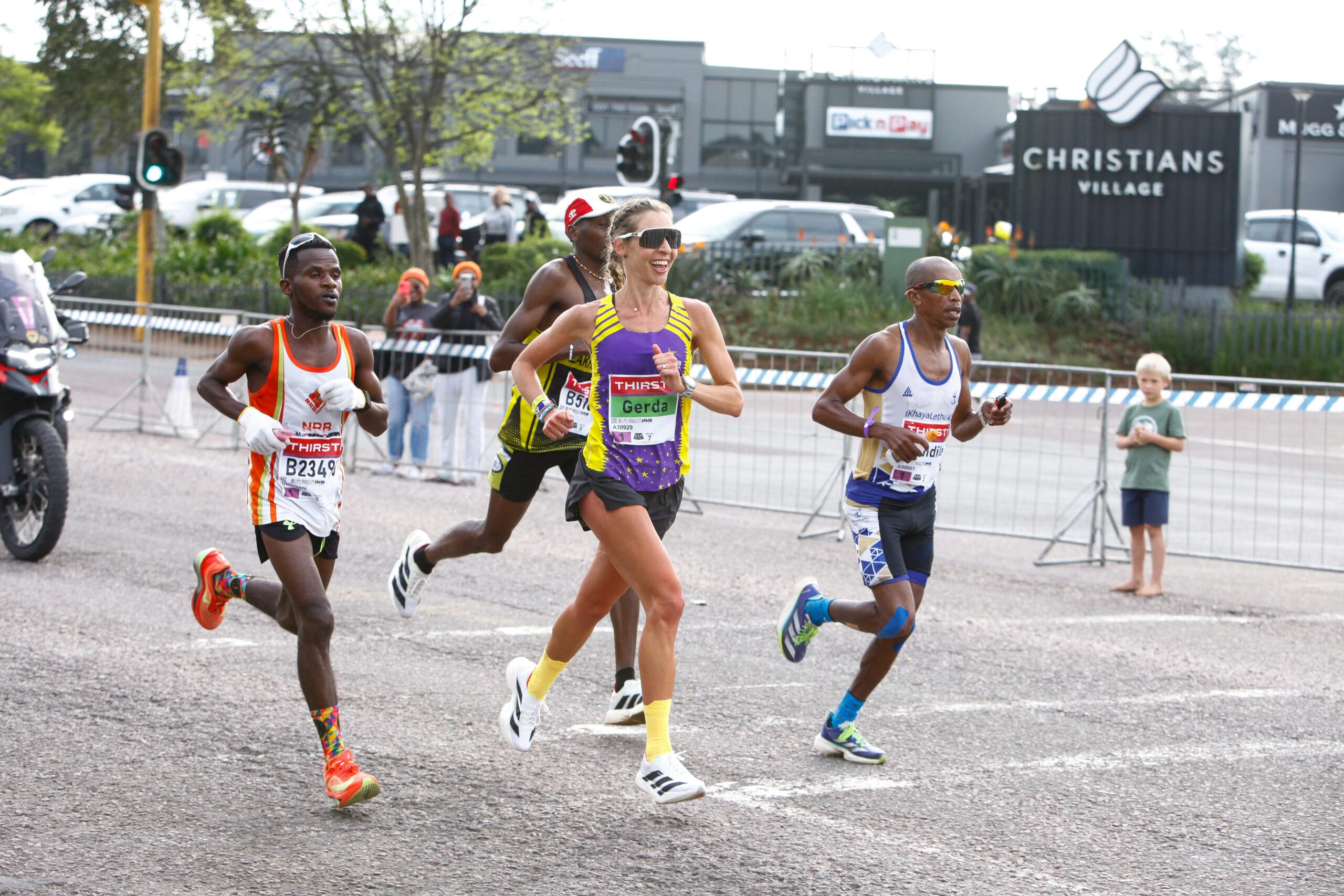
The 2026 Comrades Marathon will be run over the shortest Up Run distance in recent history, a development that could significantly favour multiple champion Gerda Steyn as she targets both victory and a lucrative payday.
Race organisers have confirmed that the 99th edition, scheduled for Sunday, 14 June, will cover 85.777km from Durban to Pietermaritzburg. The distance is 133 metres shorter than the 2024 Up Run and nearly a kilometre shorter than the 2019 route.
In an event where pacing and energy management are decisive, even marginal reductions in distance can influence outcomes at the elite level. For Steyn, who has dominated the women’s race in recent years, the shorter course presents an opportunity to push the pace from early on while still maintaining control in the closing stages.
The adjusted route comes amid ongoing infrastructure developments along the traditional course. Comrades Marathon Race Director Sue Forge said organisers had worked closely with authorities to finalise a safer and more efficient layout.
“The ongoing roadworks have had a significant impact on the route and our planning. However, thanks to the outstanding collaboration and support of the municipalities, the Road Traffic Inspectorate, Durban Metro Police and Msunduzi Traffic Police, we have been able to finalise a route that not only provides a slightly shorter distance for runners, but also improves the management of road closures, traffic flow, infrastructure removal and post-race clean-up,” Forge said.
While the start in Durban and finish at Scottsville Racecourse remain unchanged from 2024, several key adjustments have reduced the overall distance.
“We have changed the set-up of the finish at Scottsville and shortened the finish straight, while out on the route, the biggest change is that from 45th Cutting to Cowies Hill, where runners will move in a contra-flow direction. This means they will run on the other side of the road to previous years, against the normal traffic direction, which will also reduce the gradient of that section slightly,” Forge explained.
“Meanwhile, we have retained the Umlaas Road cut-through, working closely with SANRAL and the appointed contractors to remove a 12-metre section of the new roadside barriers and surface the area, enabling runners to cross directly. This adjustment will once again save runners approximately 870 metres,” she added.
The official route measurement was completed on 25 and 26 April under the supervision of World Athletics-accredited measurer Mike Rooke, using a calibrated bicycle to ensure accuracy.
Historically, comparisons with earlier races remain difficult. Before 1969, distances were recorded in miles and often estimated, with the Up Run generally listed at around 54 miles, or approximately 86.886km.
Despite that uncertainty, the 2026 race is widely regarded as the shortest modern Up Run, a factor that could have implications for record attempts.
Steyn already holds the women’s Up Run best time after clocking 5:49:46 in 2024, becoming the first woman to break six hours on the route. With performance incentives linked to both time and pace, she stands to earn a substantial bonus if she improves on that mark.
“With the shortest route on record for the Up Run being run this year, coupled with lucrative cash incentives for runners to chase the best time and best pace records, we may see those records fall again in 2026,” said Forge.
The men’s Up Run record of 5:24:49, set by Leonid Shvetsov in 2008, has also come under increasing pressure in recent years.
All indications point to a faster race in 2026, with the revised route likely to encourage aggressive strategies from the leading contenders. For Steyn, the combination of form, experience and course conditions could place her firmly on track for another dominant performance.