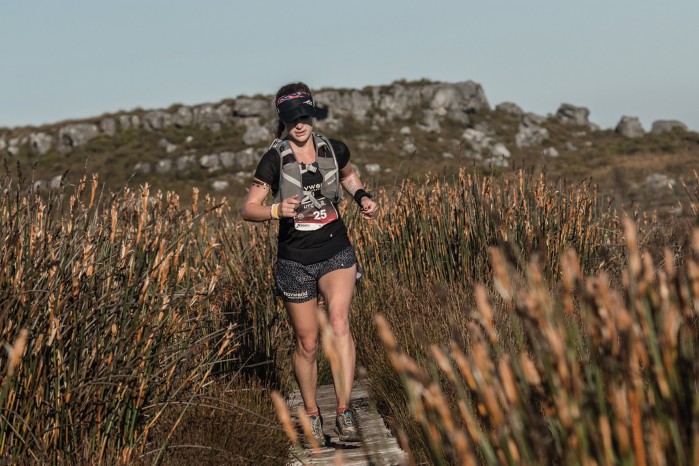


Always Be Prepared!

When event organisers send out their final instructions for ultra-events, especially for those happening in the mountains, take note and don’t fob off the compulsory kit items, because they may just save your life, or someone else’s life. – BY ALISON CHADWICK

With glorious weather to see us off, 61 enthusiastic trail runners set off at the start of the Mighty Mutter 65km or Mutter 37km trail run on 7 October. Run in the Southern Drakensberg, both events are self-navigating, and this was my third Mutter. The first 13km up to Thule Beacon at 2537m was tough going, and thanks to the great weather, we wished we’d worn our short Funky Pants rather than long leggings. However, once on top of the ridge, the temperature immediately dropped and we could see the rain approaching, and we soon pulled on an extra layer and rain jacket. Just 10 minutes later the rain started and it got very cold, and actually quite unpleasant.

We continued in these conditions for the next 10km, and I could see that one of the women in our group, Fiona Dawson, looked like she was struggling – not fitness-wise, but with the cold and rain. She did not have the correct gear, notably a waterproof jacket, nor did she have gloves. Another factor when it is raining is that no one wants to stop to eat or take a drink from the streams, and on this particular day everyone was too cold to stop, so we just kept going, and unless your food is easy to reach, you’re not going to stop to eat.

We reached our third and last checkpoint at “The Pig,” about 23km into the race, and at this point I knew I had to help Fiona, as she was shivering and shaking uncontrollably. I could see that the early signs of hypothermia were perhaps setting in, and luckily I had a dry long-sleeve thermal top, a windbreaker and a spare pair of gloves for her, and we used my poncho space blanket as her outer layer. I also insisted that she eat something, even though her hands were shaking too much. (She doesn’t eat ham, but she said she didn’t care at that stage!)

A FRIEND IN NEED
In situations like this, you just know you have to do something to help someone who is struggling, and both Fiona and her daughter Sarah said I saved her life. I think that is perhaps a bit overly dramatic, but I am grateful I had the extra kit… and to be honest, I was actually excited to finally use my space blanket, which I’ve carried with me for about seven years!

Conditions in the mountains can change in an instant. When the mist moves into the mountains, it becomes another ball-game altogether, and you have to rely solely on your tracking device to find your way. Even when I was packing the night before, I threw in a spare set of batteries and my partner said to me, “You’re not going to need those,” and I replied that maybe I won’t need them, but someone else may…

I need to point out that the women’s winner did the 37km course in 4 hours 44 minutes, but us slower runners took nine hours or more, so you can see that the compulsory kit it even more relevant for the backmarkers, as we spend a lot more time out there. At prize-giving, I found out that the event organiser, Malcolm Millar, had witnessed what had happened up on the mountain, and I was awarded the “Lighthouse in a Storm” award. More importantly, I think we all learnt from this experience. It was a tough lesson to learn, especially for Fiona our frozen runner, but also a lesson I’m sure she will never forget, and a few weeks after Mutter I received a lovely gift and card from her to say how much she appreciated my help, and that we’ll always share this special bond.

Images: Courtesy Alison Chadwick

Run With Us

From deciding to get back into shape, a journey of four years has seen friends Zoe Riley and Audrey Hattingh discover the joys of running, make new friends, get to see new places and challenge themselves, and along the way they have inspired many others to start running as well. – BY MANFRED SEIDLER

Running has a way of getting into the heart and soul, because not only is it healthy and good for you, but it’s also great fun. That’s what Zoe Riley and Audrey Hattingh, two long-time friends from Johannesburg, have found since they took up running in 2014, but while their own personal bests and race finishes have given them great satisfaction, their biggest achievement is undoubtedly having inspired many others to take up running as well. Zoe’s husband Rob and Audrey’s husband Gareth are now running, and their friend Jacqui Carr and her husband James are running, plus the various kids, and other friends and family, and work colleagues…

Not only that, but it also ties in with Zoe’s work. She is a financial broker specialising in medical aid schemes, and part of her portfolio is to encourage people to sign up for packages that reward them for being healthy. Having worked with Discovery for many years, she says the Vitality packages just made sense to her, to the extent that she wanted to buy into it herself. “I always felt that if I am going to sell the product, I need to be able to believe in it, so I decided to try out the Vitality programme myself. That led to the two of us starting to exercise together, then do our first parkrun, and eventually to start running races.”

ON THE RUN
It all started eight months after the birth of Zoe’s second child, when she felt she needed to get back into shape and started going to the gym, with Audrey agreeing to join her. “We just felt that it was time to do something again. Work, family, kids had all been the priorities, but once things had settled a bit, we felt it was time to do something for ourselves, so we headed off to gym. It was great because not only were we training, but we were also able to share quality time with each other.” However, soon gym workouts were no longer enough…

Parkruns have taken South Africa by storm since being introduced in November 2011. They offer a safe, free and fun way for the whole family to exercise and socialise, and today there are more than 120 parkruns taking place every weekend all over South Africa, with the total number of registered participants numbering nearly 450,000. Being based in the Bedfordview area of Johannesburg, the closest parkrun for the girls back then was at Modderfontein, about 15km up the highway, and that’s where the girls headed to start their New Year’s running resolution.

“Our first parkrun was on the fourth of January in 2014, and it was so much fun,” says Audrey. “We loved every minute of it,” echoes Zoe. “Our families came out, we had coffee afterwards, it was just a really pleasant way to spend the morning, and we got in our training!” That day proved a life-changing experience, and for the next year, every Saturday without fail, Zoe and Audrey would be on the Modderfontein start line. Later, however, merely showing up every weekend at the parkrun was not enough… They wanted to become more involved, so they put their names down to become part of the volunteer programme.

“After 20 runs, Event Director Wayde Morsink encourages participants to help out and marshal on run day, so we contacted him and put our names down, but then heard nothing for a long time,” says Zoe. “Then one Friday evening, at around 10pm, I received an SMS asking if we could help the following day. It just so happened that Audrey was with me at the time and we immediately agreed. The following day we helped with the marshalling, but afterwards I went to Wayde and had a chat with him. I told him that sending SMS’s out at 10pm the night before clearly meant that he needed some administrative help, so I ended up becoming the volunteer coordinator for the next two years. During that time we hit the biggest field ever assembled at a South African parkrun, with over 1800 people participating!”

STEPPING UP
As with all training, the girls eventually hit a plateau in their running, but help was at hand. The Modderfontein parkrun is close to the Bedfordview Running Club, and many club members regularly take part in the parkruns. With time spent together at the parkrun, it was natural that friendships were formed. “They were so helpful and had good advice on how to improve our running, so we ended up training more. Instead of only doing twice a week gym sessions and the weekly parkrun, we now did more runs in the week, too,” says Zoe.

“We started going to the Bedfordview Time Trial and ran the 4km loop every week. This led to our first 10km race, the Sarens 10km in March 2015,” says Audrey. “But we really wanted to do a half marathon,” adds Zoe, “and we wanted it to be a different kind of half, so we decided on Knynsa in July of 2015. We loved the fresh air, the run through the forest, the whole atmosphere, and we finished in 2:41. That’s when we decided to look for half marathons that were different to the ones that lie on our doorstep, especially after doing the Dis-Chem Half in January 2016. Dis-Chem was great fun, but it was literally on our doorstep, and we wanted something different out of our races, so we decided to do the Peninsula Half Marathon in Cape Town that March.”

The Peninsula Half includes the scenic coast road from Muizenburg to the finish at the Naval Grounds in Simonstown, but if the south-easterly wind is blowing, it can be a tough run into a strong headwind. “Running along that beachfront was simply amazing, but the wind was something to behold!” recalls Zoe. “That was tough, really tough, but we still enjoyed it. We were hoping to break our PB’s there, as the route is almost flat, but with that wind, it was not to be.”

GOOD TIMES
In sticking with their philosophy of running out of town half marathons, Zoe and Audrey gave the 2017 Kaapsehoop Half Marathon a go this past November, and there they did succeed in smashing those PBs, taking 12 minutes off their previous best. “The last 4km were tough and we had to ‘talk nicely’ to ourselves to get there,” says Audrey. “When we set out on this journey, all we wanted to do was break 2:30 for the half marathon, so when we ran in at 2:24, we were ecstatic! We have no ambitions to run anything beyond 21 kays, but would dearly love to run an international race, and Berlin looks to be the one we will look at first. And hopefully we will keep inspiring others to join us for a run.”

Images: Jetline Action Photo

Time for Drinks

Many of us drink alcohol to have fun, relax and be social, especially during the December holidays, but here’s how it affects your health and your waistline. – BY CHRISTINE PETERS, REGISTERED DIETICIAN

Under normal conditions, your body gets its energy from the calories in carbohydrates, fats and proteins, which are slowly digested and absorbed within the gastrointestinal system. However, this digestive process changes when you drink alcohol, because it is viewed by the body as a toxin and thus gets immediate attention.

On an empty stomach, the alcohol molecules diffuse through the stomach wall quickly and can reach the brain and liver in minutes. This process is slower when you have food in your stomach, but as soon as that food enters the small intestine, the alcohol grabs first priority and is absorbed quickly into the bloodstream. As the alcohol reaches the liver for processing, the liver places all of its attention on the alcohol. If you drink very slowly, all the alcohol is collected by the liver and processed immediately, avoiding all other body systems. However, if you drink quickly, the liver cannot keep up and the alcohol continues to circulate in the body until the liver is available to process it. That’s why drinking large amounts, or drinking quickly, affects the brain centres involved with speech, vision, reasoning and judgment.

But wait, there’s more…
Alcohol is also a diuretic, meaning that it causes water-loss and dehydration, causing the loss of important minerals such as magnesium, potassium, calcium and zinc. These minerals are vital to the maintenance of fluid balance, chemical reactions, and muscle contraction and relaxation. Added to that, when the body is focused on processing alcohol, it is not able to properly break down foods containing carbohydrates and fat. Therefore, these calories are converted into body fat. Meanwhile, alcohol contains seven calories per gram and offers no nutritional value. It only adds empty calories to your diet. Also, skipping a meal to save your calories for drinks later is a bad idea. If you come to the bar hungry, you are even more likely to munch on unhealthy snacks, which are often salty, making you thirsty and leading to more drinking. Rather eat a healthy meal first, and sip water between drinks – you’ll feel fuller, which will stop you from over-drinking.

Alcohol affects your body in other negative ways:
1 Drinking may help induce sleep, but the sleep you get isn’t very deep, which can trigger you to eat more calories the next day.
2 Alcohol can also increase the amount of acid that your stomach produces, causing your stomach lining to become inflamed.
3 Over time, excessive alcohol use can lead to serious health problems, including stomach ulcers, liver disease and heart trouble.
4 Alcohol lowers your inhibitions, which is detrimental to your diet plans. Research shows that if you drink before or during a meal, both your inhibitions and willpower are reduced, so you are more likely to overeat, especially greasy or fried foods, which can add to your waistline.
5 Alcohol actually stimulates your appetite.

Moderation is key
In any weight-loss plan, there are three main components: Diet, exercise and sleep. As stated, a moderate amount of alcohol can increase total calories, decrease your motivation for exercise and healthy eating, and negatively affect your sleep. Despite this, many people can enjoy a drink or two without throwing those three components completely out of whack. On the other hand, drinking heavily can significantly derail energy levels, has a larger influence on dehydration, negatively impacts hormonal levels, and can significantly disrupt your sleep. Therefore, limit your overall intake of alcohol and you will reap some of the enjoyment of alcohol consumption, while not derailing your overall progress. As with all things in life, moderation is the key.

Image: Fotolia

From Heartbreak to Hope

Finishing 13th at the 2016 Rio Olympic Games and only missing the final by one position established Rynardt van Rensburg as one of the world’s top 800m runners, so missing out on selection for SA’s 2017 World Champs team was a massive disappointment, but the man from the Free State is ready to try again. – BY REGGIE HUFKIE

The 2017 IAAF World Championships in London marked Team South Africa’s most successful champs, with six medals, but the lead-up to the meet left a bitter taste as many athletes had to deal with a controversial ASA selection policy that saw a number of athletes who had qualified according to IAAF standards left at home. One of those left out of the team was University of Free State student Rynardt van Rensburg, who had won the SA Champs title for the first time earlier this year and run a season’s best of 1:45.73, thus meeting the IAAF standard of 1:45.90, but not good enough to meet the ASA standard of 1:44.84.

“At the 2016 Olympic Games I finished 13th in the world, and my goal was to make the final at the 2017 London World Champs. My drive, my motivation, my planning, training and everything was towards London. Not being able to compete at the World Champs broke my heart. I ran 1:45.73, which was faster than my time heading into Rio!” says Rynardt. “The fact is that I train to peak at championship events, as I did in 2016. It’s a pity, but I have to accept it and move forward.”

Time for Plan B
In spite of the disappointment over London, Rynardt decided to focus on the Summer Universiade (World Student Games) in Taipei, also in August, but then another blow followed… “I picked up a hamstring tendon injury just three weeks before the World Student Games, and it was worse than what we initially thought.” He was advised to sit out the Games, but after the disappointment of London, he says he simply couldn’t turn down the opportunity to represent his country.

“I believe in chances, giving people a shot. We athletes work extremely hard in order to be amongst the best in the world, and we do not get paid well at all, and the day you take away the opportunities to compete, is the day you will see a lot of talent giving up. I am not ready to give up.” That spirit saw him go to Taipei, do enough to finish third in a tactical first round heat, clocking 1:55.00 and automatically qualifying for the semi-final round, where he won his heat in 1:48.97. However, his legs simply didn’t have enough power in the final, due to the injury, and he finished a disappointed eighth in 1:49.70.

“Things did not turn out the way I planned or the way I wanted them to, but I’m thankful for every opportunity and I will surely rise again. It was my first year as the South African Champion and I still managed a 1:45.73, which shows we did things right. It was also my third year ending as the fastest 800m athlete in South Africa, and I’m grateful for all the small victories, in spite of the big disappointments this season. 2018 will be another year, with new opportunities.”

Back to the Drawing Board
Currently on a strict rehabilitation programme, Rynardt believes he will bounce back in time for the start of the 2018 season. “Due to the injury, my training will only start at the end of November, but if I can get in shape early, I will attempt two or three indoor races in February in order to attempt to qualify for the World Indoor Champs. However, my main goal is to defend my SA title, and then I would like to have a chance at the Commonwealth Games. Once again my hopes will be on ASA and SASCOC to select me after December into the preliminary team for the Games.”

Meanwhile, the Kovsies student has decided to put his B.Sc. Psychology degree on hold and focus on his secondary studies. “I’ve been doing two or three modules of Marketing as well, and in order to focus as much as I can on my Athletics, I will first finish Marketing in 2018 and then I hope to finish my other degree after that.” In between that, he will still make time for other interests. “I do part-time work as a photographer for Spektor in Bloemfontein. I have a massive passion for photography and I love capturing sport photos, plus I also write training programmes and coach.”

Coaching youngsters also ties in with Rynardt’s passion for the sport: “I believe athletics can become as popular as rugby and football if we can get some powerful people to join the sport. And selecting as many athletes as possible to be seen competing on TV on the big stages like the World Champs and Olympics will also help grow the popularity of the sport.”

Images: Courtesy Rynardt van Rensburg

Caffeine Kick

In January 2004, caffeine was taken off the World Anti-Doping Agency (WADA) list of banned substances used in competitive sports, but earlier this year it was placed back on the WADA monitoring list, and may be put back on the list in 2018, once studies have been done this year. – BY CHRISTINE PETERS, REGISTERED DIETICIAN

Caffeine is the best known member of a family of naturally occurring stimulants found in leaves, nuts and seeds in over 60 plants, and dietary sources include tea, coffee, chocolate, soft drinks and energy drinks. Typically, these provide 20 to 200mg of caffeine per serving. The main source of caffeine in sports drinks, gels and supplements is guarana.

It's well-known that caffeine makes us more alert and delays sleep, and it's also popular among athletes, since it can improve performance in some sports. Caffeine has a complex range of actions on the body which have been extensively researched. It has several effects on skeletal muscle, and through some of these actions, caffeine may stimulate fat metabolism during aerobic exercise, ‘sparing’ glycogen stores and thus delaying fatigue.

However, other studies have found this effect to be short-lived and confined to certain individuals only. Caffeine has also been found to have other effects on the body that may influence athletic performance: It may affect the central nervous system, such as reduced perception of effort and enhanced recruitment of motor units, which may give athletes a ‘buzz’ and mask fatigue.

Caffeine Dose
Caffeine is rapidly absorbed, reaching peak concentrations in the blood within an hour after ingestion, and studies point to smaller amounts taken in throughout exercise being beneficial for performance, rather than one larger dose one hour prior to a bout of exercise. It’s also thought that as an athlete fatigues during exercise, they become more sensitive to small doses of caffeine. Looking at various studies, it seems that beneficial effects from caffeine occur at very modest levels of intakes (1 to 3mg/kg body mass or 70 to 150mg caffeine), when taken prior to or during exercise. (One cup of coffee can contain anywhere between 25 and 214mg caffeine.)

It is important to remember, however, that caffeine-loading is not good for all athletes. Like any drug, caffeine affects everyone differently. Some athletes will respond and receive a pronounced performance boost, whereas some athletes are non-responders, or may even experience disadvantageous side-effects that are detrimental to performance, such as tremors, increased heart rate, headaches and impaired sleep. However, contrary to popular opinion, caffeinated drinks do not dehydrate us, especially if we are used to caffeine.

In terms of long-term health, people often ask whether caffeine is safe. Right now, it appears that a moderate caffeine intake does not increase the risk of developing cardiovascular disease, osteoporosis or cancer, but as with most things, the most important thing to remember is everything in moderation! For the average healthy adult, moderate caffeine intakes pose no health risk, especially if we eat a balanced diet and enjoy regular physical activity.

About the Author
Christine is a registered dietician based in the Johannesburg area.

All in Good Time

He’s just 20 and currently focusing on his studies, but Nicholas Quenet is already considered a star of South African triathlon, and it appears to be just a matter of time before this young man starts making a real name for himself on the world tri stage. – BY TRACEY FALCONER, WITH SEAN FALCONER

Clanwilliam obviously agrees with Nick Quenet. The 20-year-old Maties student has driven the 230-odd kays from Stellenbosch to the small northern Cape Town to participate in the Freshpak Fitness Festival triathlon the last four years, and every time he has come back with a podium position. In 2014 he finished fourth overall and first junior, then came home second overall in 2015, while his older sister Alexandra won the women’s race that year. Last year he went one better and took the men’s title, which he successfully defended this year, coming out of the water first and maintaining his lead through the bike leg, then blitzing the run for a dominant win. However, he admits he didn’t expect to win, and really thought the chasing pack would catch him on the bike leg. “Winning again was a surprise, because with my studies getting busier, I don’t have a huge amount of saddle training time available,” he says.

Currently in his second year at Stellenbosch University, studying towards a Bachelor of Accounting degree, Nick has made the decision to focus on his studies. When asked if he would consider putting his studies on the backburner, or even on hold, if offered a pro racing contract or more opportunities to compete overseas, Nick says that will have to wait. “I have thought about that, but I’ll stick to my degree! I’m definitely a numbers man and I don’t think one can operate in this country without a degree, so my aims are to get my degree and then do an Honours here at Maties, and then try to take triathlon to the next level.”

In fact, he already turned down an offer last year to race in Europe, but having just started his studies, says he couldn’t go. “It was sad to turn the offer down, but while I’m studying, I’m biding my time and focusing on the individual aspects of triathlon, doing running and biking races, and swimming galas, so I’m stronger when I graduate. Then I hope to base myself in Europe in the hopes of getting a contract with one of the French teams and race the grand prix’s. I’ve put my mind to it to work for four years – after that I can do what I want, and hopefully by then the triathlon doors will be open.”

Great Sporting Genes
Nick grew up in Worcester, where his family owns a pharmacy. Both he and Alexandra showed huge sporting talent in primary school, so when Nick was in Grade 8, the family moved temporarily to Stellenbosch, so that the kids could benefit from the more established school sports structures on offer in the town. “We lived here with my mom while we were in school, and my dad commuted regularly, but they are now both back in Worcester, while my sister and I still live here while we’re studying,” says Nick.

While at school, Nick focused on competitive swimming, while Alexandra focused on running, but about three years ago they both changed to triathlon. That was no surprise, really, given that their father was an elite triathlete in his younger days, racing in France in the early 80s and only just missing out on the World Champs in 1986 after falling off his bike and breaking his collarbone. “He later took up running, doing the Two Oceans Marathon, and is still doing trail runs, but these days it’s more about ticking things off his bucket list,” says Nick. “He really wants to go run the Ultra Trail du Mont Blanc in France.”

Of course, Nick’s swimming ability often gives him an upper hand in triathlon events. “I have the advantage of being able to lead from the start, and countless hours in the pool is now paying dividends, especially as there is so much technique involved in swimming. It’s an advantage not to have to learn how to swim, so I can just maintain my strongest discipline. I also did biathlon in school, so my running was already quite strong, but cycling was completely new to me. Still, I’ve achieved massive growth in a short space of time and am getting stronger, even though the training takes the longest, and I’ve also worked hard on my running this season. I did my first road running race at the Sanlam Cape Town 10km and clocked 31:40. I am pleased with my time, but still want to go faster, because if you look at the results on the world triathlon circuit, I believe it all comes down to the run, with the fastest racers all winning the foot race.”

Making His Name
While Nick is very understated about his success in triathlon, a quick look at his track record shows why he is already considered a star in the sport. In 2015 he won the Junior title at the SA Champs in Buffalo City, then added the African Champs junior title in Egypt a few months later. In 2016, he was second junior at the African Champs, then added a sixth place and an eighth place in ETU Junior European Cup events in Hungary and the Netherlands, but things didn’t go as well at the 2016 World Triathlon Grand Final in Mexico. “I got a bit of heat stroke due to the 100% humidity and did not finish the event, but getting to the World Champs is still one of the highlights of my tri career so far.”

Nick’s great results have also seen him pick up a few endorsement and product sponsorships, including one from Skechers shoes, and that, in turn, saw him get invited to Los Angeles earlier this year for the LA Marathon, which is sponsored by Skechers. “It was such an incredible experience! I actually started with the elite guys at the front, but stopped at the halfway mark, as planned, to avoid overdoing things at such a young age. But it was only once I stopped and saw 35,000 people coming past that I realised just how many people there were in the race! My dad ran the full marathon and we got to make a holiday out of the trip, including seeing the incredible Golden Gate Bridge. It was all just absolutely amazing.”

Future Goals
While his academics are his priority at the moment, Nick says he still makes time for some racing, with the Clanwilliam weekend being a must-do, as well as the Slanghoek Triathlon in November near his hometown, Worcester. “The races continue, so I do the academic work throughout the year to take the pressure of at the end of the year, and then it’s down to our holiday house in Hermanus to relax. It’s a brilliant place to keep training!” Then, looking ahead, he says he has a few goals for 2018 that he wants to chase down.

“If the SA Tri Champs are at sea level, I might have a crack at the Under-23 title, and then hopefully get to African Champs as well. Everyone says third year in my course gets harder, so I’ll have to see about Europe, if the opportunity comes up, and I’d also like to go after a 30-minute 10km, bring down my time for swimming 1.5km, and do a few cycling and track races.” Beyond that, he says his main aim will be the 2019 World Champs, and at the back of his mind are the 2022 Commonwealth Games. “I’ll see how those pan out and then plan the rest.”

Greater Expectations

The weight of expectation can sometimes weigh heavily, they say, especially when you put that expectation on yourself, as 400m hurdles star Wenda Nel has realised over the last year. – BY SEAN FALCONER

The 31-year-old Pretoria flyer finished a long 2017 track season in September feeling the same mixture of satisfaction and disappointment that she has had since the Olympics last year in Rio. That feeling was compounded by her World Champs experience this year, but she says she will get over it soon – and that bodes well for her chances at next year’s Commonwealth Games in Australia.

Upward Trajectory
In 2015 Wenda ran a PB 54.37 in Beijing in May, then returned to the Chinese city in August for the World Champs and made her first global final, finishing seventh in 54.94. As a result, big things were expected of her in 2016 in Rio, especially after she won the gold medal in the African Champs in Durban with a 54.86 and had a great international season in Europe, with a season best of 54.47. However, at the Olympics she only got as far as the semi-final round, being eliminated after clocking 55.83.

“I walked away from Rio a bit disappointed. I was so focused and performance-driven, and really wanted to make the final, coming out of making the 2015 World Champs final, but I learnt so much. I think it brought me back to earth a bit, and made me realise it doesn’t just happen, that your focus, training, nutrition and sleeping pattern must all be on par to perform at the top meets. Therefore, at the beginning of this season I set specific goals, one of which was to make the final of the World Champs in London.”

Heartbreakingly Close
Once again, after a solid European season, including a season best of 54.58, Wenda went to the World Champs aiming to make the final, but once again she faced semi-final elimination. Sadly, her 55.70 was the tenth-fastest time of the round and thus she only just missed out on the final as one of the fastest semi-final losers – and that brought all the disappointment back again, but also more introspection and growth.

“To be honest, I am a bit disappointed with my 2017 season, because I didn’t make the final in London, but the more I analyse things, the more I realise it wasn’t all bad. I was competitive in the Diamond League and had some great races, but I just wasn’t consistent enough and struggled to get my timing just right. I tend to run a season best or a PB just before the big meets, but then can’t reproduce that at the major events. That is something I will be working on for the 2018 season… but Rio and London were still amazing experiences, especially Rio! It’s every athlete’s dream just to compete at the Olympics – but my goal had changed to compete in the final, not just compete, hence I felt disappointed.”

Talking Technicalities
Running the hurdles is an incredibly technical discipline, and Wenda says she is experimenting with her stride pattern to find the perfect mix that will eke out a vital second over 400 metres. “I have a race plan that I normally stick to, 16 strides to the first six hurdles, then 17 strides to the end, but I do experiment and change up the patterns. In my season best this year, I ran a race pattern I had not done before, because sometimes things happen in a race and you have to adapt. Now I am trying something new in preparation for next season, hoping to make myself sharper at the hurdles and allow for fewer strides.”

“I am shorter than many of the other hurdlers, so it’s not as easy to take longer and less strides between hurdles, but 15 strides are so much faster than 16, and my 16, especially later in the season, put me a little too ‘up’ on the hurdles, which means I need to brake a bit, then play catch-up. That’s why I want to change to 15 strides until hurdle three, then 16 to six, and 17 to the finish. I did that in 2015 and 2016 and it worked for me, but this time I may try it in the first race of the season instead of the third or fourth. Basically, I need to go faster to keep up for the first 200 metres, but without wasting energy.”

Looking ahead, Wenda says she is really excited about the 2018 season, given that the Commonwealth Games will be in April. “Normally we have SA Champs in April and we are working to peak then, so preparing for Australia will actually feel normal to us South Africans. I will also give the European circuit a go and will try to do a few Diamond Leagues again, plus we have African Champs, where I will hopefully qualify for Team Africa for the Continental Cup in the Czech Republic in September. So it will be another long season, but I’m looking forward to it!”

The New Sensation

Although he is still just 22 years old, Thabang Mosiako is quickly making a name for himself by taking on and beating the ‘big guns’ on the South African distance running scene, and he has some notable wins under his belt from the 2017 season, including an SA title. – BY REGGIE HUFKIE

This has been quite some year for North West Province-based Thabang. It started in January at the always hotly contested Dis-Chem Half Marathon in Johannesburg, where he cruised to a 1:05:53 victory, beating off the fierce competition of Desmond Mokgobu and Lucky Mohale to claim top spot on the podium. Then in April he lined up in the men’s 5000m final at the SA Senior Track and Field Championships in Potchefstroom, in a field containing two SA record holders, Elroy Gelant (5000m) and Stephen Mokoka (10,000m), and once again claimed line honours.

Unsurprisingly, that 5000m final enjoyed a blisteringly fast start, with Elroy leading the pack through 3000m in 8 minutes 15 seconds. Meanwhile, Thabang had worked his way through the field and found himself in third position as the bell sounded for the last lap, but the gap to Stephen and Elroy now seemed too big. However, summoning up every last ounce of speed, he somehow reeled in first Stephen, and had the spectators on their feet as he caught and passed Elroy with 30 metres to go to be crowned SA 5000m Champion.

Glory in Jozi
Thabang then added a third big title in September when he outran the SA 10km Record Holder Stephen to win the FNB Joburg 10K CityRun, and says it meant a lot to beat his role model: “Stephen is the man who makes me go train every time, because I want be strong like him.” In the race, David Manja set the early pace, passing the 3km mark in 8:32 with 20 runners hot on his heels. As they approached the big descent past Ellis Park hill at the 4km mark, Thabang surged to the front and broke the leading group up, with only Stephen and Lucky Mohale able to go with him.

The trio went through halfway in 14:49 before Stephen opened a 20m gap, but at 7km Thabang was back with him, and at the top of the Constitution Hill climb, with 2km to go, the youngster took control of the race. He went on the win in 29:51, with Stephen taking second 25 seconds later and Gladwin Mzazi coming through for third. Afterwards, he said, “This victory means a lot to me because this is not simply a win… I was working very hard to be in the top three, but I saw myself beating this strong man, Stephen, on the last hill before 8km. Jozi is a very difficult place to run in, and it has many hills, so for me to run 29:51 is a great achievement.”

Late Bloomer
What makes Thabang’s success at 22 all the more impressive is that he only discovered his running talent late in high school. “My coach, Spring Phakate, introduced me to athletics in 2011, and in 2012 in Rustenburg at the South African Schools Cross Country Championships, I got position two in the under-17 boys’ 6km,” says the Human Resource Development student, who clearly has his eyes fixed on still bigger achievements in running. “My long term goal is to bring home a medal for my country from the Olympic Games, and short term, well, I want to be fit and strong for any race, but I don’t just want to be strong, I want to be in the top three. On the track, I am focused on the 5000m, but my favourite race is the 10km on the road, and that is where I see myself dominating.”

In order to achieve that, the young man is hard at work in training with the rest of the Spring Training Group, as it is known, under coach Spring Phakate, and it helps that he is surrounded by serious racing pedigree to push him to new heights. The group includes FISU World Student Games Steeplechase champion Rantso Mokopane, Southern Region Half Marathon champion Joel Mmone, former South African junior 5000m champion Xaba Mavusa, and steeplechaser Dikotsi Lekopa, who was part of the SA team for the IAAF World Champs in 2015.

But striving towards success on and off the field, like his training partners, mans that Thabang enjoys a packed daily schedule. “There’s only hard work at training, and we do two sessions most days. In the morning I go for my early run and after that I am on my way to class. After class it’s training again, and if I do not have a session, I just watch athletics videos so that I can learn more.” Judging by his results this year, he’s clearly watching the right videos!

What a Year!

If there is one runner likely to agree with the old saying that “life begins at 40,” it is Ulrica Stander, especially given the amazingly successful year the 43-year-old Capetonian has enjoyed on the road after moving up to the marathon distance and beyond. – BY SEAN FALCONER

After seeing her running take a major dip in 2015 due to long working hours on top of raising two kids, 2016 saw Ulrica return to the type of form that had given her personal bests of 35:25 for 10km and 1:17:34 in the half marathon. She won the Peninsula Half Marathon and claimed the series title in the veteran category of the Spar Women’s Grand Prix, and along the way she was recruited by the KPMG Running Club, and signed up with a new coach in Lindsey Parry. That saw her decide to make her marathon and ultra debut in 2017, and the podium positions have come thick and fast since.

It started with a third position in the NutriBullet Bay to Bay 30km in January, where she was also first veteran over the line in 2:02:35 as she went beyond 21km for the first time. After running the Red Hill 36km as a training run, she then won the Peninsula Marathon in February, posting 2:58:45 on debut to take both the overall and veteran titles. Two months later she stepped things up at the Old Mutual Two Oceans 56km, clocking 4:02:45 and claiming an incredible sixth place (and second veteran) in her ultra debut.

“I was actually very grateful for my performance at Two Oceans, because my training was a bit up and down, and I felt I hadn’t been able to focus properly. I went out with the four-hour bus, then at 23km pushed on a bit with my clubmate Renier Grobler and a guy from Boksburg, but I went through the marathon mark feeling a bit tired. They say Oceans only really starts there at the bottom of Constantia Nek, so I had to dig deep to stay positive when the sub-four bus went past me. What kept me going was the incredible energy of the crowds lining the route, and I remember smiling all the way down the home straight as I came in. It really was a privilege to run such a wonderful race.”

Then in September Ulrica lined up for her second standard marathon at the Sanlam Cape Town Marathon, and in spite of severe stomach issues, improved her PB to 2:54:09 as she finished 14th and once again claimed top spot in the veteran category, added the Western Province Champs title for good measure, and posted the fastest marathon time by an SA veteran woman in 2017. “I was aiming for 2:50, but I think the gel I took at 25km reacted with my stomach and I struggled for the rest of the race. I was still ecstatic with my time and position, but I know I can go faster.”

Natural High-Flyer
Ulrica was born in Pretoria, the youngest of three kids in a close family, and showed a passion for health and fitness from an early age. She started running competitively in high school, focusing on middle distances on the track as well as doing cross country, and soon earned provincial colours in both disciplines. She then attended university in Stellenbosch, choosing to go there because her brother was already studying there, and did a B.Sc. with Human Movement Science, majoring in physiology. While at Maties, she took up triathlon and soon made a name for herself, making the SA training squad for the 1996 Olympics, but unfortunately missed out on the final team selection. She did still represent SA, at the Triathlon World Champs in the USA, and still lists triathlon as one of her favourite sports.

After varsity, Ulrica began working in the pharmaceutical industry, first as a rep and later in a marketing role, doing so well over the years that her current position as Product Specialist in Marketing for Pathcare’s Histology and Cytology departments was specially created for her. Along the way she got married and had two kids, Liam (now 13) and Mila (10), and Ulrica is obviously proud of her two achievers, who both recently won their inter-house cross-triathlon events at school.

“Liam has Western Province colours in rugby and biathlon, captains the swimming and athletics teams, and is head boy at Kenridge, while Mila won the Vicrix Ludorum at the school athletics meet after winning the long jump, both sprints and the 1200m, and she also has provincial colours in biathlon and biathle. We actually all went to the SA Biathlon Champs together and it was lekker to compete alongside my kiddies. Mila finished fourth in the biathle and was chosen to go to Spain for the World Champs, but we decided she was still a bit too young for such a trip. So, we’ve told her she can go in two years’ time.”

Following Her Dreams
On top of family, work and running commitments, Ulrica still finds the time and energy to do even more, including co-chairing her own charity, the Radiance Foundation! A few years back, her long-time friend Madeleine Pretorius entered her in the Mrs South Africa competition and Ulrica made the initial group selection. Part of the criteria for final selection was charity work, but with her marriage of 12 years coming to an end, she decided to withdraw. “The organiser offered me more time, and invited me to enter again the following year, but I felt I had to turn her down. Still, that led to a new dream of a charity to help people, and when Maddie’s friend, ophthalmologist Dr Junet van der Merwe, told us there is a huge need for cataract operations, we decided to do something about it. We started fund-raising two years ago and we’ve already funded 180 operations here in the Western Cape.

Another thing Ulrica would like to pursue more of is TV presenting. In 2012 and 2013 she was sponsored by USN and became one of their health and fitness ambassadors, which led to her appearing on the Espresso Show. “I want to inspire everyone to be the best they can possibly be, and to do it on such a platform, alongside those brilliant presenters, was amazing. The most fun was doing ‘home invasions’ and going through people’s cupboards to suggest healthier nutritional options, and it was so obvious when some people were hiding the bad stuff!”

Getting back to running, she says her list of upcoming races includes the BlueBoost Winelands Half Marathon this November, followed by the same Bay to Bay, Red Hill, Peninsula and Two Oceans programme as in 2017, and after that, perhaps Comrades, too. “Lindsey said at the beginning of this year, perhaps I can run Comrades in 2018 as a training run, then race it 2019, but my focus is on Oceans and I’m hoping for a podium finish. Because of my age, the longer the distance, the more I feel I can compete with the elites, and work-wise and family-wise, I’m now set-up to be able to focus on my running, so my goal is to give it 100% and see where it takes me.”


Getting Back on Track

With personal best times of 1:47.74 for the 800m, 3:59.29 for the mile, the SA national record for 5000m at 13:04.88 and 27:41.30 for the 10,000m, coupled with road PBs of 28:18 for 10km and 1:01:09 for the half marathon, Elroy Gelant is one of the most versatile distance athletes in SA, and though he recently made his marathon debut, he still has his eyes firmly fixed on the track. – BY REGGIE HUFKIE

In 2016, Elroy made the men's 5000m final at the Olympic Games in Rio, clinched a silver medal in the 10,000m at the CAA African Championships in Durban, and set a new South African 5000m record along the way when he clocked 13:04.88 in the Netherlands. It was a brilliant year on the track for the Potchefstroom-based athlete. Then at the 2017 SA Champs in his current hometown, the 31-year-old started the 5000m too fast and hit the wall with 2000m to go, but held on through sheer determination for the silver medal, and came back the very next day to win the 10,000m national title.

Unfortunately, he did not quite do enough to qualify for the 2017 IAAF Track and Field World Championships, but that disappointment was tempered not only by his continued success on the track, but also his success on the road. This year has also seen him take home another silver medal at the South African Half Marathon Championships, clocking a blisteringly fast 1:01:30, and he ran an equally fast 28:16 solo effort for 10km in Cape Town, which until recently was the fastest time in SA for the year. Then he made the big move – one he has been talking about for a while now – and stepped up the marathon for the first time, at the Sanlam Cape Town Marathon in September.

Going Long…
“Last year I was a pacemaker at the Sanlam Cape Town Marathon, so this year I decided it's the perfect time to make my full debut. After making the decision, I was totally excited to train for it,” says Elroy, whose 1:01:10 half marathon PB, set in 2014, and a 2017 best of 1:01:30, pointed to him being able to post a really fast marathon time. He ran just behind the leaders until the 30km mark, then tried to close the gap, but found himself running alone for the last 5km and ended up slowing down a bit, eventually finishing in 2:12:49, earning him fifth place overall and first South African over the line, but falling a bit short of his own high expectations.

“My goal was to go beyond my limits and I was looking for a 2:09 or 2:10 debut marathon time, but those last 5km were extremely difficult. I needed to believe I could achieve what I had set out for the race, but I can definitely use these opportunities to learn and prepare for future global marathons, and I am very positive to one day run a good time in Europe.”

However, having said before the race that he hoped to use it as a stepping stone towards qualifying for the marathon at the 2018 Commonwealth Games in Australia, in a somewhat surprising move, soon after the marathon Elroy said he is putting the marathon on hold – for now – because he still has goals to chase on the track. “This is a very brief outline of my main goals for the next few years. In 2018 I’m going to attempt to break the South African 5000m, 10,000m and 10km records, and my goal is to finish in the top three at the Commonwealth Games. In 2019 I’ll again be attempting the 5000m and 10,000m records, but I will also be targeting a sub-2:08 qualification marathon, and in 2020 my main goal will be a podium position in marathon at the Tokyo Olympics.”

The Challenge
Away from athletics, Gelant enjoys spending time at his family home in Pacaltsdorp, on the outskirts of George in the Southern Cape, where he was taught the importance of living a purpose-driven life. “What keeps me motivated is the belief that God provided me with a talent, and I want to live out that talent fully by giving my best in each race I participate in. Every time I compete, I run against not only the other guys, but also myself and my own ability. It's the best feeling to know that I gave my best on the day, and all of my failures in athletics just serve as extra motivation. Winning medals or championships is only a bonus for me; it's all about my God-given talent and the happiness that comes with it.”